


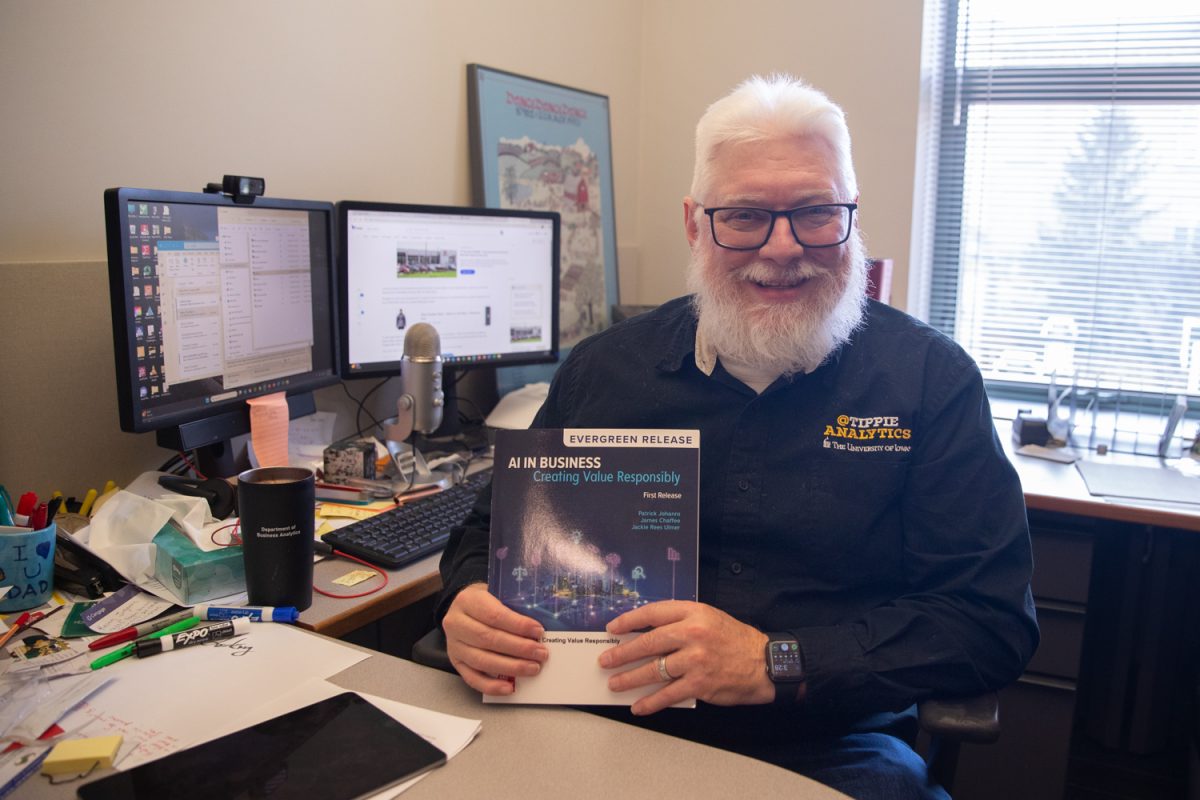
University of Iowa business analytics professor Patrick Johanns published a new textbook with McGraw-Hill titled “AI in Business: Creating Value Responsibly.”
The book will be used in his course to prepare students for the ever-changing realm of business as artificial intelligence grows in prominence.
Johanns’ book, published in January, focuses on the ethical usage and implementation of artificial intelligence, or AI, in business. Johanns is also currently developing an innovative course covering artificial intelligence in business for UI.
Johanns said the process began when the Tippie dean’s office tasked him with adding AI lessons to his Foundations of Business Analytics course. Seeing that there was no existing curriculum, Johanns decided to create his own.
According to an October 2025 report from Pew Research Center, 21 percent of workers say they use AI for their jobs, a 5 percent increase from 2024.
Global management consulting firm McKinsey & Company found in its 2025 survey on AI that 62 percent of respondents reported their organizations were experimenting with AI agents.
The report notes that most organizations are still in the early stages of implementing AI.
Johanns, a native of Osage, Iowa, received his bachelor’s, master’s, and doctorate degree from the UI. He has been with the university since 2014 and before that he was a faculty member at Purdue University from 2003 to 2014.
In 2017, he started Johanns Laser LLC, a North Liberty-based company that designs and produces laser-cut and etched items.
After writing two chapters’ worth of material, he tried to see if he could get the chapters added to a textbook but struggled to find someone to buy it off him and kept writing.
“Then it was Christmas break, and I kept writing, and when Christmas break was over, I realized I had pretty much a whole book written, and then it was a matter of finding a publisher for the whole book,” Johanns said.
The finished textbook ended up being eight chapters and 254 pages.
Johanns recalled a time where he was interviewed by the Purdue Exponent, Purdue University’s student paper. In 2008, while he was teaching at Purdue, Johanns wrote his own textbook to be an affordable alternative for business students, which garnered the attention of a campus reporter.
The Purdue Exponent article, titled “Faculty member helps cut textbook costs,” was originally supposed to be buried deep in the newspaper, Johanns said; however, the story ended up making the front page.
Johanns said the demand for AI lessons in his classes came from the job market, which now has employers seeking college graduates skilled in AI. So, he wanted to ensure his students had these skills.
“Rather than saying, ‘No, never use it,’ we better teach them how to use it responsibly,” Johanns said.
Johanns said the book was originally going to cover AI’s role in business. However, after having multiple discussions with people on the advisory board for business analytics, he saw how prevalent the question of ethics was, and he decided to include lessons on ethics in every chapter.
His book contains lessons on corporate ethics and personal ethics. On the corporate side, he said the book dives into the issues of training employees to use AI and laying off employees because of AI.
On the personal side, he mentioned how AI can create convincing deepfake videos and the numerous ethical concerns there. He also said the book teaches students the extent to which artificial intelligence can answer their questions.
“Generative AI is more focused on generating an answer for you than it is whether the answer is true,” Johanns said.
Because of this, Johanns said it is always important to fact-check any sources that artificial intelligence uses to generate answers to users’ prompts, or else users are most likely using incorrect and misleading information, and hurting their critical thinking skills.
Johanns responded to some of the larger-scale ethical concerns regarding generative artificial intelligence, specifically its impact on the environment, by saying that individual-level usage doesn’t contribute much harm to the environment.
Instead, Johanns said corporations that use artificial intelligence for fraud detection, marketing, and data analysis are the ones that are the main concern.
He also referenced concerns regarding artificial intelligence being used for defense and warfare decisions.
“When we talk about warfare, it should be such an ethical and moral decision that you would not leave that decision-making up to a computer,” Johanns said.
He referenced Anthropic, an AI safety and research company that recently decided to turn down the U.S. military’s demand to have unrestricted access to Anthropic’s artificial intelligence model, Claude. This decision led to Anthropic being labeled a supply chain risk.
“I respect them for that stance,” Johanns said.
This decision would be followed by Claude becoming the most popular app on Apple’s iPhone App Store, taking that title from ChatGPT. At the same time, ChatGPT reportedly lost 1.5 million users after its parent company OpenAI made a deal allowing the Pentagon to use ChatGPT in classified operations.
The backlash forced OpenAI to rework its deal with the Pentagon stating in a post that its AI models would not be used for mass surveillance, for direction of autonomous weapons or for high-stakes automated decisions.
Johanns said while he did include a reference to AI in the book, he decided to mostly steer clear of that topic, as it deserves its own textbook on ethics. Instead, Johanns wanted to focus strictly on training the future generation of business leaders to use artificial intelligence responsibly.
UI third-year entrepreneurship student and Johanns’ student Brooks Butcher became aware of his professor’s new book early in the semester.
“The first week, he talked about it and how it’s coming to life,” Butcher said.
Butcher is excited to see a book like Johanns’s be introduced into the curriculum, saying the increasing relevance of AI in higher education and the job market makes incorporating it in postsecondary education crucial.
“Honestly, I think it’s a great idea,” Butcher said. “Learning more about it is definitely a key factor in the college world.”
UI second-year finance and accounting student Jack Fels, who has had training with artificial intelligence, likes the idea of teaching students how to use it because of the fine line between ethical and unethical implementation.
“It can be very helpful to study, get my thoughts together, and get some guidance with my assignments, but it shouldn’t be used for cheating,” Fels said.
While Fels hadn’t heard of Johann’s new book, he had some AI training in a class at the Tippie College of Business called Business Communication and Professionalism.
“I think BCAP was pretty helpful for me because we were able to use AI to get our thoughts together; however, we couldn’t just copy and paste it on,” Fels said. “So I think it can be ethical if you use it accordingly.”
Johanns said his opinion and habits regarding artificial intelligence have changed since writing his book.
“Before I was asked to add AI material, I had not really used generative AI much at all and now I am a daily user,” Johanns said.