


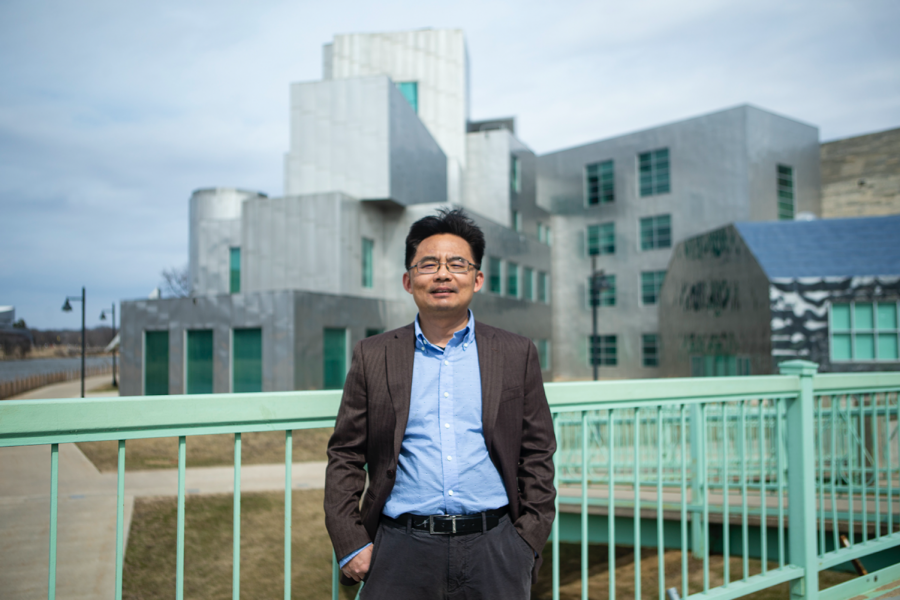
A University of Iowa professor has been selected to help lead an up to $355 million NASA mission to launch a satellite measuring the upper atmosphere to help predict weather, track pollution, and support aviation and space safety.
Jun Wang, a departmental executive officer of Chemical and Biochemical Engineering at the UI’s College of Engineering, is the deputy principal investigator of the Stratosphere-Troposphere Response using Infrared Vertically-resolved light Explorer, or STRIVE, mission approved by NASA on Feb. 6.
According to NASA, the mission has a maximum budget of $355 million and will launch no earlier than 2030.
“I feel very thrilled and also humbled to hear this,” Wang said. “I’m humbled by the leadership responsibility and the privilege of working alongside top-notch scientists and engineers on this important effort.”
Wang said the satellite will be able to detect disturbances in the upper troposphere up through the stratosphere — the part of the atmosphere roughly 10 to 40 km above the Earth — weeks before they affect the surface of the Earth, allowing earlier predictions of harmful weather conditions such as droughts, floods, and heavy storms.
Wang, also the Lichtenberger Family Chair in Chemical Engineering and Associate Director of Iowa Technology Institute, said the UI’s P3 Program, a strategic funding initiative that invests in research areas such as space and aerospace science, helped prepare him for the mission.
According to the UI Technology Institute, the P3 program invested $3.6 million in 2021 to expand space-based research across the university, which let Wang’s team create satellite data tools and test observation methods, directly preparing the UI for the STRIVE mission.
“The P3 program provided two things for me,” he said. “One is collaboration with the physics department to learn more about the hardware, the steps of planning a mission. The second one is to provide me and my research lab for Atmospheric and Environmental Research the resources needed in order to partner with NASA in the space of Earth observation.”
Lyatt Jaeglé, the principal investigator of the satellite mission and a professor of atmospheric and climate sciences at the University of Washington, said Wang was an intuitive choice for the team.
“Dr. Wang brings this really rare combination of satellite remote sensing expertise and deep understanding of how those observations improve models,” she said. “He’s been part of the leadership team from the beginning and helped the team really design the instrument.”
Jaeglé said once launched, the satellite will measure the upper atmosphere for three years, but added NASA could expand the mission’s time window since the instrument is built to last 10 to 15 years.
“If you think about most space-borne instruments that are on satellites, they look down on Earth, straight down at the surface of the Earth,” she said. “STRIVE will look at the edge of the atmosphere.”
Jaeglé said this vertical detail will provide more precision to see where different gases and temperatures are in the atmosphere.
RELATED: UI nearing end of construction for Van Allen Hall’s Iowa Spaceflight Laboratory
Wang said STRIVE’s mission to understand the atmosphere is crucial for the future of understanding and predicting weather.
“The Earth is our only home planet, the only home planet that we know in the universe that we can thrive on,” he said. “Therefore, we want to know our Earth and atmosphere as a system.”
Wang said mankind’s knowledge of the atmosphere drops off quickly as altitude increases because most observations of atmospheric variation with altitude come from ground-based measurements or buildings only a few hundred meters tall.
Wang said understanding the stratosphere is beneficial because the layer contains ozone, which absorbs harmful ultraviolet radiation from the sun.
Wang said the data collected from the ozone layer has been limited, with most data coming from occasional balloon launches or aging satellites.
Wang said the satellite aims to provide high-resolution measurements of the vertical profile information of ozone, water vapor, aerosol, or microscopic dust particles, temperature, and turbulence in that region of the atmosphere, all of which will help forecast extreme weather events and provide critical data for aviation and rocket re-entry planning.
Jaeglé said the main institution building the satellite is the Goddard Space Flight Center, a large Washington, D.C., based NASA research lab.
Luke Oman, a project scientist for the mission and a scientist in the Atmospheric Chemistry and Dynamics Laboratory at NASA Goddard Space Flight Center, said the scientists at Goddard will work to incorporate the measurements from the satellite into weather prediction models once it is launched.
According to the National Oceanic and Atmospheric Administration, the troposphere ends around 10 km and he stratosphere at roughly 50 km above the surface of the Earth.
Oman said changes in the stratosphere can influence weather patterns on Earth for a great deal of time, saying the stratosphere “has a really long-term memory,”
“When something happens there, it can persist much longer than the weather in the troposphere, which is constantly changing,” he said.
Oman said once the satellite launches, it will be able to translate the data to Earth in a day, potentially in the range of three to six hours.
“It’s really bringing together measurements that tell us about the chemistry of the atmosphere, the dynamics of the atmosphere, things that are important radiatively,” he said. “I think it’s bringing together all those concentrations that tell us about different parts of the atmosphere.”
Wang said the university’s involvement in the mission will also raise the UI’s profile in space research.
“By participating and contributing leadership to this project, it allows Iowa to create a good reputation and increase our visibility,” he said. “It advances the heritage of our space physics exploration. Now we can advance Earth observation exploration.”