
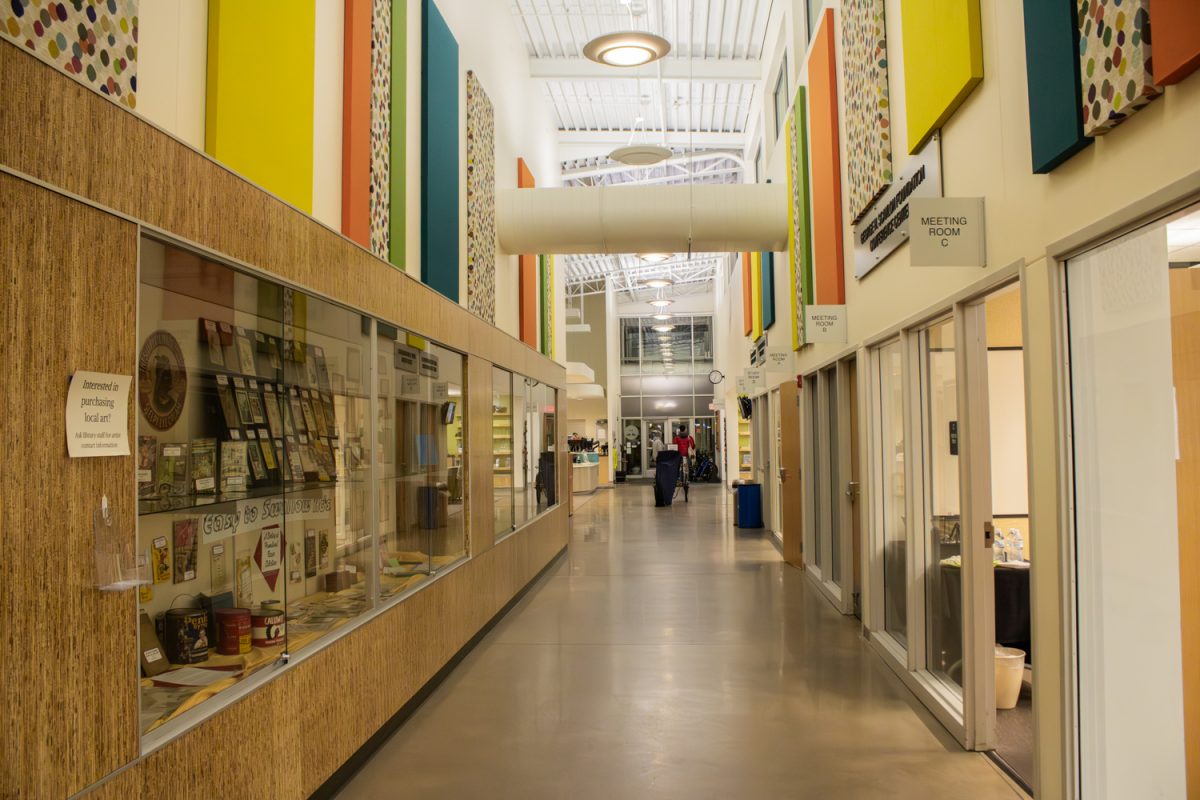
The North Liberty library will host a series of youth-led community events from March 28 through June 2026, after being selected as the only library in the Midwest for the National Teen Dialogue Accelerator, a small-dialogue program that helps teenagers share their insights on civic issues.
The program is led by the civic-focused nonprofit organization, Cortico, in collaboration with the Massachusetts Institute of Technology Center for Constructive Communication and PBS Frontline. It involves 10 libraries nationwide that aim to facilitate conversations among teenagers, and is not exclusive to North Liberty residents.
Cortico has given the library $14,000 in grant funding to implement the project and provided the necessary training and tools to record the conversations that will be featured in PBS Frontline documentaries.
Cortico Director of Programs in Youth and Innovation, Hana Carey, said the North Liberty library was chosen through a selective process with the American Library Association to identify libraries across the country. The North Liberty library’s enthusiasm for amplifying youth voices and its elected youth fellow, Allison Honz, were factors in their selection.
“That combination of institutional commitment and a highly motivated young person at the table was exactly what we were looking for,” Carey said.
Carey said Cortico made the program to address growing political polarization, misinformation, and a lack of spaces for teens to be able to share their experiences. The dialogue will cover various topics that are personal to them, including civic identity, democracy, immigration, artificial intelligence, and future employment.
“One of the things we’re most excited about is that teens themselves have real agency in shaping the conversation topics and guides,” she said. “ So while those are the broad themes, local issues and community-specific questions are absolutely up for discussion, too.”
The library’s youth fellow, Allison Honz, is a third-year University of Iowa student pursuing a combined bachelor’s in education and a master’s in library science through the undergrad-to-graduate program. She had previously worked in libraries as an advisor.
“I’ve always been interested in working in libraries, and I want to be a children’s and teen librarian for my future career,” she said.
Honz is excited for the national convention in May, where all 10 libraries, their youth fellows, and partnered librarians will gather to discuss their experiences working with youth dialogue in Boston. Originally, the event was supposed to occur in January but was canceled due to poor weather conditions.
“We were supposed to be talking about the conversation guides and how we were going to lead each of our sessions, and now we’re just going to talk about the outcomes of the project and how it went, and if we’ve seen any impact in the communities,” she said
Her belief that teen voices are often overlooked and underappreciated in society motivated her to apply as a youth fellow.
“They have really important ideas and contribute a lot to our community. And so by having this grant and participating, it is a way to advocate for them and hear their opinions,” she said. It’s going to be covered by PBS Frontline, hoping that it can make a real change in the community.”
Honz will be working with Adult Services Librarian Nick Shimmin on the project to design conversation guides and use the artificial intelligence, or AI, tools from Cortico to make voice-powered inputs.
Shimmin has worked as a librarian for 20 years and said that throughout his career, he has prioritized community-building.
Aside from the National Teen Dialogue Accelerator, he has helped coordinate two ongoing community dialogue programs: the Good Neighbor Book Club, which seeks to build neighborhoods with book discussions, and the One Small Step through StoryCorps, which connects people of different political beliefs to engage with one another.
For this new program, he said the most important things participants of the dialogue accelerator will take away from the events are having their voices heard on a large scale and getting the opportunity to practice discussing tough topics.
“They’ll be heard and their opinions and viewpoints to be understood by the people they’re around, which I think is just very rare at this point in our society,” he said.
Shimmin also hopes programs like these help promote libraries as key community spaces.
“Hopefully, we’re trying to get some press for the library as a whole,” he said. “But I really feel like the bigger thing is trying to get the press to give a little push, not only the North Liberty library specifically, but just libraries as a community hub.”