


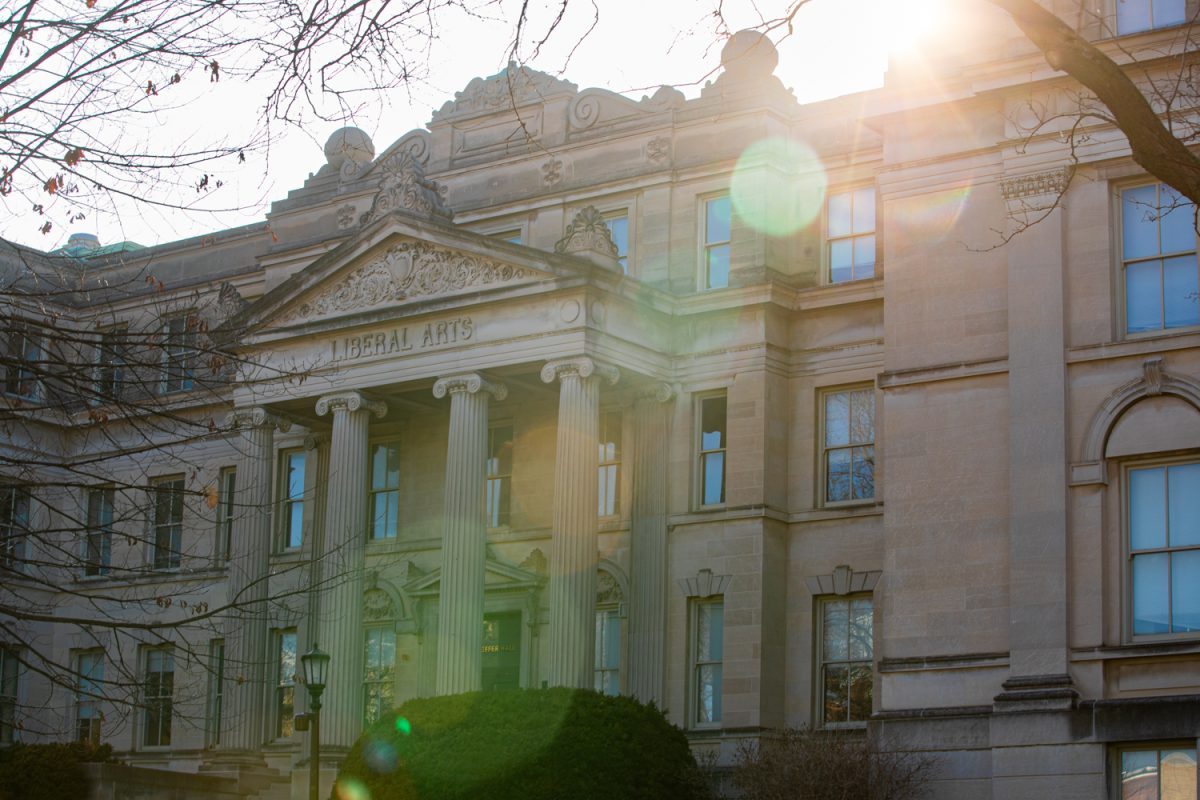
Ever since 1842, the Pentacrest has been embedded in the legacy of the University of Iowa. It is a testament to the wonder, creativity, and construction of a community which has built up the legend of such a grand monument.
The neoclassical edifice of the Old Capitol was first worked on in the 1840s, as the building was intended to be the capitol building of Iowa. Intended to look like an esteemed governmental building, it was done in a Greek Revival style, signifying the regality of its design. Once the capital city was moved to Des Moines, the Old Capitol building was transferred to a then-struggling school called “State University of Iowa.”
Not surprisingly, the building has stood the test of time and everything at the UI has been centered around the Old Capitol.
“The Old Capitol Museum’s classical architectural style adds tremendously to its prestige. Its symmetry, columns, and the iconic gold dome were fitting for an early territorial and state capitol in Iowa, and today convey permanence and scholarship, reinforcing its importance to us,” Jessica Smith, the leader of engagement and communications for the Pentacrest museums, said. “As the literal and figurative center of campus and our great city, it anchors the space and helps to shape our identity.”
The bricks that make up the Old Capitol are made out of local Iowa Devonian limestone. It is often a very durable material, and was intentionally carved out of bluffs near North Liberty and floated on barges to Iowa City.
Original floor joists, roof trusses, and supporting beams were garnered from native oak, a strong form of treewood. This style has always been attractive to the generations passing through the college — an attempt to convert the building to a more modern-office style was thwarted back in the 1970s.
Two buildings are directly behind the Old Capitol, also standing as pillars of the Pentacrest: Maclean and Jessup Halls. Maclean was built in 1912 while Jessup was built 12 years later in 1924. The buildings are almost identical, built in the Beaux-Arts style. This refers to a style marked by ornamental adornments, inspired by Renaissance and Baroque styles and popular among public universities, institutions and governmental agencies in the late 19th and early 20th centuries.
An interesting factoid about Jessup Hall is its naming: after Walter Jessup, the eleventh president of the UI. Jessup led the university’s biggest campaign for new buildings, expanding westward and essentially completing the Pentacrest to where it is today.
Parallel to the previous buildings are the two in front of Old Capitol: Macbride and Schaefer Hall, respectively built in 1908 and 1902. To make room for the new Natural Sciences building, now known as Macbride, students and others were hired to move Calvin Hall across the street where it still stands today.
Macbride and Schaefer are also built in the Beaux-Arts style, but differ as their fronts are curved, with pillars protecting the grand front doors. Macbride is now on the national register of historic places. Schaeffer Hall, meanwhile, has implemented new pieces of artistry, such as William Carlson’s “Reticulating Aperture.”
“I think [the Pentacrest is] an iconic and signature part of the campus,” UI student AJ Clauss said.
Although there haven’t been many huge changes to the Pentacrest recently, an incident occurred in 2001. Contractors accidentally caught the roof of the Old Capitol on fire while trying to do maintenance. It was massively damaged and had to be replaced, while the UI won $2.1 million in a lawsuit. The firewall in between the actual Capitol and the dome prevented more damage from happening.
Online, there are no direct sources or announcements that signal any building in the Pentacrest is making any sort of renovations in the immediate future.
Andrew Bepristis, a first year UI student, said the Pentacrest was one of his favorite spots on campus.
“It’s the banners, the dome with the flag, and the spotlights at night [that make it my favorite],” Bepristis said.