


As Johnson County weighs the future of developing large AI data centers, local leaders, hydrogeologists, and environmental advocates agree on a shared concern: the state does not have enough groundwater monitoring data to fully understand the long-term health of its aquifers.
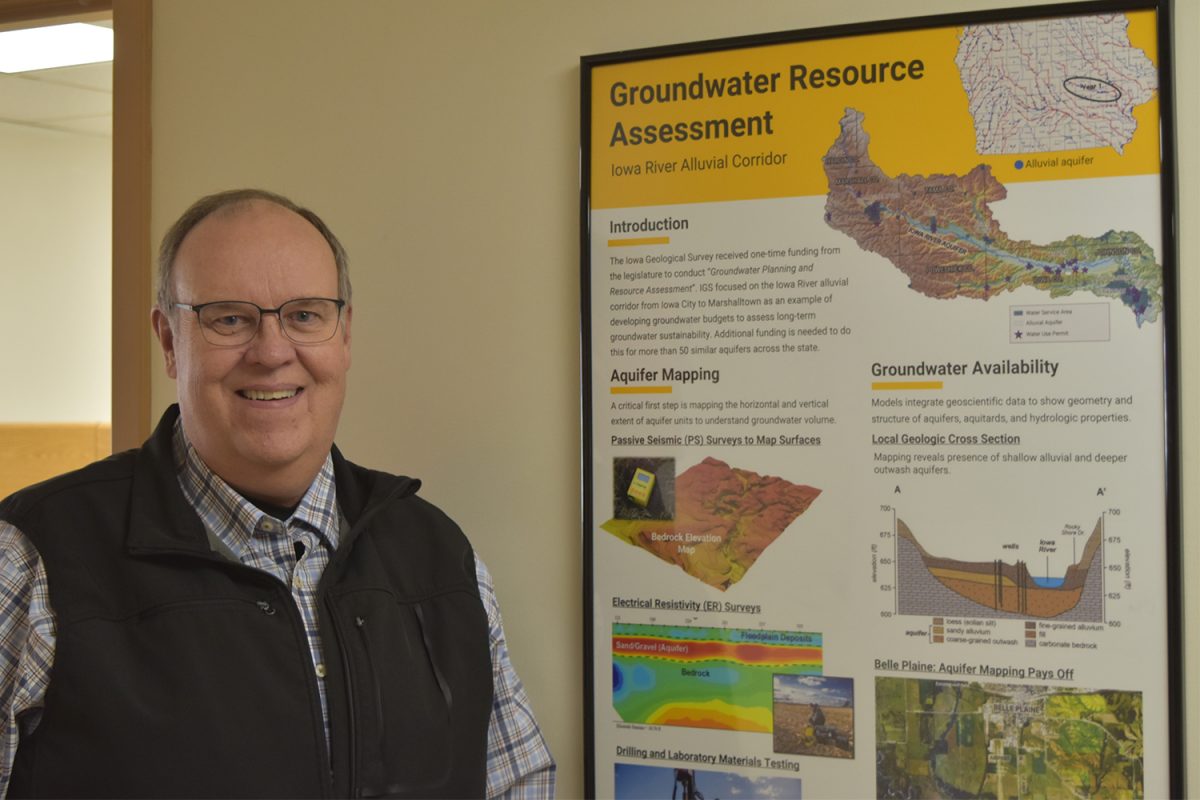
Greg Brennan, a hydrogeologist for the Iowa Geological Survey, presented water-level data for the Silurian aquifer, the aquifer Johnson County draws from, to Solon residents on Feb. 16.
He said experts from the Iowa Geological Survey concluded that while the aquifer isn’t in immediate danger, more monitoring is needed to understand local variations and plan for long-term water use.
RELATED: Cedar Rapids data centers ignite concern from energy advocates, excitement from officials
Brennan said Iowa has 49 groundwater monitoring wells, which are specially constructed to observe and measure groundwater levels.
According to the Iowa Geological Survey, Iowa has the lowest amount of groundwater monitoring wells compared to all its neighboring states, such as Nebraska with 5,269 wells and Minnesota with 1,448 wells.
Brennan said there are too many gaps in aquifer monitoring for environmental officials to assess water levels across the state.
Johnson County Board of Supervisors Chair Jon Green said water quality is equally important to county residents as water quantity, which is why the board set aside $200,000 for its budget meeting on March 3 to revive the Iowa water quality monitoring network, a system of sensors and stations that tracks real-time water quality in rivers and streams across the state shut down by the Iowa legislature in 2023.
“Year after year, we hear from the folks who vote for us that water quality is just as important as water quantity is,” he said. “And if that means that we each have to pay an extra three or five bucks a year in property taxes, I haven’t heard from a single person who thinks that isn’t a good investment.”
Two data center projects in Cedar Rapids are still underway: Google’s $576 million data center is expected to be completed by 2031, while QTS development’s, set to be the largest data center in Eastern Iowa, has a completion period of 25 years.
According to an Environmental Law Institute fact sheet published in January, U.S. data centers consumed roughly 17 billion gallons of water in 2023 for cooling. Data centers consumed approximately 21.2 billion liters of water in 2014 according to the same fact sheet, showing a rapid expansion of digital infrastructure and its need for water resources.
In November, the Johnson County Board of Supervisors passed a temporary moratorium, or a forced delay in activities, for data centers in unincorporated Johnson County.
Green said the board is three to four months away from finalizing an ordinance that would set clear rules and protections for the county before approving new data centers, ensuring they would not harm neighbors or strain shared resources like aquifers.
Green said the board will tour AI data center facilities in Cedar Rapids and Altoona in the coming months to inform the supervisors and the planning, development, and sustainability staff if there are additional considerations that they need to put into the ordinance.
Green said the presentation was a good indicator that the county must have a very long-term scale in mind when approving developments such as AI data centers that draw from aquifers.
“We’re not in a doom and gloom scenario with this aquifer whatsoever,” he said. “But we have to be cognizant of the fact that the amount of water that we can pull out of these aquifers a year is going to take tens or hundreds of thousands of years to potentially replenish.”
Green said considering Iowa’s lack of monitoring wells, the county’s ordinance must be based on both hydrology science, how groundwater and aquifers work, and on an understanding of modern data center operations.
Green said he is open to data centers being built in Johnson County if they are planned responsibly, ensuring they use resources wisely and don’t harm the county by draining aquifers, a shared community resource.
“The aquifer doesn’t care about political subdivisions,” he said. “What something that someone in rural Linn County does is potentially going to affect somebody in the city of Swisher.”
Pam Mackey-Taylor, director of the Iowa Chapter of the Sierra Club, said she is in favor of House File 2690, a bill that would require data centers in Iowa to submit periodic water usage reports to the Iowa Department of Natural Resources.
“There’s a lot of secrecy around the data centers, and so we don’t know a lot of details about how they’re operating,” she said.
Mackey-Taylor said she hopes to see data centers in the state becoming more transparent alongside an increased investment in groundwater monitoring wells.
“We really do not know the health of all of our aquifers across the state,” she said. “They are under pressure from data centers, industries that use a lot of water. We need to make sure that the uses that people want to put in those aquifers don’t drain them.”
Green said he hopes that when Johnson County’s ordinance passes in the months ahead, it will set up a coalition of responsibility in the county with shared groundwater and surface water reserves.
“The decisions that we make about aquifers today are going to impact the region long after we’re all dead and gone,” he said. “Not only do we have a duty to our neighbors today, but we have a duty for the people that are going to come after us.”