


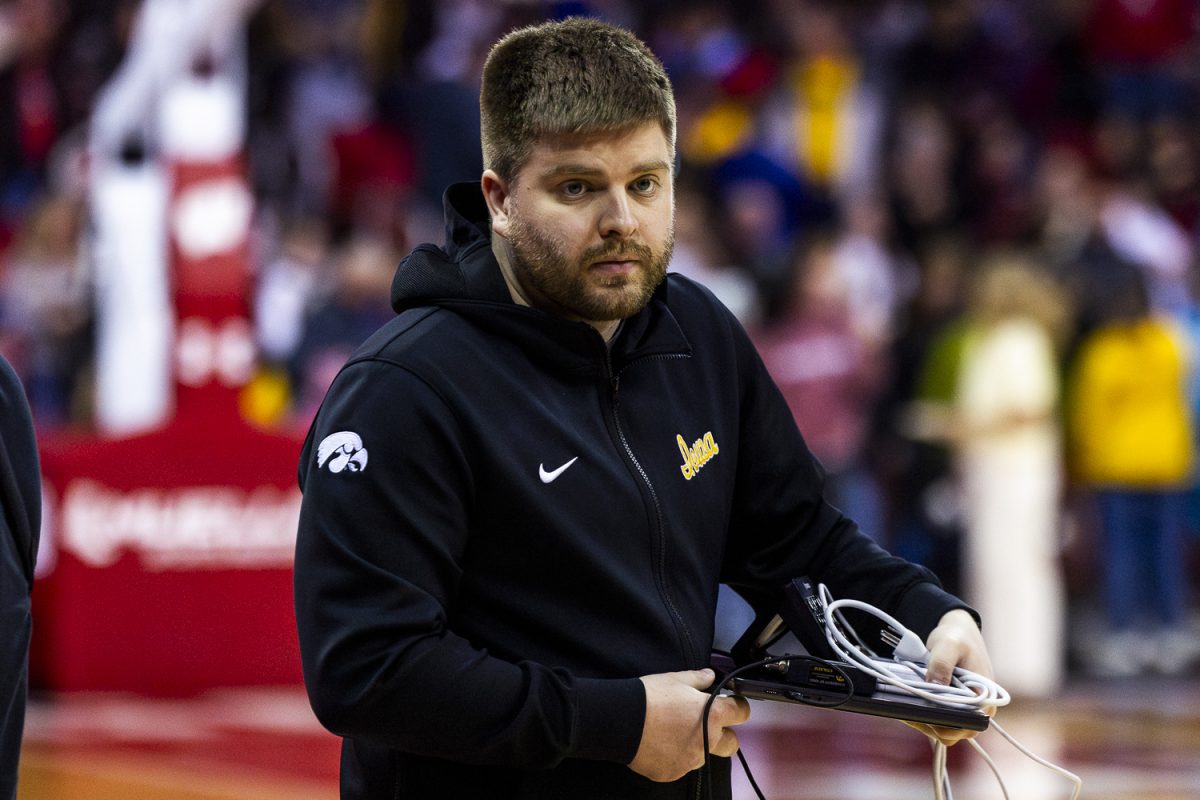
Ben Lober boasts one of the best seats at Carver-Hawkeye Arena, but his eyes rarely glance at the court. Sitting just to the right of the scorer’s table, Lober stares at his Macbook, but he’s no disinterested viewer. Rather, he might be the most active spectator in the building.
His laptop screen is divided into a quadrant of pages. The first presents the TV broadcast of the Iowa women’s basketball game unfolding on the hardwood in front of him. The tape is delayed by 30 seconds but operates at six-times speed. A little aggressive, he said, but you get used to it. His eyes follow the broadcast, but his action centers on what he calls the code window, which he uses to track what occurs on each possession.
For instance, a made three-pointer. Lober clicks pause on the broadcast. He notes the shooter, their position on the court, who made the assist, and what play the offense ran. All of these notations are colored rectangles he clicks on not with a mouse, but a streamdeck, essentially a large keyboard whose buttons mirror the options on his screen.
Every possession he tracks is then compiled on a timeline, which appears on another page. Finally, the timeline is merged with video in the fourth frame. His notation takes a few seconds. Then, he presses resume and repeats the process on the defensive end.
“If I catch up, then I’m just looking up at the court and waiting so I can keep coding,” Lober said.
The average college game contains about 140 possessions, and not one sneaks past Lober, the video coordinator for the Iowa women’s basketball team. He and his counterpart on the men’s team, Jace Smith, are two guys in their mid 20s living out a dream. They get paid to watch the sport they love while traveling with a Big Ten team. They occupy a spot on the coaching staff some might generalize or trivialize, but the pair recognize their value.
“It’s not someone out there moving a camera,” Smith said. “I don’t touch a camera at all.”
The duo track stats, identify trends, and assist on challenging calls — and that’s just the on-court responsibilities. Lober and Smith likely wouldn’t be recognized by fans, but how the Hawkeyes function depends on the guys in the chair.
“I feel like I have a hand with almost everyone,” Lober said.
Lober and Smith’s initial journeys stayed close to home. The former hails from Dansville, just a half hour’s drive from East Lansing. Smith is from Powell, Wyoming, where the state’s only Division I school sits more than 300 miles away. Yet each wound up at their in-state school.
Lober started as a student manager and his initial duties with the Spartans involved the typical activities like rebounding and setting up drills at practice. But as an economics and quantitative data analytics major, Lober carried over his impact to the team’s metrics department. He created a player efficiency measurement system on Excel that would assign a player a certain score based on certain statistics or actions in a game or practice.
For example, a made two-pointer adds two points to the total, while a miss subtracts one. But the system expands beyond the box score, including “hustle plays,” like tallying pass deflections and screen assists.
“Whatever was asked, I pretty much did. Just because I love basketball,” Lober said.
Smith played basketball in high school, and after returning to campus after studying abroad, he wanted to get back in the sport. The only job opening on Wyoming’s men’s team was the video coordinator, and Smith soon found himself with extra homework. A kinesiology and health promotion major, Smith took separate classes on Excel, learned how to code in Python.
He stayed at Wyoming to pursue his master’s degree and briefly met Iowa men’s basketball coach Ben McCollum when McCollum worked at Northwest Missouri State. The school had just accessed Hudl, a sports technology software, and Smith said he walked McCollum through the process. The pair reunited when McCollum took the job at Drake, although not in Des Moines. Rather, Smith served a remote role, working by day as a middle school teacher in North Dakota.
Smith said McCollum gives him some “free reign” on how he operates. Whether it’s creating, breaking down, and categorizing game film or creating stat-tracking templates for practices, Smith’s distant contribution helped the Bulldogs to 31 wins and a trip to the second round of the NCAA Tournament. When Iowa hired McCollum after that season, Smith followed, this time making the move in-person.
“It’s important to have guys that you trust,” McCollum said. “It’s important to have guys that will have your back.”
After spending one year as a graduate assistant at Canisius College in Buffalo, New York, Lober returned to the Midwest after the Iowa position opened. In his interview, he presented the same player efficiency rating he built, which now could be automated.
Lober and Smith prioritize efficiency. Saving time is essential when coaches want information as soon as possible. For instance, having clips of ball screen coverages ready by halftime. Postgame, the pair organize film clips by various categories, through automation and their own judgement. The coordinators evaluate their performance based on the team’s success.
“I’m always looking to do more or learn something new,” Smith said. “When we win, I feel like I’ve done something. When we lose, I feel like I could’ve done more.”
Lober and Smith interact with other coaches throughout the game. Lober said he’ll remind head coach Jan Jensen the success rate of a certain play. Smith will send specific video clips to a coach’s iPad upon request. Perhaps the most immediately consequential role for the coordinators is the challenge system.
With the TV broadcast at their finger tips, the two will review a suspect whistle, whether its out-of-bounds possession, block or charge, or basket interference. However, the coordinators have no more than 10 seconds to reach a verdict, choosing whether or not to risk burning a timeout. Jensen relies on Lober’s judgement, admitting he’s right more often than not. The two have a contest on who is more accurate regardless of time limit, and Lober leads.
“Ben can handle it, and I trust him unequivocally with it,” Jensen said. “It’s fun. It doesn’t always work where I’m acting unilaterally.”
With the praise of their respective coaches – McCollum called Smith “the best film guy in the country” – the two coordinators appreciate their value, but they also find joy in the nature of their job.
Ask Lober or Smith the least favorite part of their occupation, and they scoff at the question. Smith lets out a laugh. He’s previously worked in construction and landscaping, but he can’t see himself working anywhere but on the sidelines, keeping track of everything on the court.
“To be honest, I love this job,” he said.