


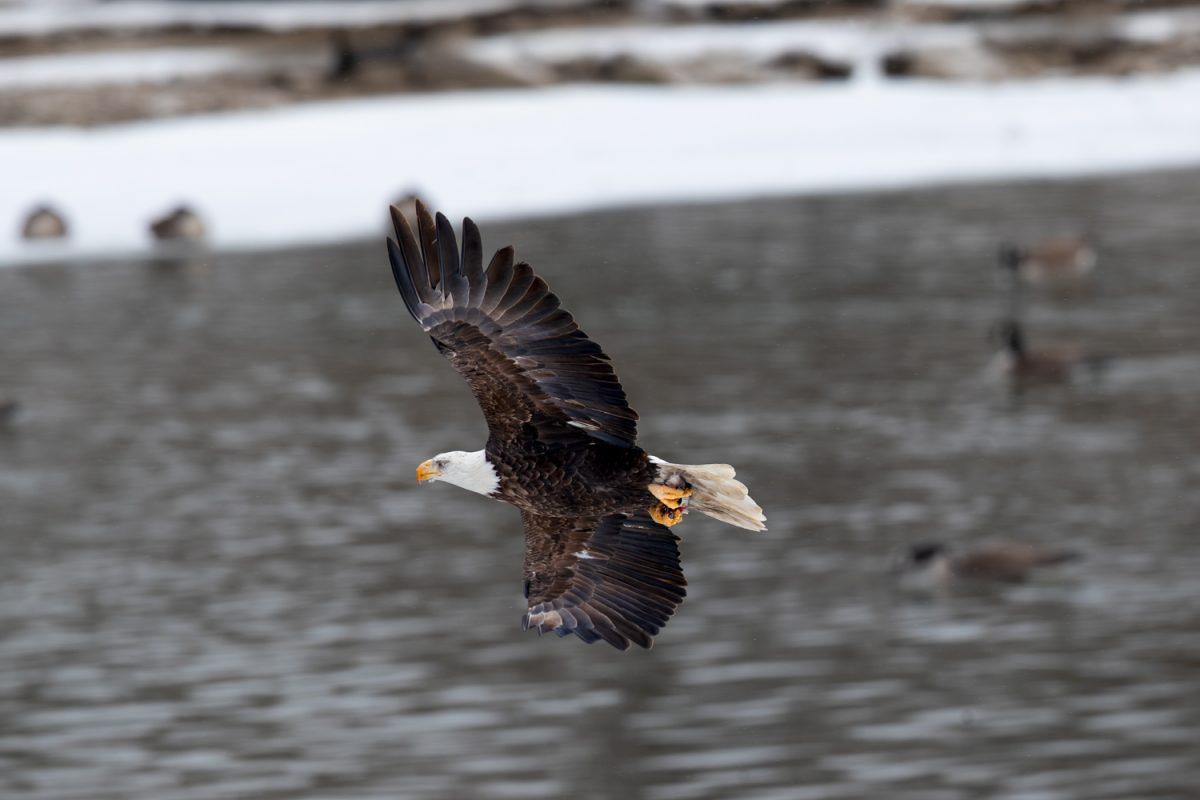
Just after sunrise, when the Iowa River is edged with ice, and the trees along the bank stand bare, University of Iowa professor Patrick Weiguo Fan raises his camera toward the treeline. The city is quiet, but above the river, wings cut through the cold air.
Fan said winter mornings in Iowa City are the perfect chance to catch a glimpse of America’s national bird.
Fan began photographing bald eagles about three years ago after a friend mentioned they were living in town.
This winter brought historic numbers. During the Iowa Raptor Project’s annual Winter Raptor Survey, researchers counted 372 eagles between the Coralville Dam and Highway 22, the highest total ever recorded.
Each year, as freezing temperatures lock up lakes and rivers further north, bald eagles move south in search of food and open water. Along the Iowa River, from the Iowa City City Park to the stretches below the Coralville Dam, the river corridor becomes one of the most reliable places in the region to see them.
David Conrads, director of the Iowa Raptor Project, said eagles can be spotted all along the Iowa River through Iowa City and beyond. When Coralville Lake and portions of the river freeze, birds concentrate in large numbers around open water below the Coralville Dam and other areas where they can fish.
Bald eagles are migratory, Conrads said, and winter conditions also make them less territorial. That shift allows them to gather in unusually large groups, something not typically seen during nesting season. Large congregations can form anywhere open water remains accessible, turning stretches of river into temporary gathering grounds, he said.
Fan visits the river almost daily with his camera. He shares his photos on Facebook and runs a YouTube channel dedicated to his wildlife photography, documenting not only bald eagles but also swans, pelicans, and other seasonal birds. Early morning and before dusk, he said, are the best times to see them.
His favorite locations include City Park, the Benton Street Bridge, and areas near the dam, where he has seen more than 50, and sometimes nearly 100, eagles gathered at once.
Fan has observed the gathering of eagles along open water areas. But for Fan, the birds are more than a photographic subject.
“They are dedicated to each other, and they protect each other, they hunt together, they raise children,” he said. “For me to spend some time with them is very encouraging.”
The resurgence of bald eagles in Iowa has taken decades, Conrads said. In 1977, only one bald eagle nest was documented statewide. Since the banning of DDT, a pesticide used for farming, in 1972 and the introduction of federal protections such as the Endangered Species Act, more than 1,590 nesting territories have been recorded across all 99 counties, he said.
“It’s really a remarkable comeback,” Conrads said.
The Iowa Raptor Project, housed within the UI’s College of Education, plays a role in the ongoing recovery. The program focuses on conservation, education, and research related to birds of prey.
Through field research projects, public programming, and seasonal surveys like the winter eagle count, the organization tracks population trends and helps educate the community about raptor habitats and threats.
Still, the birds face ongoing threats.
Sonja Hadenfeldt, coordinator at Raptor Advocacy, Rehabilitation, and Education, or RARE, said the organization sees between 10 and 15 injured bald eagles each year. The organization works to treat injured birds of prey and return them to the wild when possible. The group also provides educational outreach to reduce preventable injuries.
Many of the bald eagles treated by RARE suffer from lead poisoning. Hadenfeldt said eagles often scavenge deer carcasses left behind after hunting season, and when deer are shot with lead ammunition, fragments can remain in the meat. If ingested, the metal can poison the birds, sometimes leading to severe neurological damage or death, she said.
Conrads also said lead poisoning from humans using lead bullets for hunting remains a significant threat, along with highly pathogenic avian influenza. Even as winter sightings increase, conservationists emphasize that the species’ recovery is not guaranteed without continued awareness and responsible practices.
Conrads encourages residents to observe eagles from a distance. Energy conservation is critical during the winter months, and approaching perched birds can force them to expend unnecessary energy.
Using binoculars and giving them space helps ensure their continued success along the Iowa River corridor, he said.
Along the riverbanks, the blend of city life and wildlife creates a striking contrast. Students walk across bridges on their way to class while eagles perch in nearby cottonwood trees. Traffic moves steadily below as white heads scan the water for fish.
As winter continues, the open water below the dam will remain one of the best places in the state to witness a species that once nearly disappeared from Iowa skies. For Fan, each sighting is a reminder of resilience.
“We just need to learn from some of these birds, especially the bald eagles,” he said.