



To celebrate the 250th anniversary of the Declaration of Independence, three bronze bison sculptures will be displayed at the University of Iowa Museum of Natural History on March 15 from 1:30 p.m. to 3 p.m. Curators specializing in mammals from the Smithsonian will be present to answer questions, as will a film crew shooting a documentary about the momentous trip.
The 2,000 pound bison will make the journey from Colorado to Washington, D.C. to be shown in the Smithsonian’s National Museum of Natural History. They will make stops at the University of Nebraska State Museum, the Chicago Field Museum, the Denver Museum of Nature and Science, and the UI Museum of Natural History.
“This is a really incredible way to get involved right here in your community with something that is important at the national level,” Jessica Smith, the communications specialist for Pentacrest Museums, said. “It’s really special that Iowa City and University of Iowa have been designated as an important stop.”
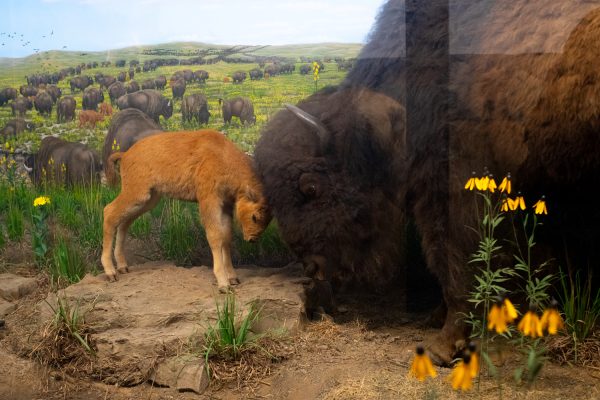
While the bison was named the national mammal of the U.S. in 2016, they have held historic significance for centuries. In the late 19th century, bison faced extinction.
According to the National Park Service, the number of bison went from 30-60 million to less than 1,000 bison, but after Theodore Roosevelt and others created the American Bison Society in 1905, their population recovered.
Smith said the bison were also very important to Native American tribes, who used them as a resource for survival.
Gary Staab, sculptor and owner of Staab Studios located in Missouri, is the artist behind the statues. He has created wildlife inspired pieces for clients like the National Geographic Society, BBC, Discover Magazine, and the Smithsonian. Like many others, he sees bison as an inspiring and fascinating species.
“It would be really easy to be melancholy about this whole experience, but the Smithsonian is choosing to tell the story as a positive story. People got together, and they figured out how to save the species, so it’s a really extraordinary thing,” Staab said.
The bison statues took over a year for Staab to create. While the sculptures are 25 percent larger than life, they start out as small statues used to determine the pose and gesture of the animal. Once he and the client are satisfied with the design, the final statue is created. The top shoulder of the bison reaches 10 feet tall and its size can be compared to a small elephant.
RELATED: UI alumni and staff contribute to NASA’s lunar rover research
Surrounded by 30 bison-related decorations in her office, Liz Crooks, director of the Pentacrest Museums, said bison play a large role in supporting ecological health in Iowa.
“They are very important to Iowa because as a prairie state, they were integral to keeping the prairie rich, thriving, and vital,” Crooks said. “Their grazing with their hooves and the mud wallows they created all played an important part in keeping the native areas healthy. We would have been a natural migration pattern for bison when they were in their heyday.”
The UI showcases many historical artifacts in their Natural Museum to document bison’s importance to Iowa. These exhibits include bison skeletons, prairie exhibits, taxidermies, and bison bones that Native Americans used as scrapers. Previous artifacts from the Smithsonian can be seen in the university’s museums.
Once the bison reach the Smithsonian, they will be permanently installed at the entrance of the National Mall, where they will face the Smithsonian Institution building. The historic site held living bison in the South Yard behind the Smithsonian Institution building in the 1880s.
Those who come to see the sculptures at the UI will have the opportunity to bid the bison farewell as they travel to their final destination.
“They’re inviting folks to wave the truck away, and this will be documented, of course,” Smith said. “We really want to give that warm Iowa send off and have as many folks there as possible.”