


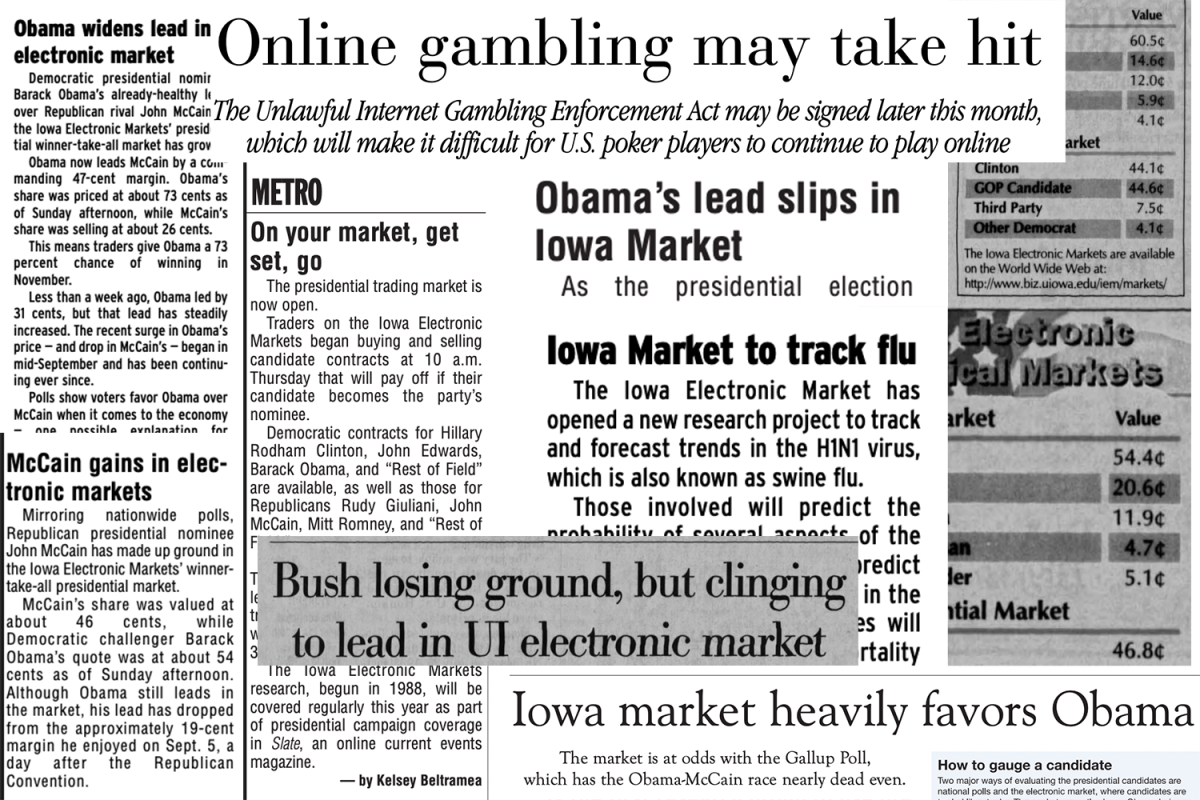
Back in the late 1980s, three University of Iowa professors believed they could predict polling data better than the pollsters at that time, leading to the creation of a site allowing users to place bets on political events. Now, the prediction market site has become a learning tool at the UI and has influenced other companies to replicate the concept.
On Feb. 13, NBC News published an article titled “Three economists grabbed a beer. A multibillion-dollar industry was born.” The article detailed how prediction market apps like Kalshi and Polymarket trace their origins back to UI and the prediction market site, Iowa Electronic Markets.
The Iowa Electronic Markets site is still up and running to this day with three markets accepting investments. The first is which party, Democrat or Republican, is going to control the U.S. House of Representatives, the second is which party will control the U.S. Senate, and finally which party will have the majority when combining the House and Senate.
According to reporting by NBC News, the site was created in 1988 after inaccurate polling predicted Michael Dukakis beating the late Civil Rights leader Jesse Jackson in the Michigan presidential primary, an inaccuracy sparking the creation by three former UI professors at a local Iowa City bar.
UI professor and Iowa Electronics Market director Thomas Gruca, who worked with the three founders back in the 1990s, said the bar they drank at was likely one of two places that still reside in Iowa City.
“Knowing them, it was either Joe’s or Airliner,” Gruca said.
The three creators of the site were former UI professors Robert Forsythe, George Neumann, and Forrest Nelson.
RELATED: UI earns Fulbright top-producing institution award for the 10th year
The three originally called the site the “Iowa Political Stock Market,” with the first market on how likely it would be for Dukakis to beat George H.W. Bush in the 1988 presidential election.
This would spawn the now multibillion-dollar industry that is prediction markets when the Commodity Trading Futures Commission would first recognize event contracts in 1992 specifically for the site.
According to the Corporate Finance Institute, a prediction market can be defined as, “an exchange-traded market where individuals can bet on the outcome of a variety of events with an unknown future.”
The Corporate Finance Institute also mentions that prediction markets can exist for a variety of events across different sectors, something the creators of Iowa Electronics Market saw the potential of back in the 1990s.
In 1995, Gruca created the first movie box office prediction market after being tasked with creating a new market outside of politics.
Gruca, who came to the UI in 1991, said he wasn’t familiar with prediction markets and that his interest in them grew after seeing the site’s successful predictions.
To try to predict movies’ box offices, Gruca had his students get involved with the prediction market by turning in forecast diaries filled with their predictions.
A year later, the Hollywood Stock Exchange was created by filmmaker Max Keiser and chair of Lions Gate Entertainment Michael Burns in Los Angeles, California with a similar concept; however, it used fake money while the site used real currency.
However, in 2010, an amendment was added to the 1958 Onion Futures Act, which was a U.S. law that banned the trading of “futures contracts” for onions. The amendment added motion picture box office receipts to the list of banned futures contracts, ending the site’s box office predictions.
Gruca said movies weren’t the only subject they were first on either, as the site was also the first to conduct prediction markets for pandemics. It did not do a market for the COVID-19 pandemic, but did do markets for flu pandemics and outbreaks.
For those markets specifically, the site would encourage front-line physicians and nurses to bet on whether or when a pandemic would occur. The results would typically predict about a month in advance of when flu cases would spike, allowing hospitals time to prepare.
Gruca said, in past semesters, students would open the site accounts and bet around $10 on one of the open markets, allowing them to decide if certain “yes” or “no” contracts are overpriced or underpriced. Gruca said the students would have fun taking small amounts of money from their classmates.
“They’re losing the money to their fellow students,” Gruca said. “Even if it’s a dollar, they get really into it.”
Gruca said he also liked the assignments because they were self-graded and allowed the students to see in real-time how well they invested.
UI finance professor and Iowa Electronic Markets board member Thomas Rietz has also used the site in his classes and has found mixed results with students.
He said using the site in class forces students to engage in active learning, which some like and others view as hard work. He said he likes the way it works in the classroom, but acknowledges that it creates extra work for students and the instructor.
Gruca said the purpose of opening markets to bet on is where the site differs from newer prediction markets such as Kalshi and Polymarket.
“The purpose is not to make money, we’re nonprofit, we’re even non-revenue,” Gruca said. “Our purpose is to see if different groups of people can put their heads together and solve really hard forecasting problems.”
When it comes to Kalshi and Polymarket, Gruca said their interests don’t align with those of the Iowa Electronic Market.
“Their only interest is making money,” Gruca said.
Gruca said these companies’ profit-first mindset has had an influence on how their apps work for users. The apps allow users the opportunity to bet on the same event multiple times, amplifying their gains and their losses.
Rietz said a critical difference in the site’s commitment to accuracy in forecasting.
“The difference is we are designing our markets and our contracts specifically to make the most accurate forecast possible,” Rietz said.
For Kalshi and Polymarket, Gruca said their goal is to encourage as much site traffic and betting as possible for their revenue, with apps opening as many markets as possible so they can drive up engagement and bets from users.
Another way the site differs from newer prediction market apps is the inclusion of a price limit. Rietz said it has an investing limit of $500 to prevent someone from having too large an influence on the market.
For Kalshi and Polymarket, the apps generally do not include limits on how much a user can invest and are available to users who are 18 years old or older.
Despite the differences between the site and newer apps such as Kalshi and Polymarket, Rietz said the newer apps often reference older ones as evidence for why they can exist.
“They’re loosely based on us,” Rietz said. “They reference us frequently in their application to operate as a market.”