


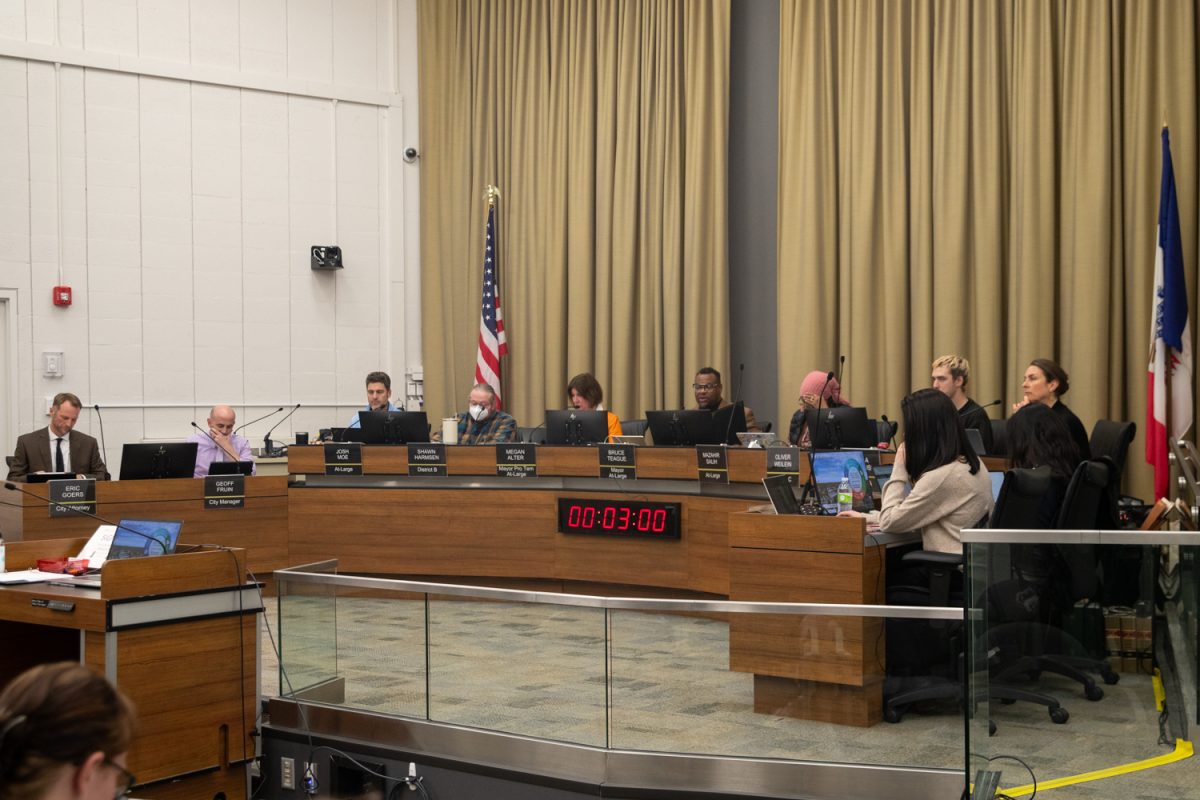
The Iowa City City Council passed a resolution to not renew Fieldhouse Bar and Grill’s liquor license during a city council meeting Tuesday.
The decision came to a unanimous vote in favor of the resolution, denying Fieldhouse’s application to renew the license, which was previously suspended by the council on Jan. 20.
Fieldhouse can continue operating and selling alcohol until Feb. 28, at which point its license cannot be renewed, unless an appeal is made to the Iowa Department of Revenue.
The vote passed 6-0, with Councilor Laura Bergus recusing herself from the discussion and vote on the resolution upon request from the applicant, Tracy Barkalow, owner of the Fieldhouse property.
Barkalow’s request was made because Bergus formerly legally represented Barkalow and his company. Bergus expressed disagreement with the alleged inherent conflict of interest between herself and the resolution, but still chose to refrain from participating in the discussion.
Despite the liquor license being suspended, Fieldhouse was able to remain open and continue serving alcohol due to an active appeal against the suspension to the Iowa Department of Revenue.
Iowa City’s city officials published a news release on Feb. 4 recommending that the city council’s suspension of Fieldhouse’s alcohol license be rescinded after city staff discovered that the ordinance used as the basis for the suspension of the Iowa City Code no longer exists.
The code stated that an establishment could not serve alcohol if not located entirely on the ground floor with windows allowing for visibility inside. The ordinance was removed in 2015 after a new ordinance was created to permit rooftop service areas in the city.
While this ordinance can no longer justify Fieldhouse’s liquor license suspension, Development Services Coordinator Danielle Sitzman argued on Feb. 17 that the bar is still in violation of another city ordinance, recommending they disapprove the proposal.
Sitzman argued that Fieldhouse violated a city code that requires a new drinking establishment to maintain a distance of at least 500 feet from another drinking establishment. She said the motivation behind this ordinance, which was established in 2009, was to minimize incidents of overdrinking in the downtown area.
“The policy goal at the time was not to prohibit alcohol serving establishments altogether, but to slow further saturation and prevent additional clustering in already impacted areas,” Sitzman said. “The separation requirement was enacted as a public health and safety protection strategy aimed at reducing the negative impacts associated with too many late-night drinking establishments too close together.”
City manager Geoff Fruin highlighted the importance of the zoning ordinance for the downtown area’s commerce.
“The 500-foot rule has had a tremendously positive impact on downtown Iowa City,” Fruin said. “It’s opened up opportunities for a much more diverse set of businesses and land uses downtown. There’s additional retail opportunities, there’s additional commercial, office, professional service opportunities that would not exist today without that 500-foot rule in place.”
The property was initially classified as a restaurant rather than a bar when it applied for a Class C liquor license under the previous owner, Jason Zeman. This distinction would, and has, allowed the business to sell alcohol despite its location violating the 500-foot separation requirement.
Barkalow responded to Sitzman and Frin at the city council meeting, defending how Fieldhouse has operated in relation to city and state ordinances. He said if the liquor license is not renewed, then he will immediately apply for an appeal with the Iowa Department of Revenue.
RELATED: City of Iowa City recommends reversing Fieldhouse’s liquor license suspension
“Renewal will not close our business, but it will increase legal exposure for the city,” Barkalow said. “If the court ultimately rules in our favor, the city would have suspended, unsuspended, and failed to renew our license based on an ordinance interpretation in a way that conflicts with state law. I think you all would look very foolish in the press if that happens.”
Barkalow maintained that Fieldhouse qualifies as an eating establishment, arguing that the city does not have definite restrictions on how the menu distinguishes the two types of establishments.
When the business was granted its license in January 2025, it cited its hours of operation as being between 11 a.m. and midnight. By closing at midnight, Fieldhouse was granted not only its license, but recognition as an eating establishment.
Fieldhouse very rarely closes at midnight on its busiest nights, Iowa City Police Department Sgt. Rob Cash said.
Cash said during the department’s night watch between 11 p.m. and 7 a.m., the bar consistently stays open up until at least 1:30 a.m. on weekend nights.
According to city documents, by staying open past midnight, Fieldhouse violates the alcohol license that it had applied to as an eating establishment. However, it cannot reapply as a drinking establishment, because its current location is in violation of the 500-foot separation requirement.
Before the council’s vote, Mayor Bruce Teague shared his perspective on the zoning requirement’s importance, stating that it diversifies businesses downtown.
“That has been a good thing for our community, and what I see before us tonight, and what I’ve seen is really kind of going against that zoning code, and so I will be voting in favor of the resolution to not approve,” Teague said.
Councilor Oliver Weilein said the majority of businesses in downtown Iowa City do not have an issue with complying with zoning ordinances and that Fieldhouse had been given multiple chances to comply.
“It was just intentionally ignored, because sometimes people don’t want to follow the rules,” Weilein said. “Yeah, you could try it in court. But to what end, other than trying not to follow rules like everybody else and to try to make money at the expense of our community?”
Barkalow said the situation ultimately came down to the establishment’s hours of operation. He said the 500-foot zoning ordinance is being used to circumvent state law.
According to Iowa Code, an alcohol license cannot be issued when the building does not adhere to city ordinances, laws, and regulations.
“The fact is that you can have a restaurant downtown, it can be open 24 hours a day downtown. The only difference is that we have a liquor license, so they’re regulating our hours of sale of alcohol. It’s that plain and simple, and it’s illegal,” Barkalow said. “The city is violating state law. We will appeal it, and we will be successful on appeal. And that is the biggest issue. You guys can do whatever you want tonight, and I guess we’ll just see it in court next week.”