


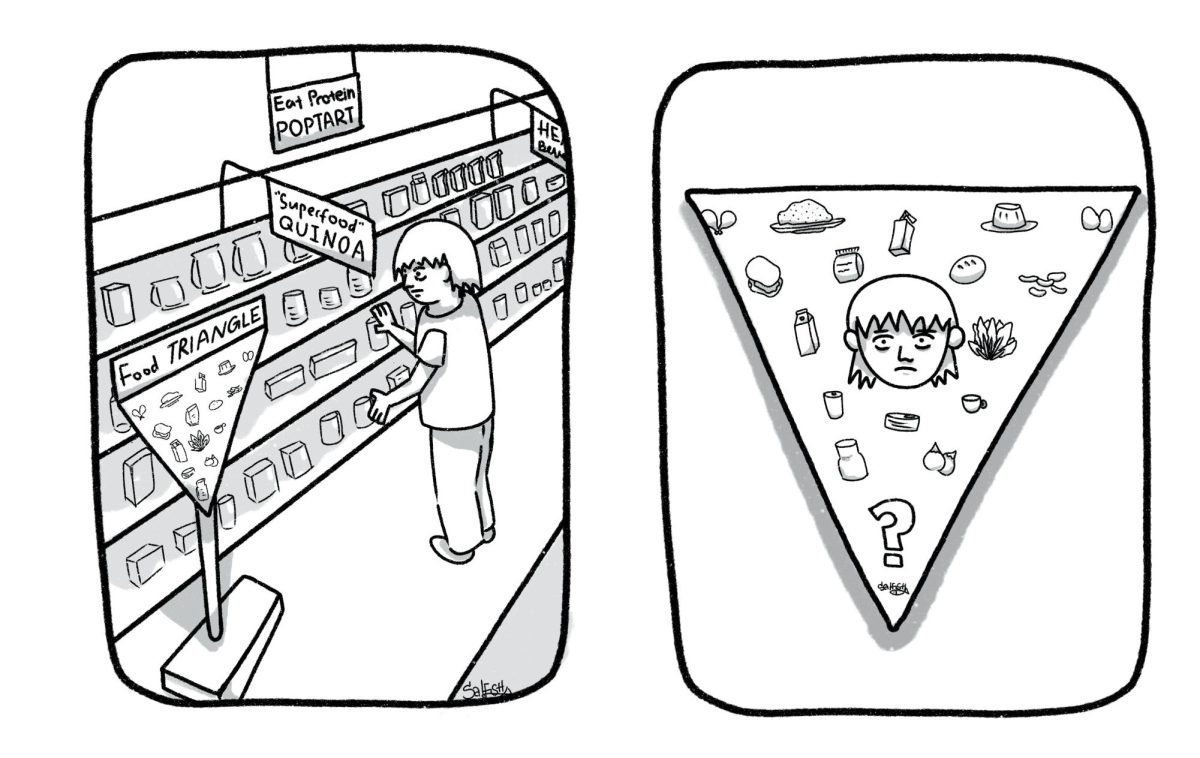
Earlier this year, the Trump administration released new dietary guidelines for U.S. citizens. The announcement was a part of Health Secretary Robert F. Kennedy Jr.’s Make America Healthy Again, or MAHA, movement.
These guidelines included a food pyramid that is flipped upside down. The new pyramid places greater emphasis on consuming protein, dairy, and healthy fats. Some foods pictured on the pyramid are steak, ground beef, a block of cheese, and whole milk.
This is not the first time the food pyramid has undergone changes, but it is by far the most drastic. The most recent version was the My Plate graphic that had been used since 2011 and simplified food servings into quadrants on a plate. These guidelines placed emphasis on primarily vegetables and grains, with fruits and proteins being last, and then a small portion of dairy for everyday consumption.
However, the new pyramid has put grains at the bottom of the inverted figure and shrunk the serving sizes exponentially.
Other than the fact that the new guidelines contradict previous food recommendations, another troubling fact is that several of the authors of the new guidelines have ties to the food industry, specifically the beef and dairy sectors, which brings into question the legitimacy of some of the recommendations, specifically for meats, fats, and dairy.
The reality is that the new food pyramid and guidelines are not new ideas and are a result of internet food and diet trends that have increasingly complicated what the idea of a proper diet looks like.
As mentioned, the recommended amount of protein has grown by a noticeable amount. Previously, the guideline was that a person should eat 0.8 grams of protein per kilogram of body weight; now that number has nearly doubled, with the new recommended amount being 1.2-1.6 grams.
While protein is good for the body, the quality and type of protein can play a major factor into nutrition and a person’s physiological health.
Stephanie Borst, University of Iowa assistant professor and registered dietician, has kept up to date with the new guidelines and wants people to remember to diversify their sources of protein.
“In addition to choosing a protein at each meal, we should consider the other nutrients within that protein source,” Borst said in an email to The Daily Iowan.
Borst said that choosing lean and plant-based proteins helps lower a person’s saturated fat intake. Plant-based proteins, especially, were something she wanted to highlight as consumption of those would increase a person’s fiber intake.
Third-year UI law student Joe Rychwalski also emphasized the need for fiber and worried that its need in people’s diet is being overlooked.
“Fiber seems to be getting lost,” Rychwalski said. “If you are eating too much protein and not enough fiber, that’s hindering your digestion.”
Researchers have found that a high-fiber diet is linked to lower colon cancer rates. It is important to note that according to Scientific American, as of 2023, colon cancer had jumped to the leading cause of cancer deaths in Americans under the age of 50.
The National Cancer Institute found that red meats and processed meats, which are higher in fats, are associated with higher rates of colorectal cancer. Those are the same high-fat red meats pictured as part of the new food pyramid.
So if people want to jump on the trend of eating a high-protein diet, they need to be conscious of their fiber intake and maybe look into plant-based options for protein.
Plant-based proteins, though, have not been trending on social media. Instead, what has been trending on social media is “high protein” versions of consumers’ favorite foods.
Originally, these “high protein” versions of food were reserved for energy bars, but have now made their way into some of the most popular U.S. snacks. Some of the new high-protein options consumers have are Doritos, Pop-Tarts, popcorn, cookie dough, and countless other absurd options.
The trend has also made its way into fast food, as Chipotle has been advertising its high-protein meals, including a cup of only chicken.
There is also Dunkin’ Donuts, which has gone viral after the store announced its protein milk option.
Borst has kept up with new products that have protein injected into them and a label advertising their “high protein” content, and she advises against them as healthy alternatives.
“Adding protein to processed foods does not change the fact that it is still processed food,” Borst said in an email. “Processed foods often contain added sugars and are low in vitamins and minerals.”
Despite the new options for protein, Borst still urges consumers to get their daily protein intake from foods that are naturally high in protein.
Rychwalski has noticed these products in stores and advertised online, and he does not view them as healthy or appealing.
“I personally am going nowhere near them,” Rychwalski said.
While Rychwalski understands that some of these options can be quick and easy options for protein, he’s concerned about the ingredients inside them and would rather stick with natural foods.
“My mantra is try as much as possible to be natural,” Rychwalski said.
So, as the government, advertisers, and social media trends flood your feed with conflicting ideas regarding nutrition, it is always a safe bet to stick with natural foods, to diversify your protein intake, and to listen to the experts rather than groups looking to make a profit off of your confusion.