


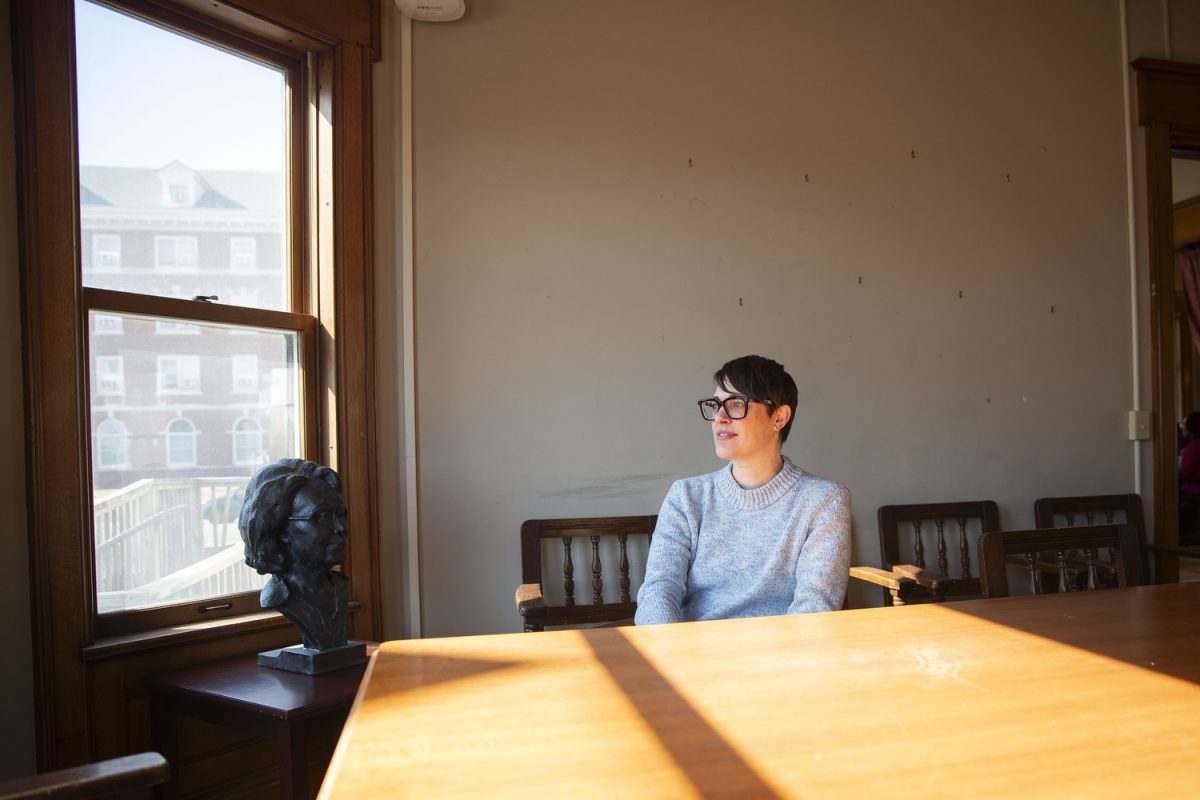
On the second floor of Shambaugh House, down the echoing wooden hallways of the historic Iowa City building, rests a large desk covered in books from around the world and across genres. Sunlight shines through the office’s blinds and casts a glowing beam of light onto the busy workspace of Cate Dicharry, the new director of Iowa’s International Writing Program, or IWP.
Despite a year of faculty transitions and political decisions influencing the program’s financial situation, Dicharry is hopeful for a bright future.
Since 1967, the program has been hosting writers from around the world during its 11-week fall residency to interact with the literary community. On. Feb. 26, 2025, the IWP’s grant agreement with the U.S. Department of State was terminated, resulting in a loss of nearly $1 million in federal funding per year. A few months later, Christopher Merrill announced his retirement from the program he had run for 25 years.
In the face of recent challenges, however, Dicharry is adamant that the IWP will continue to operate as it always has, with more emphasis on the community and university allies around it.
“I’ve been here for a long time. This place has my heart and soul,” she said. “This is one of those places where you get very invested in what we’re trying to accomplish.”
Dicharry has been involved in the IWP’s mission for cultural advocacy since joining the program in 2016 as the leader of youth programs and later developing grant-funded initiatives to bring visiting residency writers together across geopolitical, religious, and cultural divides. Bridging those gaps is still important even today, Dicharry said.
“There’s a lot of conflict, there’s a lot of division in the world,” she said. “We say we’re about cross-cultural exchange and mutual understanding, so the question becomes: What does successful mutual understanding look like right now?”

After a brief period leading writing and humanities programs at the Carver College of Medicine, Dicharry, author of “The Fine Art of F— Up” returned as associate director of the IWP right after the program learned of its defunding.
Despite the financial setback, Dicharry said she remains positive because without the priorities of the State Department to consider, the program has far more freedom in who to admit and where to focus program initiatives.
“There’s a way in which now we have an opportunity to do anything we want,” Dicharry said. “We can dream big. We can totally reinvent what we’re doing.”
Options have been presented to align more closely with other departments at the university, including those Dicharry said she has worked with in past roles to engage international writers. Engaging with community partners, like Porch Light Literary Arts Center, is also a way Dicharry plans to keep the IWP on track.
“We’ve been talking with Cate about programming things the writers will like,” Jennifer Colville, director of Porch Light, said. Porch Light is a local space for writers to collaborate through writing events, classes, and readings. “‘The Lights On Salon’ series has been going for a few years and brings writers together, but we’re excited to see how it can grow.”
Deeper integration into community life is at the center of the IWP’s future, but any attempt to understand this crucial moment in the program’s life cannot be made without an understanding of the institution’s storied past.
Merrill, in his decades of leadership, once faced an intersection point, too. Throughout his tenure, he acted as poet, teacher, advocate, and intitutional architect and faced political and cultural challenges on a similar scale to those present in 2026.
The security of the IWP has ebbed and flowed in the half-century since its opening, as has Merrill’s life. But the ethos behind it has always kept it steady.

Merrill’s early life
When Merrill was about 12 or 13 years old, he attended his usual hometown Fourth of July parade in Brookside, New Jersey, where he grew up. A town of roughly 1,800 people, Brookside’s parade usually consisted of firemen waving from firetrucks and candy being thrown from flatbeds. But that year, six young people dressed all in black appeared at the end of the town’s main road and marched just behind the procession.
They carried a coffin silently, without pomp or circumstance, a mile down the road to the town center. Merrill was too young to understand the significance, but the Vietnam War was at its height and protests were seen as an intrusion rather than a welcome dissent.
Once the protesters reached the town center, Merrill’s baseball coach grabbed one of them and slammed him into a batting cage. Emotions were high in Brookside — the coach’s nephew had been killed in Vietnam two weeks earlier.
Decades after the parade, Merrill would write a poem about what he saw that day: the coffin, the silence, and the sudden violence. It would eventually be published in his first poetry collection, but when he read a version of it at the Bread Loaf Writers’ Conference at Middlebury College in Vermont, where Merrill got his bachelor’s degree, he was approached by Stephen Kramer, who revealed he was one of the protesters.
Kramer was a fellow poet and grew up in Brookside, too. The connections to Brookside throughout Merrill’s life don’t stop there.
Thomas Gustafson, whom Merrill called “Tim” when they were neighbors growing up, became a famous writer and professor at the University of Southern California. “American Pastoral,” Philip Roth’s canonical work of fiction, Merrill said, features an image of Brookside’s post office on the cover.
“It’s very strange. These moments are just kismet,” Merrill said.
These convergent moments, where history seems to loop in on itself, have recurred in Merrill’s life both personally and professionally.
Now 68, Merrill is living in Santa Fe, New Mexico, where he and his wife lived decades earlier before his storied career had fully taken shape. Recently retired after over two decades as director of the IWP, he discusses his move to Santa Fe unsentimentally.
It wasn’t a decision rooted in symbolism nor was it a lifelong plan. The decision was instead made based on housing availability, the presence of old friends, and the familiarity of the environment.
“It’s a physically incredibly beautiful place, especially so if you like mountains and desert,” Merrill said. “There is a rich mix of cultures, too, as it is about a third Hispanic, a third Native American, and a third white.”
New Mexico is also a place shaped by layers of historical convergence and cycles, following a similar pattern to Merrill’s story. Just as his retirement offered the institution of the IWP to reflect on where it will go in the future, Merrill has had time to look at how far he has come after feeling the sting of the State Department’s funding cut.
Growing up in Brookside, his ambitions were twofold. Merrill wanted to become a professional soccer player and write poetry. Despite the literary history that would eventually blossom from his community, at the time, the environment around him wasn’t overtly literary. His father, a banker, met Merrill’s dreams with skepticism.
Soccer came before writing, and he found some success in the sport, as playing it throughout adolescence eventually got him a full ride to Middlebury College.
“I was a passionate player and a good technical player, but my body broke down a lot,” Merrill said.
When his time on the pitch at Middlebury had elapsed, he pursued a Master of Arts in creative writing from the University of Washington. In Seattle, he met his wife, Lisa Gowdy-Merrill, a classical violinist who would travel with him in an era of a life defined by relocating.
After writing his first major poem, “A Boy Juggling a Soccer Ball,” his former college coach offered him a position coaching the B-team at Middlebury. He accepted the offer and took the post for a time before deciding once and for all that writing was what he was meant to be doing.
Alongside Gowdy-Merrill, he traveled between Vermont, Washington, Louisiana, and Oregon. For a time, he edited “Quarterly West,” a literary journal based at the University of Utah, while freelancing for newspapers to make ends meet.
Meanwhile, Gowdy-Merrill was playing with orchestras and chamber groups, which ultimately led the couple to Santa Fe for the first time, where she played for the Santa Fe Opera. The pair were finding success in their respective arts while traveling, but another momentous shift was about to enter Merrill’s life.
While on a reading tour for his first book, “Workbook,” Merrill met Aleš Debeljak, a Slovenian poet. They got along instantly, and Debeljak invited Merrill to hike across the mountains of Slovenia together. He agreed.

Writing at the core of everything he did, Merrill turned the trip into an assignment for “Sierra” magazine, pitching a story about two poets walking the landscape after the Cold War. By the time the duo arrived in 1991, though, the war in Yugoslavia had begun.
In the middle of their three-day hike, they came across a hut they thought they’d stay in for the night but instead found it full of war refugees from Bosnia.
“My friend said he didn’t have the heart to ask them questions, but I did. I thought, ‘This is a story I can tell,’” Merrill said. “I spent six weeks in Slovenia before I returned and told my editor, ‘OK, this probably isn’t going to be what you thought.’”
The story went out anyway, and it hooked Merrill on writing. He returned to Slovenia for three months a second time and pitched a book on the war when he returned. Then a second book idea came up, and with it, more months of reporting from the Balkans.
“My friend said he didn’t have the heart to ask them questions, but I did. I thought, ‘This is a story I can tell.’”
Christopher Merrill
This continued reporting resulted in his first two prose books, “Only the Nails Remain” and “The Old Bridge.” He found his instincts as a poet, witness, and listener lent nicely to nonfiction journalistic writing.
Once the war wound down, he took a position at the College of the Holy Cross in Massachusetts.
It was an ideal job, Merrill said. He taught two classes a semester, wasn’t on any committees, didn’t go to any meetings, and had plenty of time to write.
“It was a sort of prestigious job, and I was negotiating my long-term stay when I got this call from Connie Brothers, the long-time administrator at the IWP in Iowa, in 2000,” Merrill said. “I told my wife I had this weird call from Iowa, of all places and thought maybe they want me for a reading. But they wanted me to apply for the job.”
By the late 1990s, the IWP was in a crisis after years of mismanagement.
It was on the brink of academic receivership, when a university’s administration takes control of a department.
Merrill hesitated. The family finally had a sense of comfort after the period of traveling and work, and the Holy Cross job offered stability.
Still, Merrill found the offer compelling, finding the challenge of rebuilding the program interesting.
“My wife said at some point, ‘You know, if you don’t take it, you might spend the rest of your life wondering whether you should have taken it,’” Merrill said. “I think that was probably true.”

Merrill in Iowa
In August 2000, Merrill arrived in Iowa City with his wife, a daughter, and another on the way. Despite not thinking he would be traveling much after moving to Iowa, the job required frequent trips.
“Those first few years were just miserable,” Merrill said. “I just felt like I was putting out fires everywhere I turned.”
Thanks to the support of former U.S. Rep. Jim Leach, R-Iowa, and then-UI Vice President for Research David Skorton, Merrill felt supported. The program stabilized, with annual fall residencies up and running successfully. This also strengthened the IWP’s relationship to the U.S. Department of State’s Bureau of Educational and Cultural Affairs, where it received a majority of its funding.
This bond resulted in new programming under Merrill, including summer writing programs, international conferences, digital projects, and advancements in cultural diplomacy.
“I had argued that we think about cultural diplomacy as a two-way street, not just bringing scholars and writers and artists and the like to the U.S. via programs like the IWP or Fulbright or what have you, but thinking of it as a two-way operation so that we are listening as much as we are giving,” Merrill said.
Cultural diplomacy was always at the forefront of the IWP’s philosophy during his directorship, and it remains so under Dicharry, who experienced Merrill’s passion firsthand in their years working together. His commitment to finding new ways to connect Iowa City to the world was visible even from other departments in the university.
“I always knew Merrill as the resident cultural entrepreneur of the university,” Loren Glass, chair of the UI Department of English, said. “He’s highly motivated and restless, but I choose that word because of the way he got institutions started, money raised, and connected people. He’s a mover and shaker in the sense that he always got writers connected with the community and the rest of the world.”
Glass has known Merrill since 2004, when Glass was hired at the university and the IWP was already well underway in its transition period. Despite not working together frequently, Glass’ path occasionally crossed that of Merrill’s, and he’s even interviewed the former IWP director for the Los Angeles Review of Books in the past.
In Merrill’s time at the IWP, the program held events in Fez, Morocco; Paros, Greece; and Konya, Turkey, bringing together writers from the U.S., Iran, Afghanistan, Syria, and Pakistan. The IWP had hosted more than 600 writers from 160 countries, and three alumni would win Nobel Prizes for Literature.
“I think of him as a poet, in the classical postmodern sense, in that he has a quasi-religious devotion to poetry in the world. I remember him saying poetry and prayer are similar practices,” Glass said.
He reached for a low stack on the wall-sized bookshelf that lines his office and plucked out Merrill’s autobiography, ‘Self-Portrait with Dogwood,” identifying the dogwood plant on the cover.
“He engages with poetry as nature, as a connection to our world. I often think about him in terms of cultivation and mysticism,” Glass said.
Merrill’s work to recognize the poetry of the environment and bring people together brought him goodwill with the State Department and laid the groundwork for Iowa City’s designation as a UNESCO City of Literature in 2008.
But still, in February 2025, Merrill received a brief email from U.S. Secretary of State Marco Rubio stating the program no longer aligned with national interests, and all grants were terminated. This marked the end of a nearly 60-year partnership with the IWP. Merrill’s previously negotiated retirement would go into effect late in the year.
“They didn’t care about the Nobel Prizes,” Merrill said. “They asked why there weren’t any Americans on the list.” The untying from the federal government was more than financial; it also delegitimized the IWP to important international networks where the program had previously visited.
“It’s part of a larger isolation,” Merrill said. “And the world is moving on without the U.S.”
Merrill had already begun negotiating his retirement before the news hit. So when the final residency closed, he got in his car and drove to Santa Fe.


The future of the IWP
Even without funding, the strength of the organization’s programming in the last several decades has turned it into a staple of the community, according to Colville, Porch Light’s director.
“It’s a very centering place,” Colville said. “As a destination for writers and for the literary community here, the IWP is very centering.”
Dicharry worked with Merrill for close to a decade, and the mindset he carried to constantly foster connection is still ingrained in the organization; it is simply going to adapt to the new cultural and political needs of the time, Dicharry said.
“There’s a lot of division in the world, and we say we’re about cross-cultural exchange and mutual understanding,” Dicharry said. “So we’ve had a lot of conversations since I’ve been in the directorship, about what successful mutual understanding looks like right now.”
While the conversations regarding the mission of the IWP continue to evolve from the inside, the impact the institution has made on the community is palpable.
“I think [Merrill] turned us into an international literary capital,” Glass said. “Iowa City has become a sort of pit stop and cultural capital. As Chris once said, we punch way above our weight. I think the IWP has powerfully contributed to the cosmopolitan culture and the diverse demographics of Iowa City.”