


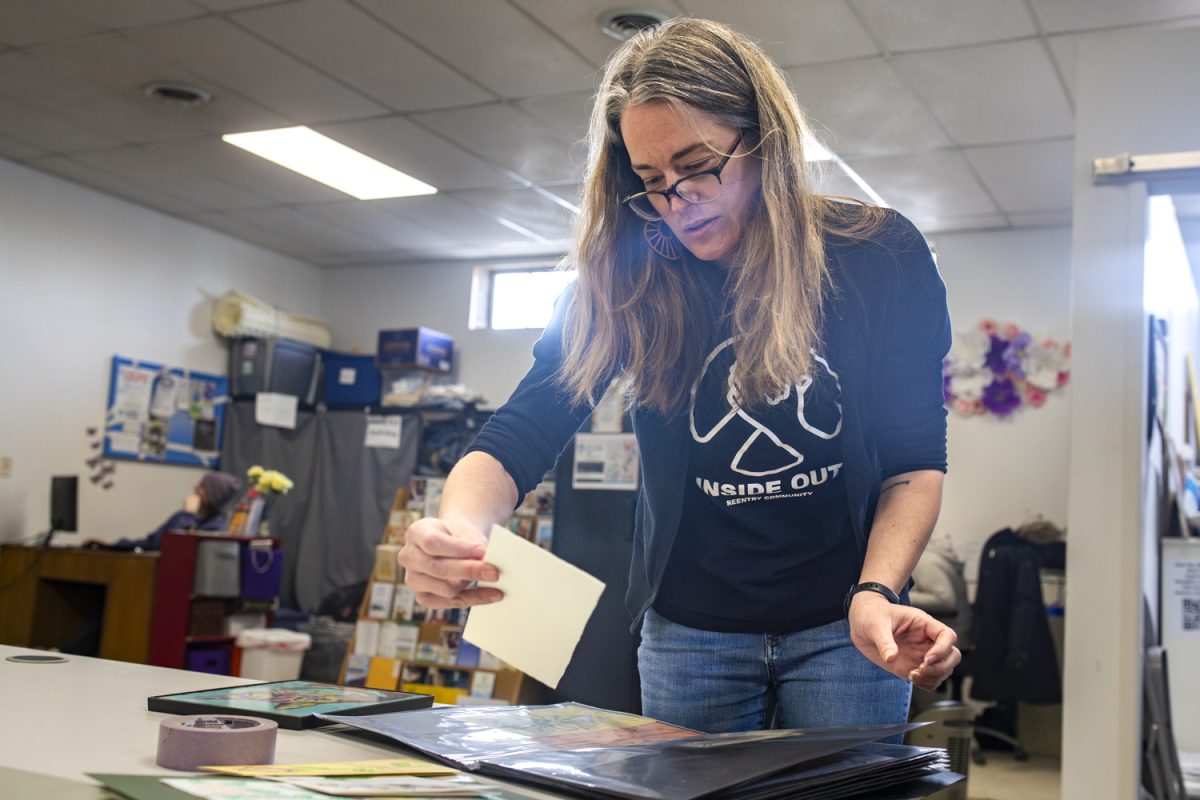
Inside Iowa City’s Public Space One, the annual “Art from the Inside Out” exhibition fills the gallery with paintings, drawings, and poems.
Organized by the nonprofit organization Inside Out Reentry Community, the show features the creative work of incarcerated and formerly incarcerated people as expressions of humanity beyond a prison sentence.
Among the contributors is artist Reggie Grandstaff, whose writing explores love, regret, and personal change. He had three poems on display. “Your Love I Feel” centers on devotion and emotional connection. Another poem, “The anger in our Pain,” turns inward, examining responsibility and the consequences of one’s actions.
His poem “Forty” traces a life shaped by time and consequence. It reflects on aging behind bars, fatherhood at a distance, and the fragile work of rebuilding. The poem closes on a powerful note: “love doesn’t always get to stand in the light. / But it stands anyway.”
Grandstaff said his three children are his inspiration. They influence both his subject matter and his drive to keep writing.
“Sometimes I think of a line, and I need to write it down,” Grandstaff said.
He described how poems often begin with a fleeting thought he feels compelled to capture. All poems are presented simply as typed pages, encouraging viewers to slow down and read closely. The format mirrors the writing’s introspective yet
simple nature.
Michelle Heinz, executive director of Inside Out, said the exhibition is a way to share the creative work she and others were already seeing from people in the legal system.
“We’re seeing all this incredible art, and we really wanted to just get it out to the community,” Heinz said. “Art is really unifying. Everybody loves art. It’s such a great form of self-expression.”
Many participating artists cannot attend the show in person, so Inside Out invites visitors to write feedback notes. Those notes are mailed to the artists.
“Even though they can’t be there to see their art on display, they can still hear what the attendees felt about their artwork,” Heinz said.
The logistics can be complicated. Heinz said communication often happens through letters and mailed artwork rather than face-to-face interaction, which can slow coordination. Still, the show continues to grow each year, with new artists submitting work after hearing about it from others. For many participants, it is their first time sharing art publicly.
“It’s very empowering to know, hey, your art is beautiful and can be in a show,” Heinz said.
The exhibition spans many media and stories. One piece features a peaceful landscape by Selvyn Tillett, inspired by mountain ranges he admired growing up in Belize. The painting displays his love for landscapes.
In his artist statement, Tillett describes discovering painting while incarcerated after watching Bob Ross and experimenting with acrylics. His work adds to the show’s broader themes of personal growth.
The pieces in “Art From the Inside Out” do not ask viewers for sympathy or praise. Instead, they offer glimpses into reflection and hope. Grandstaff’s poems sit comfortably within that space — not as declarations, but as honest moments on paper.
The result is a gallery that feels less like a showcase and more like a conversation about humanity, creativity, and second chances.