


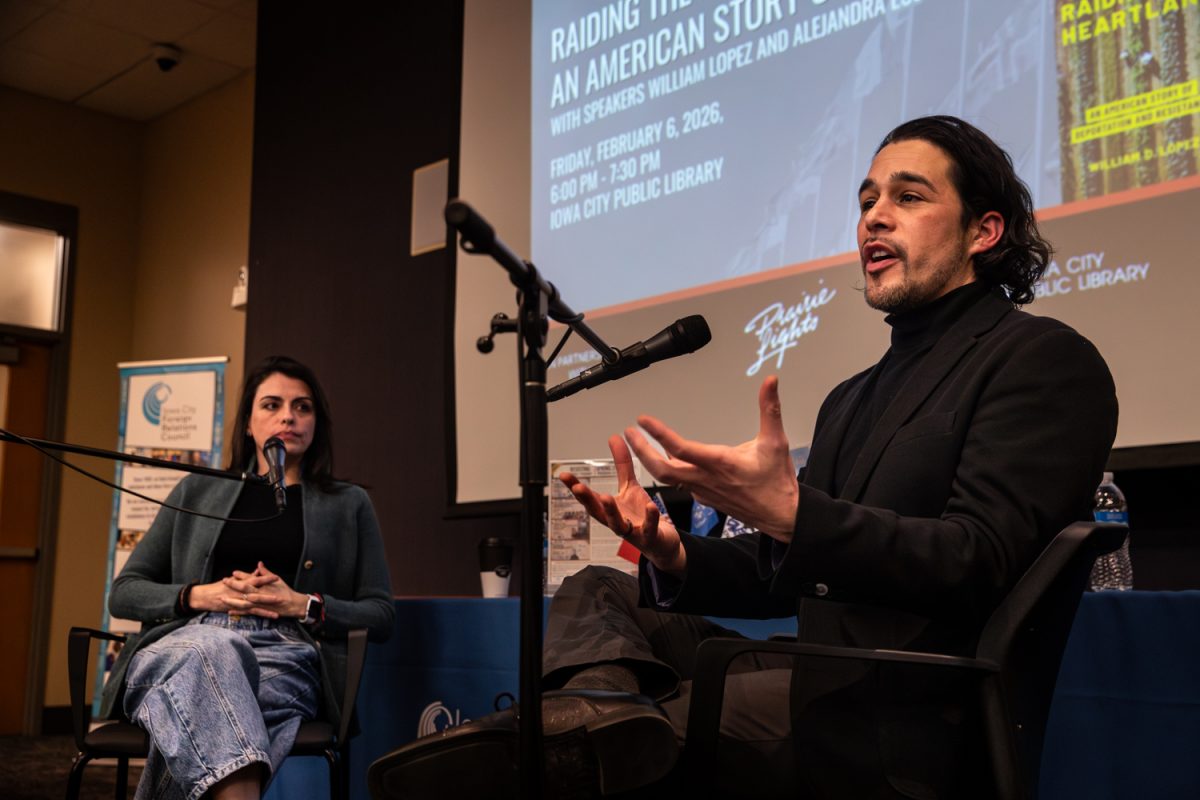
Groups like Escucha Mi Voz have been active in the Iowa City and Cedar Rapids areas protesting the presence and actions of the U.S. Immigration and Customs Enforcement, or ICE, in the Midwest, organizing “know your rights” trainings and accompanying people to their check-in appointments in response to an increase in detainments at ICE check-in appointments. Escucha Mi Voz’s lead organizer Alejandra Escobar joined author William D. Lopez to discuss his new book, “Raiding the Heartland: An American Story of Deportation and Resistance” on Feb. 6.
The conversation was part of the Iowa City Foreign Relations Council’s spring 2026 program series, Resisting Global Tyranny, and drew in a crowd of over 100 people with some in the crowd having traveled from as far as West Branch and Muscatine to attend.
The Resisting Global Tyranny program series, which brings together scholars, students, and community leaders in conversation, explores how people resist authoritarianism and challenge structural injustices through panels and film screenings, with all events free and open to the public.
Lopez is a clinical associate professor at the University of Michigan School of Public Health. His new book continues from where his award winning first book, “Separated: Family and Community in the Aftermath of an Immigration Raid,” left off and brings readers into the small and rural communities have been targeted by large-scale worksite raids during President Donald Trump’s tenure. It explores the effects these worksite raids have on the health and well-being of the communities affected as well as how these communities respond to the attacks.
“I wanted to look at raids because they’re so catastrophic in communities that they bring to light the violence that is occurring every single day, just on a different scale,” Lopez said.
“Raiding the Heartland” includes intimate interviews with the families and communities of those who were detained after large-scale raids, like the 2008 raid at Agriprocessors meat packing plant in Postville, Iowa, where 389 workers, 20 percent of Postville’s population, were arrested as a part of Operation Endgame under the Bush administration, which had the goal of deporting 11 million undocumented people by 2012.
The book examines the effects of detainment, deportation, and large-scale immigration raids from a public health perspective, with an emphasis on the effect on small, rural towns, 80 percent of whom, the Institute for Health Care Management estimates, are medically underserved and face barriers to accessible health care.
The institute also cites distance from health care services as another barrier that rural communities face, a barrier that, Lopez said, becomes further complicated for immigrant families who may stop utilizing social services and medical resources they’re entitled to out of fear of being pulled over while driving and detained, something often referred to as the chilling effect. A recent Supreme Court ruling has made it legal for ICE to do just this and profile individuals on the basis of race and language, increasing this fear and causing many to avoid going out or sending their children to school.
“Having people around helps you stay healthy. They help you when you’re down, they lend you a car, they take care of your kids,” Lopez said. “When this community network gets fractured by fear of ICE, people lose those social support systems.”
While these worksite raids have been taking place for decades, during Trump’s second presidency there has been a shift to having U.S. Border Patrol and ICE agents occupying a city and organizing house raids, like the widely publicized immigration raid that took place in Chicago’s South Shore neighborhood. Lopez said that he believes the purpose of these raids is to create a spectacle and to incite chaos that allows law enforcement to respond with more violence and military action.
“I think they’re using tactics that they tested on Black communities, especially during the War on Drugs, and what many would characterize as breaking and entering, but others would characterize as home raids,” Lopez said. “Now we’re seeing them at large scale in immigration enforcement.”
In “Raiding the Heartland”, Lopez characterizes deportation in the Midwest as “quiet, then violating, and climactic, traumatizing, then utterly, bitterly, lonely and cold.”
“They’re quiet, and it’s dangerous because it makes the community believe that it’s not happening. It makes selected officials not stand up for what’s right,” Escobar said as she spoke to Lopez Friday evening. “It’s quiet, and it’s painful in that silence.”
The effects of these large-scale raids could be seen in the quietness left in their wake: workplaces left empty without employees, churches without their congregation, and classrooms missing half of their students.
“After immigrant families themselves, our nation’s educators were the ones who absolutely experienced the brunt mass of deportations,” Lopez said. “I say that because every time a deportation happens in the school year between the hours of 8 and 5, it’s going to be the teachers that have to explain to those students what happened to their parents.”
These teachers, Lopez said, are often the ones who also have to figure out how to get children home safely when a parent or guardian might not feel safe enough to pick their child up from school following a raid, or who may have been detained and are physically unable to pick up their child.
The book also addressed the issue of a drop in attendance among Latino students following an immigration raid.
Jorge Guerra, an assistant professor of instruction in Latina/o/x Studies at the University of Iowa, remembered attending protests in Mount Pleasant, Iowa, where 32 workers were detained at the Midwest Precast Concrete Facility. In the day following the immigration raid, around 90 children were reported to have not attended school.
“We’re talking about Mount Pleasant and Postville, these communities are very small,” Guerra said. “In so many ways, I feel like you have no other choice but to be supportive because these are the people who are part of your everyday lives in small town or rural Iowa.”
Guerra teaches courses in Introduction to Latina/o/x Studies and covers topics such as immigration in Iowa and the Postville Raid. While these can be sensitive subjects, Guerra said that he believes it’s still an important part of history to teach, especially since many in his class don’t seem to know this part of history.
“I do find it to be a duty for me to expose these stories and histories so that students can have a better understanding of who they are as Iowans, who they are as Midwesterners, and how they’re supposed to see and understand immigration,” Guerra said. “People still think about Border Patrol and immigration with the U.S.-Mexico Border. People don’t think about it in the context of how, to use the phrase of an article I teach, ‘the border is everywhere now.’”
As many as 2,000 federal agents were deployed in Minneapolis earlier this year in response to allegations about fraud involving Somali residents in the city, according to the Associated Press.
People across race and citizenship status rushed to the street to protest the presence of ICE, something that Lopez said he believed is the key to combating the effects of hypervisibility, which could cause many immigrants and Latinos in the Midwest to feel unsafe protesting visibly.
“Like we’re seeing in Minneapolis and like what I saw in ‘Raiding the Heartland’, the answer is these cross-race and cross-citizenship solidarity, movements based in solidarity,” Lopez said. “To acknowledge what happened to Renee Good and Alex Pretti, certainly they’re not absolved from bodily violence.”
Lopez attributed this to there being no attempts to hold ICE agents accountable, horrible hiring practices, and an administration that excuses and encourages the violent actions of ICE, such as a recent memo leaked to the Associated Press that authorized ICE to enter homes without a judicial warrant.
However, just as Lopez observed in “Raiding the Heartland,” communities respond to community harm, including religious groups and faith-based organizations, like Escucha Mi Voz, who hosted a “know your rights” training” at St. Paul’s United Methodist Church which drew in an estimated 600 people on Jan. 31.
“It’s impossible to maintain this energy if we don’t do another part of it,” Escobar said Friday evening. “It’s a big effort. It’s rallying, it’s going to ICE to accompany people, it’s going to training, but also it’s taking care of each other, it’s loving each other, it’s connecting with each other.”
This is precisely what Reverend Jonathan Heifner of St. Paul’s United Methodist Church observed at the “know your right’s training” as he saw what he believed to be a method of combating hypervisibility: providing a safe space and support for people to make themselves visible.
“They put themselves at an incredible level of potential risk by telling their stories, but the important piece of what that was they were given the option and it was made clear what this was, what they were stepping into, and they were clear on what the risk could potentially be,” Heifner said. “What I think was a piece of making that possible was the kind of network that Escucha Mi Voz provided so that they could be visible in a place where they knew they had support and camaraderie.”
As the conversation closed Friday evening, Escobar reminded attendees of the importance of voting in local elections, where voters can apply more pressure and demand accountability in response to frustrations over representatives in the House and Senate voting to continue funding the Department of Homeland Security.
“Power is our capacity to act together in order to make a change, that’s what we’re seeing in Minneapolis,” Escobar said Friday evening. “From our community here in Iowa City, we need to connect. We need to organize and really think of what’s going on in the country and what we can do to change this.”