

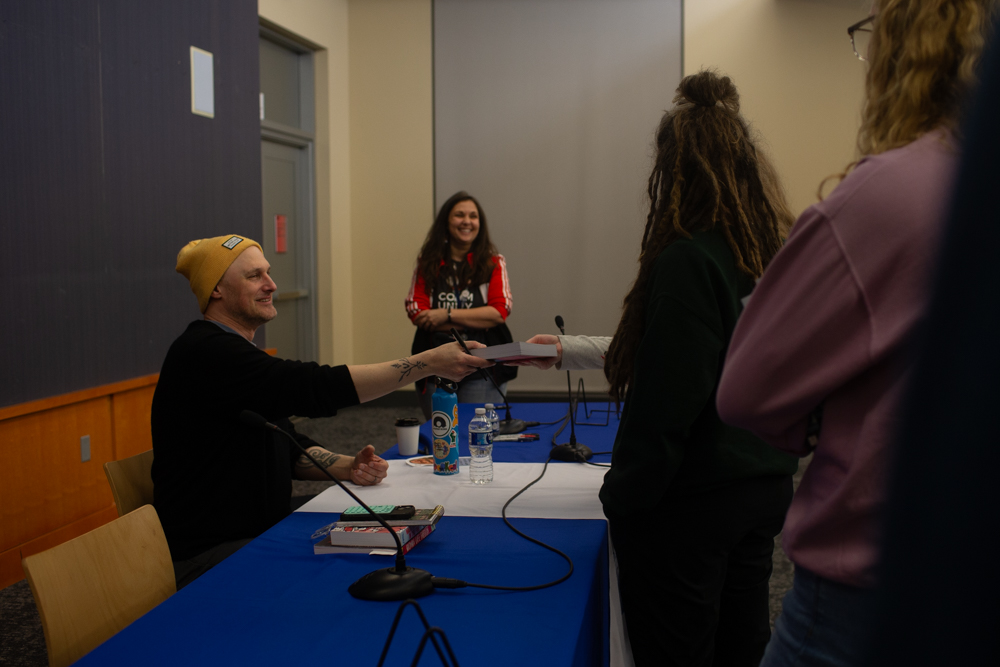
Jarrett Dapier is an author, librarian, and drummer. His new graphic novel, “Wake Now In The Fire,” was published on Feb. 3, and is centered around the Chicago Public Schools District’s decision to ban Marjane Satrapi’s “Persepolis” from classrooms and libraries and the response to the enforcement. Dapier helped to uncover how the ban occurred.
This interview has been edited for length and clarity.
The Daily Iowan: What would you say to young writers who want to speak up about current events?
Jarrett Dapier: Telling your story is a political act. Expressing yourself and exercising your freedom of speech is a political act and demands to be taken seriously. If you’re writing truthfully and honestly about who you are and what you’ve experienced, being a conscious person in the world, I think that itself does an enormous amount of good and should never be underestimated. Putting out creative work itself is vitally important, especially in a struggling democracy.
Were you into writing comic books before the Chicago Public Schools decision?
I took it seriously starting in high school, when I took creative writing classes with amazing teachers who recommended writers. One of those authors was Kurt Vonnegut, who was recommended by a friend, actually.
I also took it seriously in college, where I studied at the University of Illinois. I always continued to write throughout my 20s, whether it was for publication or not — so, journals on my computer, journals in my notebooks, starts of picture books, and starts of middle-grade novels. I also loved writing scripts. Working in teen services at a public library, I started a program adapting young adult novels to the stage.
I’ve now adapted three or four different books. Similar to how the action takes place under the lights, in a graphic novel, the action takes place in illustrations. But you provide the context and the conflict through dialogue and action.
Do you think the situation on book bans has improved or gotten worse since the experience you’re writing about?
It has definitely gotten worse. It has become an inferno that has taken hold of a lot of communities, including both suburbs and cities. This story was originally an outlier. There were only a few instances, at least in the research I could find, where a whole school system ordered the removal of a book from every school. The Chicago Public School system is over 500 schools, and it blew up in their faces, thankfully. There were a lot of ways the books were protected — they could not unilaterally remove the books from the libraries the way they desired to.
I often spoke with librarians and other faculty about this case study, and I’ve learned about it as an extreme example, but unfortunately it’s now been nationalized. So, you’re seeing hundreds of titles challenged at one time by people who haven’t read the books, and you’re seeing school and library boards receptive to this wholesale removal of literature from kids, teens, and adults. It’s bad everywhere, and it’s almost like a pathogen caught by… people who want to control what we read, write, say, and think — who we can be. So, it’s astronomically worse.
Did you enjoy “Persepolis?”
Oh, yeah. The entire reason for diving into the research and noticing the problems when the ruling came down in 2013 was that I loved the book so much. The fact that the book was being censored and targeted at that mass scale was very notable.
I just loved the way that it melds personal storytelling and personal experience with history-based storytelling, with the Islamic revolution of 1979, how it affected Iranian society, and how it affected the main character, who was raised as a free thinker and raised to question everything, including politics and religion, and how dangerous it became for her society to suddenly transform into a theocracy. So I think somebody in danger for their belief in free expression compelled me. I just fell in love with her character. Yeah, she’s a badass. It’s a very sad story, and it’s continued to stoke my attention and interest in Iranian history. Especially with what’s been going on over the last five years.