Art is everywhere in Iowa City, from printmaking to paintings; art galleries can be found on and off the college campus, featured in Iowa City’s Gallery Walks, or hiding in plain sight.
In this guide, we’re taking a tour of eight Iowa City galleries and hearing from some of their owners and operators. From a museum near campus or a gallery inside a hospital, we hope you learn more about the art Iowa City has to offer.
Arts Iowa City’s ArtiFactory
Established in 1975 under the name Arts Iowa City, it was originally designed to be used for classes and workshops, but it always had the goal of hosting a different artist each month. In its current location, ArtiFactory now operates as a gallery space and an educational space for classes.
Located on the Wesley Student Center’s lower level, viewers can learn about and view different artists’ work each month and chat with ArtiFactory volunteers or with Philip Beck, Arts Iowa City board’s co-president, who enjoys interacting with the community when they come to visit.
“I go and sit in the gallery, open it up usually twice a week,” he said. “When people come in, it’s just so nice to talk to them, and they are so appreciative and enjoy the artwork, and I really like that. I like that interaction.”
The current exhibit on display features oil paintings by artist Steven Erickson and will run through February.
The Art Mission
Established in 1999, this frame shop on Linn Street serves as a natural gallery for paintings and prints. Upon entering, viewers are greeted by artwork lining the walls, encased in owner Kathleen Rash’s frames.
Rash herself can be found behind the counter, where frames of every color are organized in neat columns on the wall, or in her workshop where she builds the frames. The art she displays in her frames include pieces by Iowa artists as well as her own art.
Describing herself as a working artist, Rash works as a trained weather spotter for the National Weather Service and takes pictures of storms. She later uses those pictures as inspiration for her paintings.
The works she displays include paintings by George Walker, Byron Burford, Hans Breder, Sylvia Schuster, and more. Rash got to know those artists doing framing work for them, and then displayed their work when she opened her business.
Within the first eight or nine years of opening, Rash had participated in 24 different Iowa City gallery walks.
One of Rash’s favorite parts of working with those artists was seeing them as human beings. As a fellow artist, she appreciated the mutual respect they had for each other.
“I became a good framer, partly because of their help, and they’d been dealing with other frame shops in the past, but once we started working together, we’d set a pattern, and they trusted me to do exactly what they wanted,” Rash said.
Iowa Artisans Gallery
Having operated in Iowa City for over 40 years, Iowa Artisans Gallery was established by 12 artists in 1984. The store is packed with art, featuring works by 200 artists across a variety of mediums, including wall art, jewelry, pottery, ceramics, glass, fiber, metal arts, and more.
Bethany Young, the gallery’s manager, took over in 2020, when the original owners retired, but had been working for the gallery for 23 years. Her favorite part of running the gallery was the relationships she formed with the artists, as well as the various art events throughout the year.
“I especially love hosting artists for exhibits and receptions, particularly for our ‘First Friday’ series each month,” Young wrote in an email to The Daily Iowan. “Iowa City Arts Fest is also a really fun weekend where we host artists, and they will do demonstrations of their craft for the community to observe.”
Stanley Museum of Art
Originally known as the University of Iowa Museum of Art, the Stanley Museum of Art has a long history in Iowa City. The museum was established in 1969 and has been in its current location since 2017.
Two bronze heads created by sculptor Robert Arneson sit on the grass in front of the modern glass building. Through the big glass doors, the colorful mural “One An Other” by artist Jiha Moon is displayed against a white wall for viewers to admire before taking the elevator up to the galleries and exhibitions on the second floor.
One current exhibit, titled “Weaving Narratives: African Textiles in Iowa,” consists of walls covered in beautiful, colorful textiles, representing different African cultures in Iowa.
A few of the textiles came from Elizabeth Stanley’s collection, part of the Stanleys’ donation of nearly 600 African art objects to the museum. The exhibit itself will be on display until April 29.
As viewers progress through the galleries, they can view all types of art in various mediums.
The museum’s current collections consist of modern art, contemporary art, ceramics, drawings, prints, photography, African, Oceanic, and Asian art, Indigenous Art of the Americas, and textiles.
Each room has new art to discover, and viewers can spend hours learning about all the art the Stanley has on display.
Public Space One
Facing the UI Health Care Medical Center Downtown is a white, two-story house.
That house is the Public Space One Northside gallery and is one of three historic houses under PS1’s operation.
Upon entering, viewers are invited to pick up info cards about the exhibit before entering the first room. Most exhibits in this Northside gallery fill two rooms, but it depends on the mediums and the artist’s wishes.
The exhibit on display is an interactive video installation titled “DEAD OR AMAZING,” so the first room is converted into a waiting room.
Both rooms have large windows that flood the space with light, and when art is displayed on the walls, the bright sunlight helps to amplify the colors.
Artist’s talks are held during their exhibit’s installation, and the large rooms can quickly become packed as visitors come in and listen.
The second room houses the video installation for the current exhibition. To create an immersive experience, blackout curtains cover the windows and doorways to prevent any light from entering the room.
For any interested visitors, the exhibit will be on display until Feb. 21.
Lasansky Corporation Gallery
A family-owned and operated business, the Lasansky Corporation Gallery has been in Iowa City since the early 1980s.
Upon entering, viewers can hang up their coats next to a 19th century steel printing press and browse a rotating selection of prints by artist Mauricio Lasansky.
Mauricio Lasansky died in 2012, but the gallery is operated by his grandson, artist Diego Lasansky, along with other family members.
The current selection of pieces span across Mauricio Lasansky’s career, from his black-and-white piece “Doma,” made in 1944 to colorful, complex pieces made in the 1990s. The style of printmaking Lasansky utilizes is called intaglio, where a drawing is etched on a copper plate and printed on paper with the help of a press.
For Diego Lasansky, his favorite part of running the gallery was being able to work with his family. He also enjoyed interacting with people who were interested in his family’s work, and he hoped that people would be able to learn more about printmaking and his grandfather’s work.
Education about printmaking and the artist was what he hoped viewers would take away from the gallery.
“Often when people come, education is a big part of it, whether they’re coming to research or they’re coming to collect,” Diego Lasansky said. “This form of education allows you to be a little more informed as you go to do something with it.”
University of Iowa Main Library Gallery
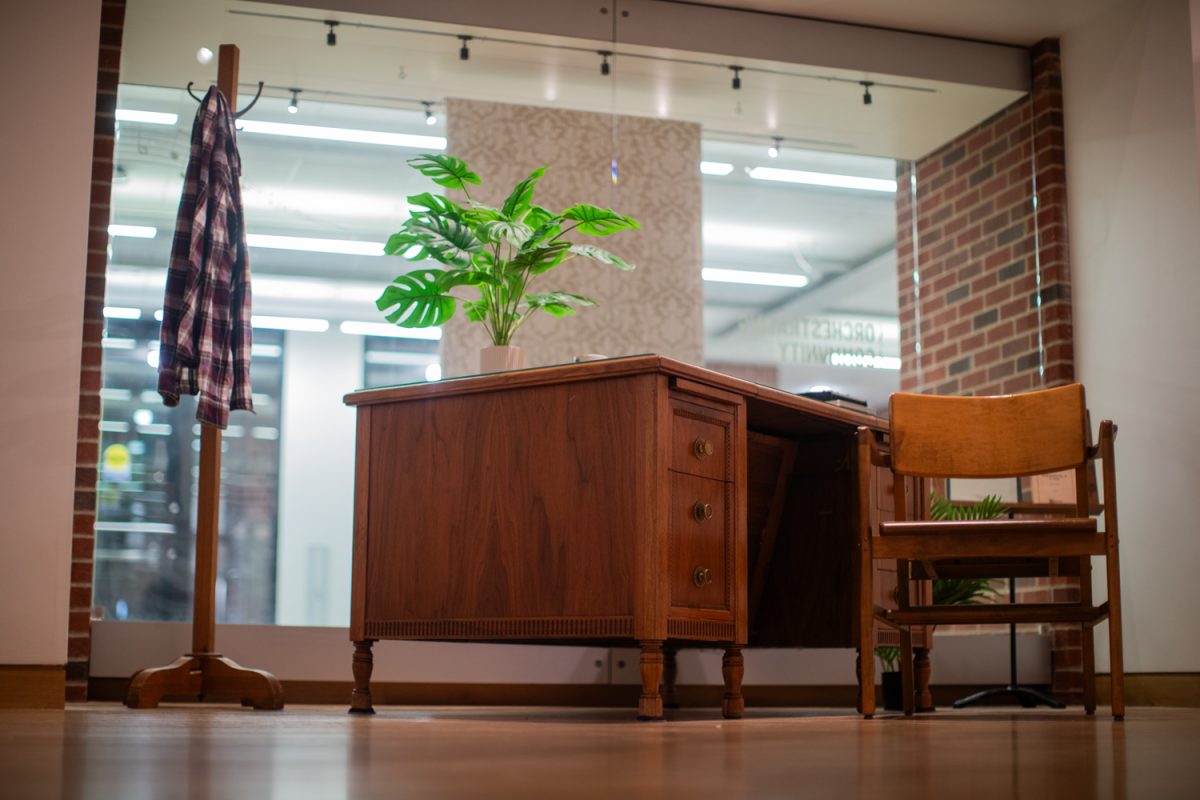
Located on the ground floor of the UI Main Library, the gallery space has been displaying exhibitions since 1951. It operates as a space for students, with classes being encouraged to visit.
A new exhibit is displayed each semester, ranging from topics such as historical figures on the UI campus to crafts.
Exhibits are curated by UI faculty members with the help of library gallery staff and can feature materials from the university’s archives and collections across campus.
Throughout the semester, curators will give talks or guided tours of their exhibits, which have been featured in various Iowa City Downtown District events over the years.
The current exhibit is “Orchestrating Community: The Public Service of Iowa Conductor James Dixon,” which will be displayed until June 26.
Project Art
A gallery in an unexpected place, Project Art is located in the UI Hospital and Clinics. Established in 1978, it was designed to be an art collection that improved patients’ experiences.
It has evolved to more of an art museum, consisting of 6,500 pieces of permanent art as well as temporary exhibitions.
While initially designed for patients, the public can also view the galleries with the help of an art pass, obtained with 48 hours notice to the Project Art team.
Anna Villareal, the collections coordinator, tracks and cares for the permanent collection, which involves use of a collections management database and collections care, and helps maintain the pieces.
She also oversees a temporary exhibit series called the Artist — Art and Art Illness Series, which showcases pieces of art with illness as the subject matter as well as artists who have dealt with illness.
Villareal described the current exhibit in the Art and Art Illness series, Rose-Lynn Fisher’s “The Topography of Tears,” which will be displayed through March.
Fisher, an artist based in Los Angeles, featured photomicrographs of her tears collected over eight years.
“It’s a unique space we can connect to health-related topics and touch patients or family members or caregivers who might be experiencing similar emotions,” Villareal said.
Nichole Wolz, the visual and performing arts coordinator for Project Act, oversees the rest of the temporary exhibitions, including their installation.
She said the exhibit program consists of five gallery spaces throughout the hospital that rotate every three months. Project Art produces about 18 temporary exhibitions a year.
Wolz, a printmaker herself, was particularly drawn to one piece in the permanent collection, a 2019 paper installation called “Confluence” by artist Amy Genser.
The piece is made of mulberry paper and is inspired by the aerial waterways of Iowa, Wolz said. Having worked in her position since September 2025, Wolz said that seeing that piece had made her want to work there.
Villareal said she and Wolz manage a lot of installation and de-installation, and that is one of her favorite parts of working at Project Art.
During that process, she gets to interact with staff, patients, and their families.
“We have favorites, everyone has favorites, but it’s so interesting to see how an individual might experience an artwork different from another person based on what they may be going through or what they needed from the artwork at the time,” Villareal said.