


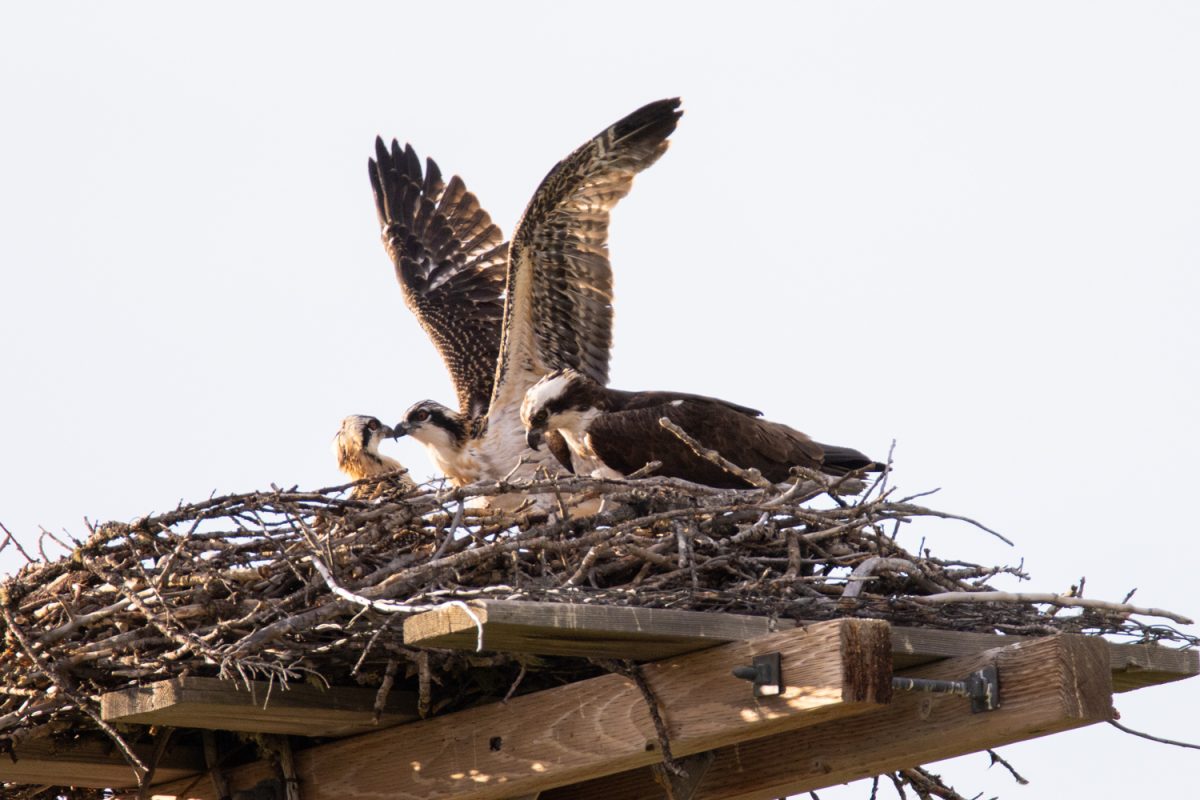
Conservation specialists in Johnson County are reflecting on a 2025 state record of identifying 70 osprey nests and at least 58 young osprey, a large fish-eating bird of prey commonly known as the “fish hawk.”
According to the Iowa Department of Natural Resources, an effort began to reintroduce the osprey species in 1997, with no successful osprey nests documented in the state since colonial times.
Of the documented nests, 30 were confirmed to produce young ospreys. In 2021, there were only 44 reported nests.
Osprey populations largely declined in North America in the 1950s due to the widespread use of DDT, a pesticide designed to repel insects.
The osprey restoration program transported young ospreys from Minnesota and Wisconsin to locations across Iowa such as the Coralville Reservoir and Saylorville Reservoir.
The last of the birds were released in 2016, and the department’s objective is to actively monitor nests to maintain a steady population, according to the DNR.
RELATED: Latest JoCo Conservation Bond projects underway
According to the Animal Diversity Web, an online scientific database run by the University of Michigan, ospreys are an indicator species, a species that reflects the environmental health of the area they are in, providing a valuable lens into Iowa’s natural land.
David Conrads, the director of the Iowa Raptor Project, a program within the University of Iowa College of Education dedicated to conserving birds of prey such as hawks and owls, said from the restoration program’s beginning, the university has been a collaborative partner with the department.
Conrads said the Iowa Raptor Project helped build and operate the Macbride Nature Recreation Area Hack Tower, a tall release structure that provided shelter and food, allowing birds to leave when they were ready for the wild. The department later used the tower in 1997 to release ospreys into the area.
“It’s great news to go from zero to that number in basically 28 years,” Conrads said. “It’s pretty remarkable.”
Conrads said other birds like the peregrine falcon and bald eagles declined throughout Iowa due to DDT. DDT was officially banned in the U.S. in 1972.
“What we are seeing post-DDT and post-establishment of the Endangered Species Act is that a number of these raptor populations have increased tremendously, and that’s good news,” Conrads said.
Riggs Wilson, a DNR wildlife research specialist who contributed to the report, said the record number of nests found is not only a result of an increasing osprey population but also better nest reporting by volunteer numbers within the department members.
The report says ospreys cluster in three main areas: the Iowa City to Waterloocorridor, the Des Moines metro area, and around Spirit Lake.
“The areas where we see these clusters of nests are areas that have plenty of water resources for foraging,” Wilson said. “Ospreys eat mostly fish, so if there’s a lot of water nearby, that’s going to be an area that is very favorable for them to nest in.”
Wilson said ospreys also tend to favor nesting in tall structures, making cellular towers prime candidates for the bird of prey.
Brad Freidhof, the Johnson County Conservation director, said he regularly sees an osprey nest on his drives past a cellular tower near the Costco in Coralville.
Freidhof said he believes climate change could be contributing to birds of prey populations increasing in northern states like Iowa.
“As temperatures warm further north, we see that population growth,” he said. “We’ve seen that with pelicans expanding northward in the state of Iowa and other wildlife species. So it’s a great opportunity. I hope people enjoy watching them because I surely do.”
Freidhof said Johnson County’s bodies of water make an attractive area for osprey.
“We’re doing a good job in the state of Iowa, looking for habitats to protect and restore for these populations,” he said. “We have great habitats here in Johnson County, with Coralville Lake and the Iowa River, Lake MacBride, and numerous other bodies of water that they can fish from.”
Freidhof said the Johnson County Conservation Board will continue to protect properties buffering rivers and streams because the rivers provide wildlife habitats and help recharge aquifers underneath the ground. Freidhof said a great deal of the projects funded by the 2024 Conservation Bond, a $30 million bond to fund natural resource projects, involve Johnson County protecting habitats along the county’s rivers.
“If we can build corridors along our interior rivers and streams, populations like ospreys hopefully will utilize and enjoy those habitats along those big cottonwood that they historically would have used,” Freidhof said.
Conrads said while 2025 was a historic year for ospreys, there is no guarantee the population will continue to climb.
“It can change overnight with things that we haven’t even dreamed of,” he said. “Is there going to be a new chemical that maybe the testing didn’t reveal that it was going to have a negative effect on populations? Is there going to be a naturally occurring disease to make a big negative impact like HPA? It’s hard to predict.”
Wilson said as the department continues to improve nest reporting, he hopes to see the osprey population continue to soar.
“It would be great to continue to see the osprey population do well in the state of Iowa,” he said. “It’s really good to see a successful restoration effort. That’s pretty neat to see everybody’s hard work come to that fruition.”