


Near the end of January, a winter storm ravaged the country, starting near the Rocky Mountains and moving to the Midwest and the South, then ending on the East Coast.
The storm has proven to be deadly, as according to the Associated Press, at least 85 people have died across multiple states, with approximately half coming from Tennessee, Mississippi, and Louisiana.
All three are red states led by governors who have previously expressed skepticism regarding climate change. Tennessee Gov. Bill Lee and Mississippi Gov. Tate Reeves have both questioned humans’ role in climate change. In Louisiana, Gov. Jeff Landry has labeled climate change as a “hoax” and wants the oil and gas industry to grow in Louisiana.
Iowa, which was one of the midwestern states affected by the storm, has also had a questionable track record with climate change as of late. In May 2025, the Iowa State Board of Education approved new K-12 science standards that don’t mention humans’ environmental impact on the planet, but do mention that Earth has experienced natural warming and cooling over time.
During the middle of the winter storm, on Jan. 27, the U.S. officially withdrew from the Paris Climate Agreement. This is the second time President Donald Trump has done this, as back in November 2020, the U.S. withdrew for the first time before rejoining under former President Joe Biden in 2021.
In the wake of this recent winter storm and the U.S.’ withdrawal from the Paris Climate Agreement, it is important to remember that climate change is real and needs to be a larger issue on the ballot.
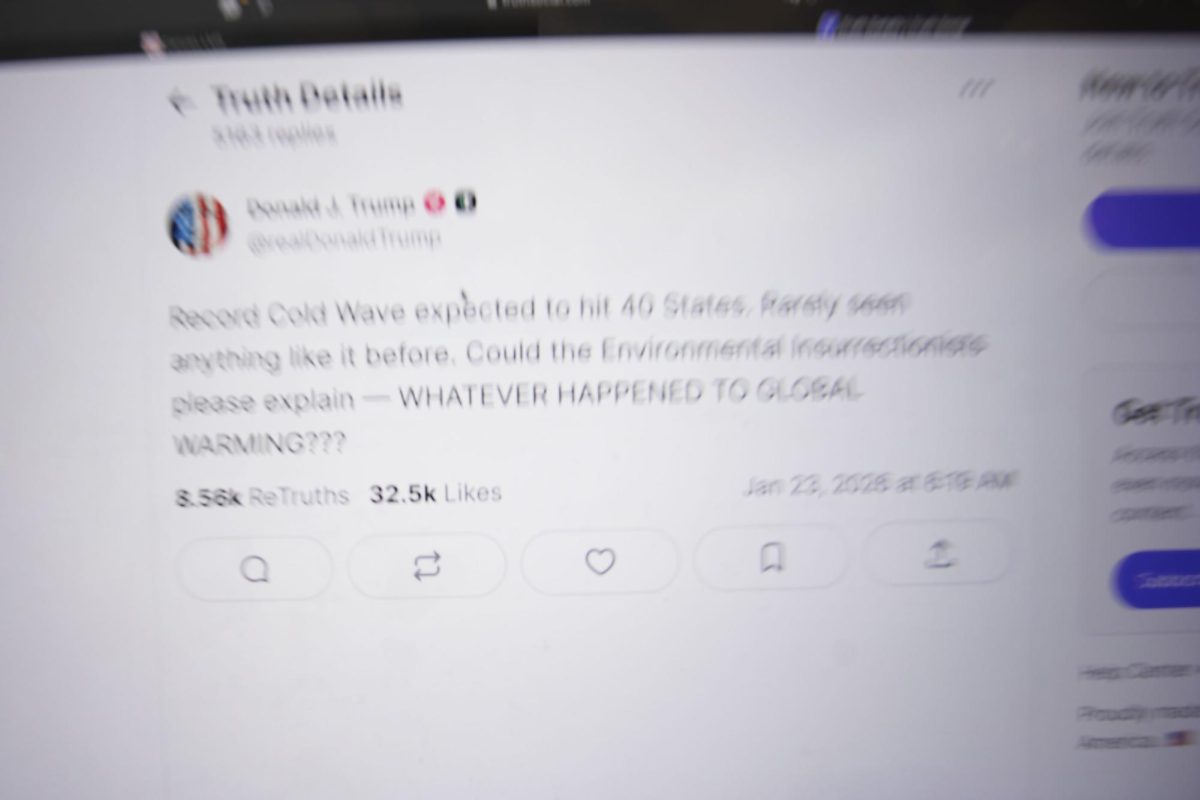
Ahead of the storm, Trump posted his disbelief in global warming on Truth Social.
The president wrote, “Rarely seen anything like it before. Could the Environmental Insurrectionists please explain – WHATEVER HAPPENED TO GLOBAL WARMING???”
This isn’t the first time he’s voiced his nonbelief in global warming as he has often called it and climate change a hoax. In fact, most of his environmental policies are built around the idea of climate change being a hoax.
It appears that the president, and presumably others, use the terms global warming and climate change interchangeably despite the two having different meanings.
According to National Geographic, global warming refers to the increase in Earth’s overall average temperature resulting from human activities that burn fossil fuels, creating a greenhouse effect. While climate change refers to changing weather patterns stemming from global warming.
UI Professor Kylah Hedding teaches a course on environmental communications designed to teach STEM majors how to properly relay information regarding the environment. She has also noticed the misuse of the terms via many forms of communication.
“I do wish people would be precise in the way that they’re talking about [the environment],” Hedding said. “Also contextualize what that means.”
This storm itself could be an example of climate change and stems from global warming, as the rising global temperature has potentially caused a split in the strong band of winds circling the North Pole, the polar vortex, causing that cold air to move south.
So while encouraging proper understanding of environmental issues would be a good place to start, as that is how misinformation and disinformation thrive, it won’t be the solution.
Hedding recognizes that when it comes to environmental technology and policy, for many lawmakers, it’s not about positively impacting the planet, but rather how it will financially affect the economy and lobbyists.
“Money is the big driver of everything in politics, sadly,” Hedding said.
During this past election cycle, the oil and gas industry spent over $219 million, according to the Yale Climate Connections, with the majority of which went toward Republican candidates. The fossil fuel industry has always been involved in politics, but since 1992, its contributions toward Republicans have quadrupled in value.
While U.S. politicians are too busy taking checks from the fossil fuel industry, Hedding points out that other countries are passing us in terms of environmental innovation and economic growth.
“We’re starting to lose out to China when it comes to renewable energy technology, ” Hedding said, “That’s because China recognizes that [renewables are] where all the money’s going to be in the next 10 to 20 years.”
So, as the U.S. moves backward by pushing a “drill, baby, drill” agenda that climate scientists warn against, what can be done to undo this damage?
The first major step is fighting for the climate to be one of the headlining issues on Americans’ ballots.
This will be easier said than done, though, as Hedding notes that while most people can generally support protecting the environment, it’s never been near the top in prominence of election issues.
According to data from the Pew Research Center, only 37 percent of registered voters said that climate change was a very important part of their vote in 2024. Adding to that, 62 percent of registered Harris supporters said it was very important compared to only 11 percent of Trump supporters.
Of the list of 10 issues Pew collected survey data on, climate change tied for last with racial and ethnic inequality. Both being tied for the bottom is extremely problematic.
Hedding believes that critical thinking from voters regarding climate research and the positive impacts of renewables will drive this up.
The reality is that the information on the positives or renewals and environmental innovation is all there, and people need to access it because there’s only one Earth, and eventually, there will be a point of no return.