


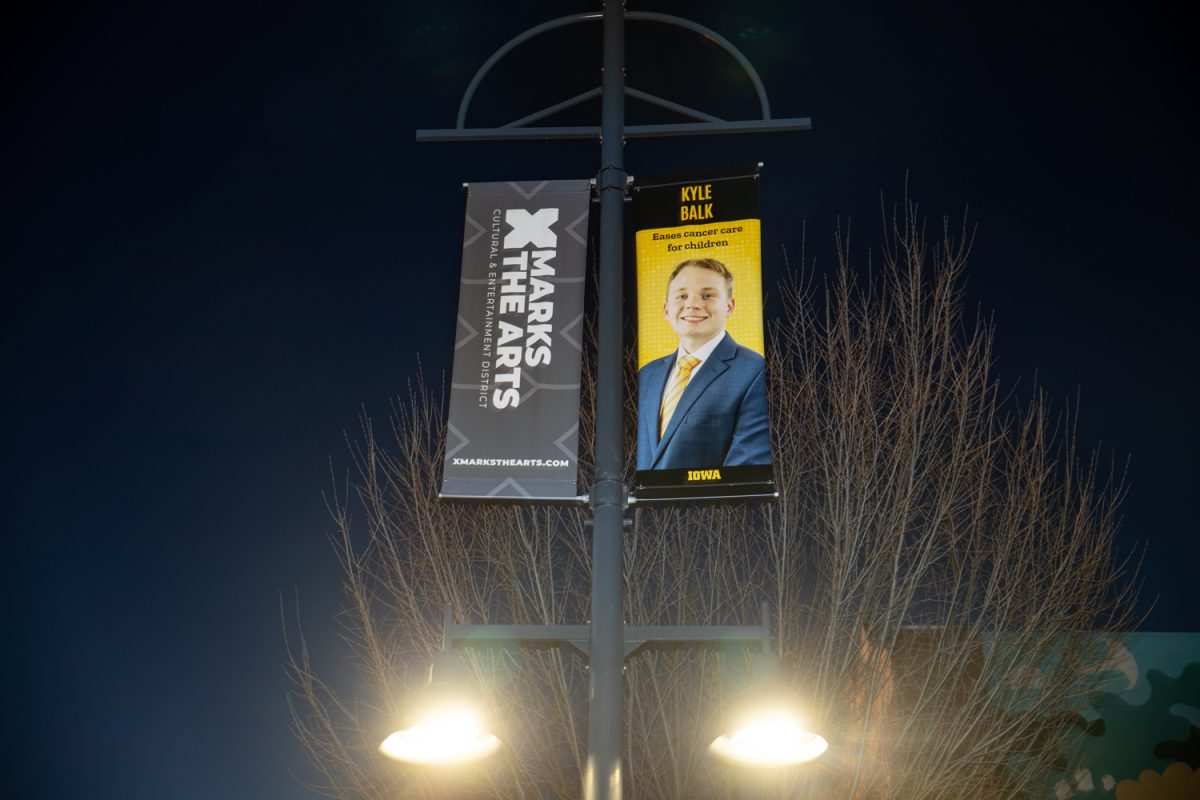
The University of Iowa has marked 10 years of commemorating highly-achieved students in research and writing fields through the yearly “Dare to Discover” campaign.
The initiative is led by the Office of the Vice President for Research and recognizes research efforts by students and scholars and their overall impact on the community.
The banners of the 40 students are hung in the Iowa City Downtown District and will come down in March or April.
David Schwebel, the Vice President for Research, said the campaign brings awareness to the continued work of students both within and beyond the university.
“Our goal is to highlight the amazing research that our students and postdocs do across the University of Iowa,” Schwebel said. ”Our students sometimes forget how much our students, not our faculty, but our students impact the health, the well-being, and the enjoyment of the lives of people in Iowa and across the world.”
First sponsored by the office in 2016, the initiative began to recognize faculty before transitioning to recognize students in 2018. This year’s campaign recognizes a total of 40 undergraduate students, postdoctoral research scholars, master’s of science students, and Ph.D. students who were nominated by their professors.
RELATED: UI sees steady double major enrollment despite national increase
Kyle Balk, a UI fourth-year biomedical engineering student, was nominated for his research in the James Byrne Radiation Oncology Lab by making prescribed medications more easily administered for child cancer patients.
“I think it’s a really cool honor,” Balk said. “When I started on campus as a freshman, I remember walking downtown and seeing the banners of people hanging up, and I was like, ‘Wow, that’s really cool. I wonder what you have to do to get on that,’ so I think it’s a really cool full circle moment that 3 ½ years later I’m one of the people featured.”
Nominations were of researchers who work in the university’s three distinctive collaborative opportunities — neuroscience and mental health, cancer research and patient care, and writing and communications — Casey Westlake, the communications manager for the Office of the Vice President for Research, said.
Nominations were taken from mid-August to mid-September through a web form, and the review process prioritized nominations from faculty and staff who worked with the student. After the students were selected, they each had their portrait taken and wrote a summary about the research in which they are involved.
“Part of it is getting the word out about the amazing things the students are doing,” Schwebel said. “And so that’s a team effort. Many of the students, departments, and faculty members spread the word through social media, through emails, and just talking to people on the street.”
Balk also gives credit for his nomination to the other researchers he worked with.
“It’s cool to walk downtown, see my face hanging up, and nice to have that recognition for the research that we’re doing,” Balk said. “My personal recognition speaks not just to me but to everyone in my lab.”