


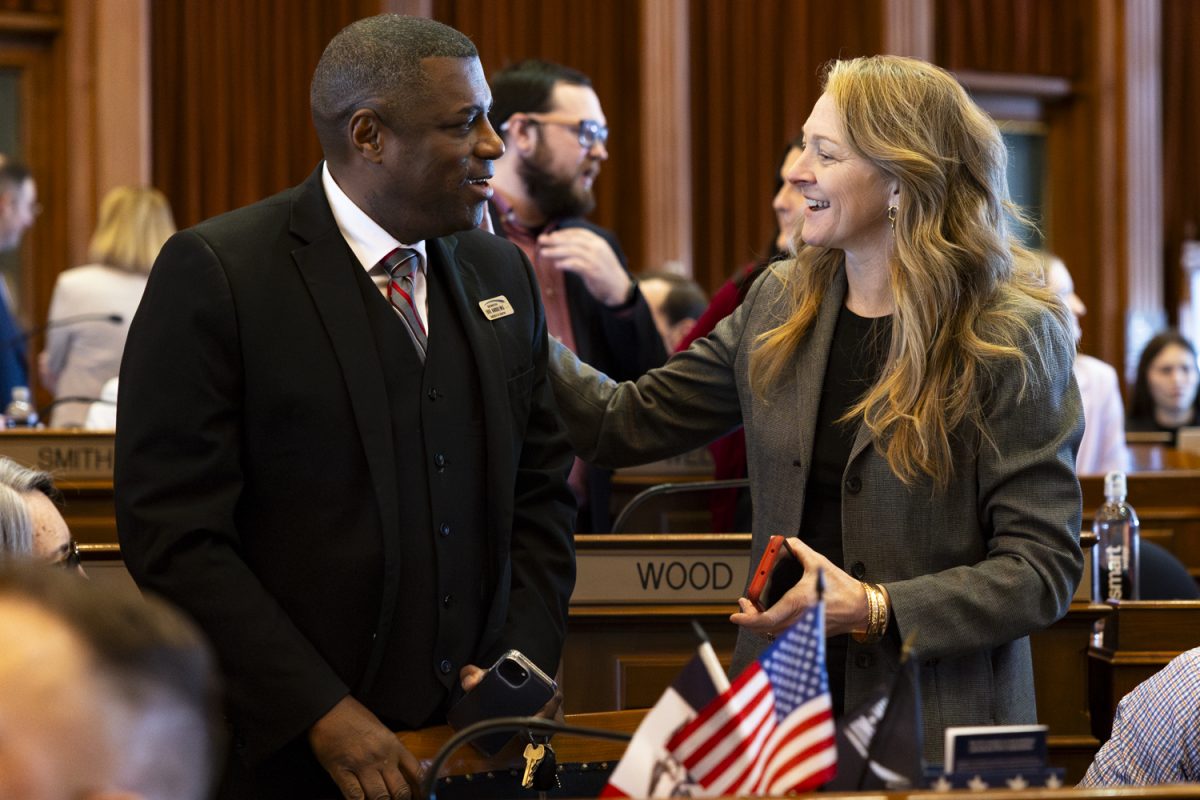
A subcommittee of Iowa lawmakers advanced legislation to committee on Thursday modifying specifications relating to the protection of free speech for students enrolled in school districts, charter schools, and innovation school zones, designated groups of schools within a district receiving waivers from the state.
House File 2106 prohibits school districts from discriminating or penalizing a student for engaging in religious or political speech and allows students to engage in protected speech in school by expressing viewpoints, organizing clubs, or wearing clothing or accessories.
The bill was supported by faith-based organizations, students involved in the Turning Point USA, which is a nonprofit organization advocating for conservative politics, chapters of their high schools, and Republican lawmakers. The bill was opposed by education groups and Democratic lawmakers.
Sara Beth Nolan, a lobbyist from Alliance Defending Freedom, a nonprofit conservative Christian legal advocacy group, said she is in favor of the bill and said students should be able to go to school without fear of discrimination from their peers or teachers.
“This bill strengthens fairness rather than favoring a particular viewpoint or political
perspective,” she said. “Students who engage in civil discourse become better citizens, leaders, and community members, and allows respectful expression teaches citizenship, critical thinking, and civil discourse skills that most people would agree are urgently needed.”
Leo White, 15, president of the Turning Point USA chapter at Centerville High School, said he supported the bill because students feel pressure to stay silent due to their political or religious beliefs.
“I believe that having conversation is a key to a diverse and well rounded learning environment, and not to mention one of the reasons why our country is so great,” he said. “We can disagree.”
Samuel Proctor, a senior from Marion High School, also voiced support for the bill. He said high schoolers feel like they are being censored and moving forward with this legislation will allow more people to speak out on their religious beliefs.
“It took me years to find my voice in America,” he said. “You should be born with it.”
RELATED: Lawmakers table resolution to prohibit judicial review until further discussion
Rep. Samantha Fett, R-Carlisle, said the bill is an important American value to be able to have conversations and to be able to disagree.
“When it comes to the guidance being distributed to our school personnel, whether that’s principals, teachers, superintendent, or school board members,” Fett said. “These are questions that they deal with daily, and they are not prepared to answer them because they don’t know, and so this is an opportunity for people to learn.”
Opponents of the bill raise concerns of redundancy
Michelle Johnson, a lobbyist for the Iowa Association of School Boards said she was against the bill as schools already have sufficient First Amendment protections in school, raising concerns surrounding the language of the bill.
“Rather than applying long-standing First Amendment standards that focus on the speech itself, this bill shifts the analysis to a comparison of students through the new standard than the similarly situated students,” Johnson said. “The comparative standard could result in more restrictive outcomes for students.”
Melissa Peterson, a lobbyist for the Iowa State Education Association, said the association is registered against the bill because it includes “redundant instruction” already established in the U.S. Supreme Court case Tinker v. Des Moines Independent Community School District, which granted K-12 public school students free speech as long as it did not disrupt learning.
“If the situations expressed today are happening, we need to work on enforcement of existing law,” she said.
Rep. Angel Ramirez, D-Cedar Rapids, did not sign off on the bill and echoed concerns of the legislation’s redundancy to rights established in the First Amendment.
“Public schools already have to balance student free expression with safe and orderly environments,” she said. “I’m curious, if this bill changes that balance, and if so, how does it avoid running a foul with case law that already exists?”