


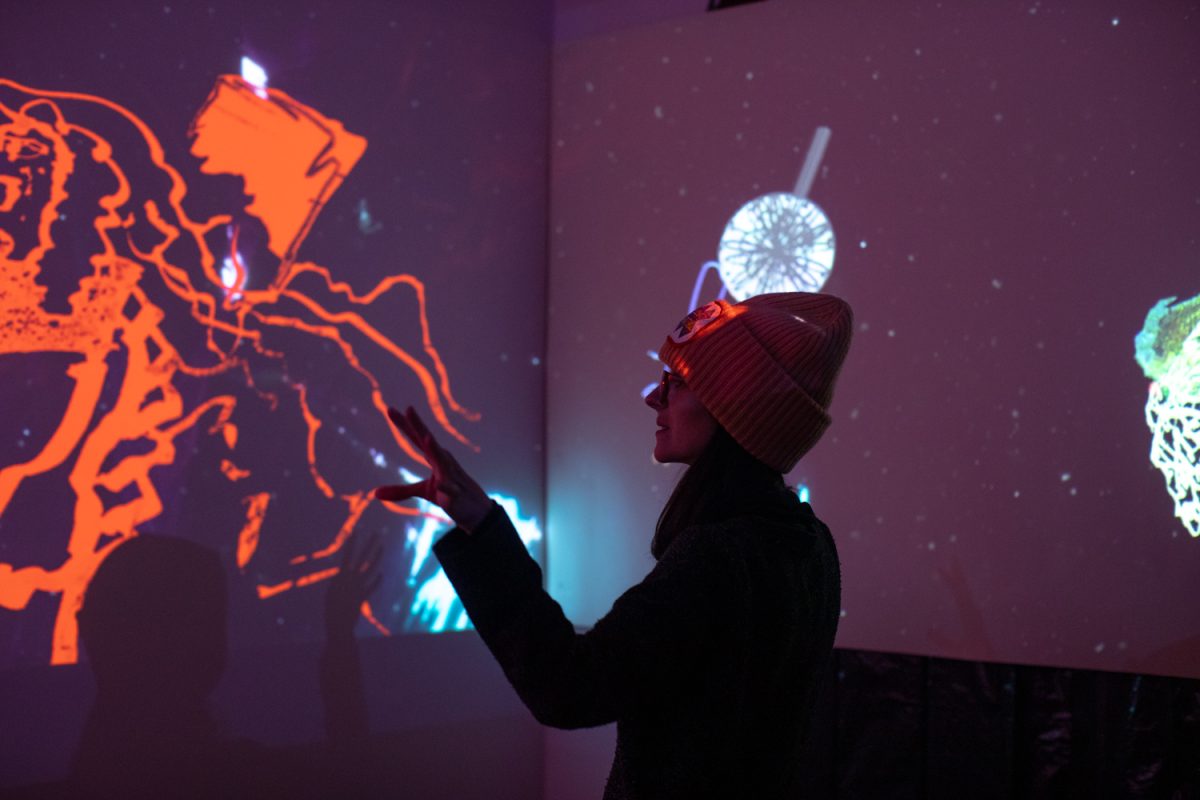
Public Space One’s latest exhibit, “DEAD OR AMAZING,” showcases a combination of interactive software and art. Created by artists Ethan Edvenson and Charles Borowicz, the exhibit features drawings by Edvenson accompanied by audio and video tracks by Borowicz. It utilizes a software program known as Isadora, which tracks the body’s movements to make an interactive display.
Borowicz came up with the idea in 2017 while at a residency in Indianapolis, inspired by a friend who used the same software for a dance performance. Borowicz first collaborated with Edvenson two years ago on a video project for artist SUNDANCE MOONHOUND.
Edvenson’s work primarily consists of mixed media drawings, but he has an interest in video work. Borowicz’s work is mostly photography and video work, but he loves to draw as well.
Edvenson makes his drawings with India ink, a drawing ink made from black soot and chalk pastel before cutting and layering them into shaped pieces. Rather than frame his drawings, he explained, he instead installs them on the wall.
“They feel more alive that way, so they don’t really fit in a standard frame, or they can organically weave off in unusual compositions, which is partly why we wanted to use them for this, because they exist in their own space,” Edvenson said.
Edvenson’s drawings have a unique shape, which caught Borowicz’s interest and made him want to include them in this project, Borowicz said. After seeing how Edvenson created his drawings by disassembling and layering them, Borowicz thought they would work well for an interactive exhibit.
“I really wanted to create some kind of art piece that was triggered by events, and what you need to do, you need a lot of pieces to make that interesting,” Borowicz said.
The final project was a 45-second interactive, immersive experience for each participant, aided by the use of blackout curtains. A room in PS1’s Northside Gallery was converted into a waiting room with chairs and a table with a large computer, which controlled the installation. The curtains separated the two rooms.
Behind the curtains was a room shrouded in darkness. The only light came from three projector screens, showing a screensaver of shapes resembling bubbles, red streaks of light, and a single word projected on the middle screen, “Welcome.”
The word faded, and the screens came to life with bursts of color, light, and sound. Each interaction with the exhibition is different.
For one viewer, the audio could be a deep, unintelligible voice, the display consisting of bubbles and streaks of color, and the drawings varied and numerous. For another, they could be greeted with a flurry of voices and colors resembling paint splatters.
At the end of the display, participants can move their hands to prompt streaks of color to appear on the screen in time with their movements. For Edvenson, that play aspect of the exhibit was what he liked about it.
“I like it most when you’re able to move around and kind of experiment and see if I move my left hand, what does that do, what sounds does that activate around me, or drawings come up?” Edvenson said.
John Engelbrecht, PS1’s executive director, said before opening the show, a man and his three kids had seen it from outside the PS1 building and had come in to view the installation. He said they stayed inside the installation for 15 minutes, exploring how to make the exhibit work.
“It’s a small delight, I think, for folks to experience an art gallery in that way,” Engelbrecht said.
For Borowicz, that idea of an experience was what he hoped participants would take away from the installation. He hoped they would be engaged with the piece and be interested in how it works.
“I like that it’s kind of open-ended,” Borowicz said, “I believe art is always an experience, but for sure this is an experience.”