


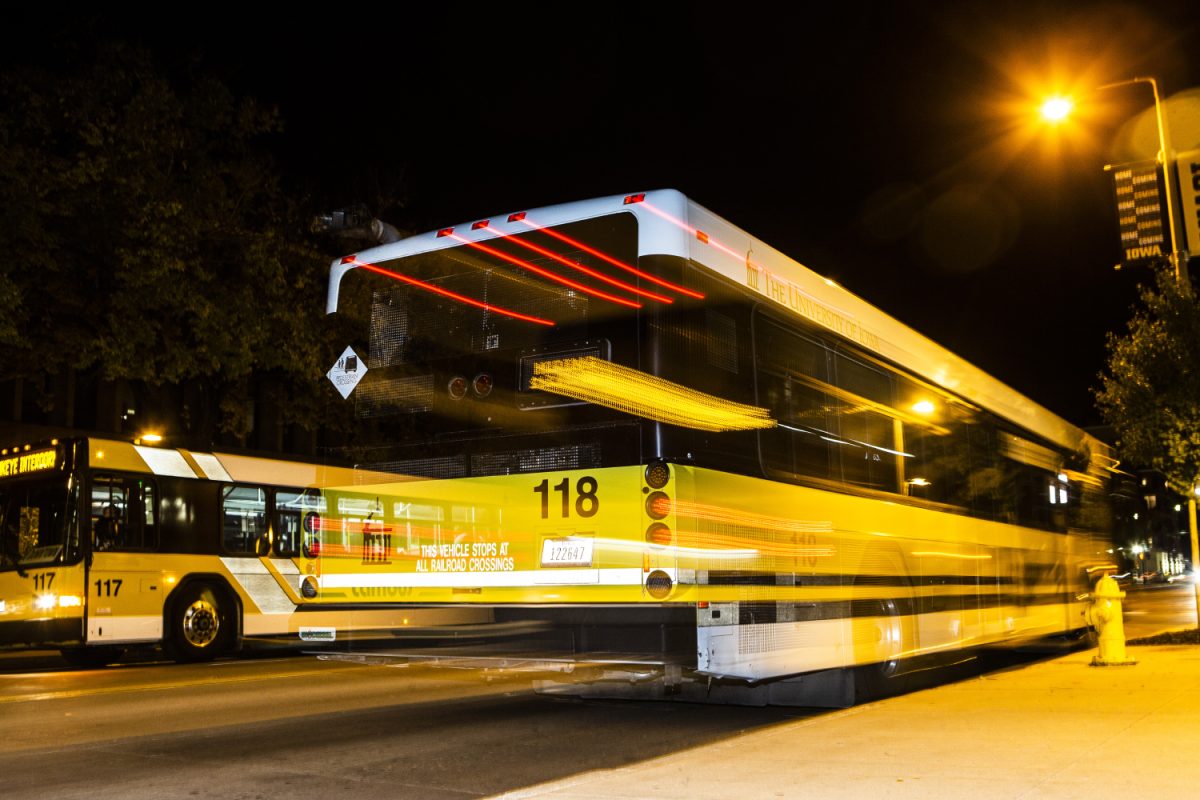
CAMBUS, the University of Iowa’s student-operated busing system, will introduce six new diesel-electric hybrid buses after receiving a $6.1 million grant from the Federal Transit Administration awarded in January, replacing six buses purchased between 2008 and 2009.
Mia Brunnelli, CAMBUS manager, said the new buses will make the rides less error-prone. Brunnelli said the older buses have been running into maintenance issues, causing rider delays. Brunnelli said the six older buses were due for retirement in 2022 and cost 60 to 70 percent more to maintain than a new bus.
CAMBUS provides over 3 million rides per year, according to UI Parking and Transportation.
Brunelli said riders can expect the same experience as the diesel-powered buses with the new hybrid buses. She said the six new buses will be slightly taller, meaning they most likely won’t be able to clear under the Iowa Avenue Bridge.
Brunelli said the change will not affect riders on routes that pass under the bridge; the transit service will still have 26 other diesel buses that are shorter.
“Other than that, passengers really won’t notice a difference with these buses,” she said. “It’s kind of like the difference between a gasoline car and a hybrid car. You essentially get better gas mileage.”
Brunelli said the UI Department of Transportation is still in the process of purchasing the buses and expects its integration into the current fleet to take 18 to 24 months.
Although prices for buses vastly fluctuate, Brunelli said she expects a diesel bus to cost from $750,000 to $800,000, while a hybrid bus can cost up to $1.1 million.
“These first ones we get will be a great test of that to see if the increase in price to go hybrid rather than diesel works with that additional fuel economy,” she said. “As far as whether or not we’ll continue to buy hybrids or electrics or other alternative fuels, I think that will really just depend on how these ones pan out.”
RELATED: Federal grant gives over $16 million to fund new electric campus buses
Megan Andress, a UI fourth-year student, said she’s never been on a CAMBUS that has had maintenance problems. She said she wishes more funding was concentrated toward opening new routes to prevent overcrowding, especially since Iowa City closed the 4-Downtown Shuttle in August 2025.
“Every single day, [CAMBUS] is crowded to the maximum, no matter what time I ride,” she said. “They’re also turning down people at bus stops, it’s ridiculous. I take the bus four times a week, and I see that happen about twice a week.”
Andress also said the buses have been frequently tardy as she’s ridden them this year, anywhere from five to 15 minutes late.
On top of the late arrival, Andress said using the Transit app to track the route often leads to greater stress for students with the app frequently telling riders they missed the bus because it can’t compute the bus being late.
Although Andress said she’d like to see more fundamental parts of the service, such as routes and the app, given attention before the buses, she appreciates the lower emissions the new buses will bring.
“I do think it’s good that we’re switching towards electric,” she said. “Public transport is already helping to cut down on car emissions, lower emissions are even more awesome.”
CAMBUS is not the only Iowa City transit system moving toward lower-emission vehicles. Iowa City Transit is looking to purchase four diesel-electric, hybrid buses to replace four diesel-powered buses, said Darian Nagle-Gamm, Iowa City’s director of transportation services.
Nagle-Gamm said the city is currently waiting to hear if the $4.3 million Low or No Emission Grant they received in 2023 will be approved by the federal government to spend on the hybrid buses. Similar to CAMBUS, the purchasing process would take up to two years, Nagle-Gamm said.
According to the Iowa City Climate Action & Adaptation 2025 annual update, Iowa City emitted nearly 700,000 metric tons of CO₂e, short for carbon dioxide equivalent, combining multiple greenhouse gases into a single unit based on how much heat they trap in the atmosphere. Twenty-two percent of the total emissions came from transportation emissions.
“We do have long-term plans to move towards an all-electric fleet,” Nagle-Gamm said. “It’s in the City of Iowa City strategic plan. But it’s probably going to take us some time to get there, and we’re probably going to see a mix of different propulsion types, before we get to an all-electric fleet.”
Nagle-Gammsaid 85 percent of Iowa City’s bus fleet uses diesel propulsion, or engines, while 15 percent are electric.
Nagle-Gamm said the current electric buses, purchased in 2021, are out of commission due to maintenance issues. The buses were bought from Proterra Inc., a company that filed for bankruptcy in 2023 and was bought by Phoenix EV in 2024.