


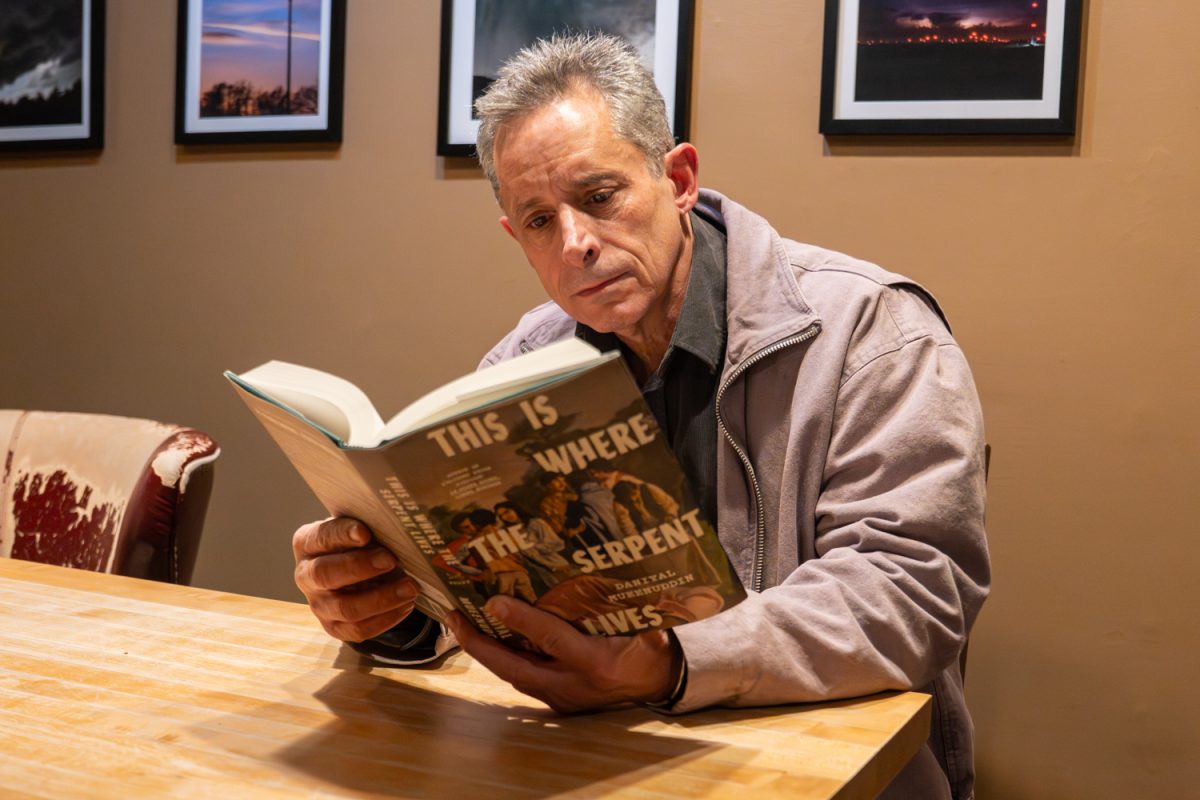
Daniyal Mueenuddin was born and raised in Lahore, Pakistan, until he was 7 years old, then moved to Elroy, Wisconsin. He’s a graduate of Yale Law School and Dartmouth College, with his work appearing in The New Yorker, Granta, and Zoethrope. In 2009, he published “In Other Rooms, Other Wonders,” which was nominated for a Pulitzer Prize. His newest book, “This Is Where the Serpent Lives,” delves into some of his personal experiences in Pakistan, in addition to other stories revolving around class systems.
The Daily Iowan: You’ve lived inside and outside of Pakistan throughout your lifetime. How has that dual perspective changed your writing overall?
Mueenuddin: My family has owned land in Pakistan for a fair amount of time. One particular story closely tracks my own life, which is a story called “Muscle.” It’s about a guy who was educated abroad in prep school, then goes to college, and tries to rescue his family farm from people who tried to take it from him. It was the same thing I did after I went to college.
My dad gave me the option of either staying in the U.S. or coming back, but he pointed out that if I didn’t come back, I would not retain control of my lands, which were being threatened by the people who were supposedly running them on my father’s behalf.
The farm was far out there, about 13 hours by road away from our home, so it was a considerable trip, and the people took advantage of that.
They assumed I wouldn’t come back. Instead, I did go back and spent several years there right after college.
I took control of the farm, and it was fairly complicated. But I was ultimately successful with the help of various friends and family.
What impacted your writing style, and how did you know you wanted to write fiction?
Originally, I wanted to be a poet. I wanted to write poetry for a while because my mom had an excellent library at the farm, and she was always a big reader. When I went to the farm, I knew it would be a great time to write and a great time to read. I knew right from the beginning it was going to be really lonely, but it was bearable.
I started out writing poetry. I’m not quite sure why, but I always thought it was a higher calling. I had sort of a ranking: poets, short story writers, and then fiction writers. Maybe I thought that because I was young and foolish.
So I wanted to be at the top rank by writing poetry, and I spent many years doing that. At some point, I realized I got too old for that lyric poetry. I actually gave up on writing for a bit and thought I might not ever be really good at poetry because I wanted to be really good. So, I went off to law school and did that for a while. Then I finally realized that what I really wanted to do was to write, damn it.
How did you first approach writing this book?
With poetry, it requires inspiration. As Randall Jarrell said, if you sit around in rainstorms hoping to get hit by lightning, you’ll only really get struck about five or six times. It can be hard to write on command.
But with fiction, you can do it on command. You have to sit down and bust your head against it, but sooner or later, you’ll get somewhere. Therefore, I think that enabled me to pretty quickly speed up as a fiction writer. I put my heart into it and tried like hell, and it seems to have worked out pretty well.
What inspired you to speak about the perspectives present in this piece?
I had an intimate understanding of the place and people. Not just the people, though, but also the farm.
I’m more of a businessman than a farmer. My job is to select good people. I tried to streamline this business, but I made lots and lots of mistakes, got made a fool of, and got cheated plenty of times. Pakistan is famous for its corruption.
I started writing about it because I really knew it well. That’s what I loved writing about. I loved the place. I love the characters.
What role models in your life inspired you to become an author?
My mom was a writer. So throughout my childhood, when we lived in Lahore, she had this expectation of me. She had this room up on the roof, and I would come home from school to hear her manual typewriter tapping away with that mechanical sound.
She carried it around the world and was very attached to it. She would be hammering away on this thing all the time, and I wanted to do the same.
I loved books, too. I was one of those geeks who spent all his time lying on this orange sofa in my bedroom reading as soon as I came home from school. She subtly created this expectation in me that I would become a writer. And because I loved reading, it was easier for me to write.
My mom was also really good friends with a reporter in D.C., Katherine Anne Porter. She was a really great modernist writer. She became my godmother, and that was really important because she was a very grand lady.