


College campuses act as a notoriously cyclical cesspool for fashion pieces, items, and lifestyles among young adults, and the University of Iowa is no exception to this consistently trendy culture.
Nicholas Zimmermann, a second-year UI student, took note of ever-evolving fads on campus, drawing attention to the constant need for change and novelty.
“It seems like there’s a new ‘thing’ every semester, whether it’s a water bottle or a pair of shoes or a popular game,” he said.
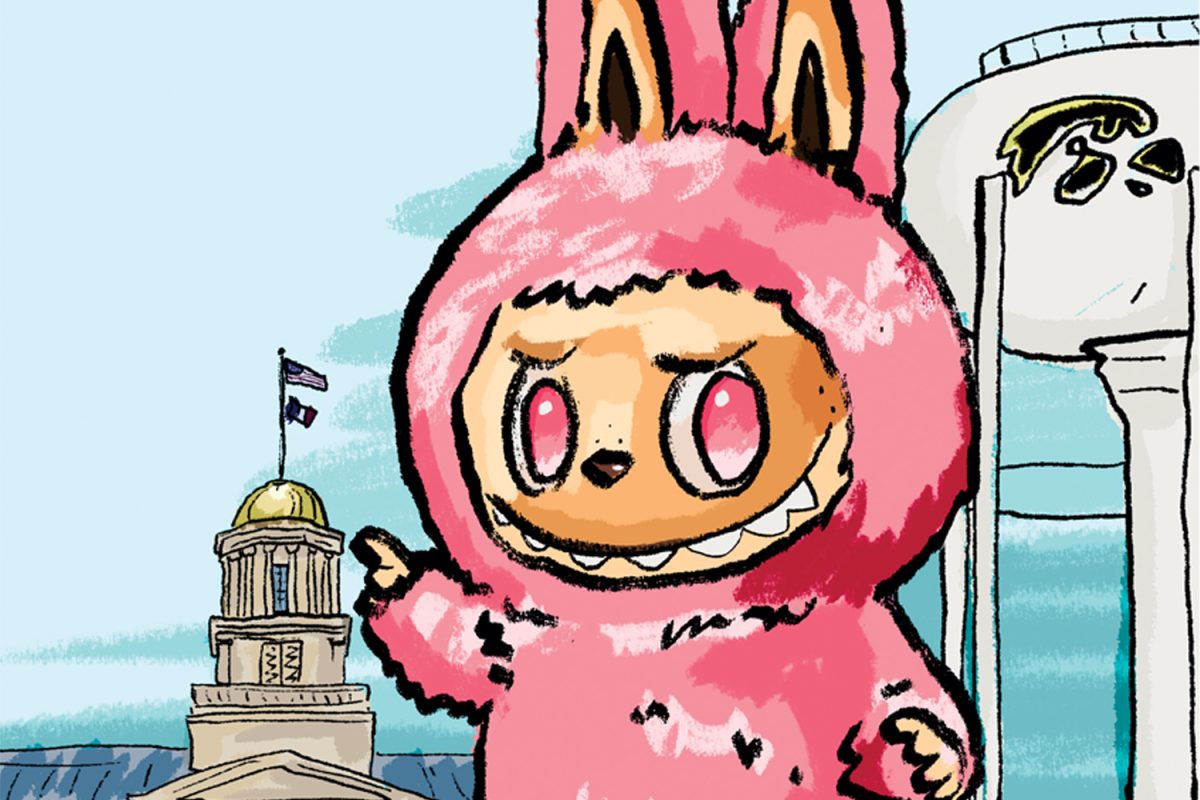
One of the latest trends gaining traction recently is the impish collectible toy doll line known as Labubus. Labubus are a cultural phenomenon, a staple of what is considered the “performative male” trend: a new, distinct style and way of dress.
These little dolls generated $677 million in the first half of 2025 alone, according to data from Demand Sage, a site that collects data to aid in business insights. The collectibles are not the only elements of self-expression that have gained traction in the past year, though.
Local clothing and fashion stores reflect Zimmermann’s stance on trends; it doesn’t take long for people to move onto the next big thing. Pitaya, a boutique located on the Iowa City Pedestrian Mall, keeps on top of evolving styles, a necessity to survive in today’s fashion culture.
Every week, the storefront mannequins are redressed to draw in customers. Decked out in new arrivals and fresh styles, the mannequins show off outfits based on events happening in Iowa City, such as Greek life date parties, holidays, and fashionable sporting fan attire.
Although the mannequins are based on situational outfits, Pitaya finds its most popular items to be what’s trending online, which, according to 22-year-old store manager Emma Johnson, are never guaranteed to last for long.
“There are items that will come and go in as short as a few weeks,” Johnson said.
Due to the college campus location, Pitaya employees find social media sites such as Pinterest and TikTok incredibly helpful to track what is hot among young adults.
“It takes a lot of people and doing a lot of research; we really pay attention to what people are picking up and trying on. Overhearing customer conversations and asking questions about what people are looking for specifically are also big factors,” Johnson said.
Whether it’s new patterns, colors, or cuts, Johnson noted the unpredictability of clothing longevity and how quickly fashion can go out of style. Constantly checking socials and following popular influencers changes the game when getting ahead of the next big thing.
In the digital age, social media has been proven to affect how certain trends grow and evolve. With one quick post to social media, a fresh video quickly popularizes new forms of self-expression, from clothing styles to water bottles and keychains.
If a post gains enough of a following, it quickly cycles through the feeds of various people who have taken an interest or interacted with similar posts in the past. This cycle can be rapid, spreading styles in seconds.
Dana Rupe, director of the UI’s John Pappajohn Entrepreneurial Center, said the fashion industry has two major seasons, spring and fall, which bring their own trends, but this cycle now moves at a much faster pace.
“We used to see trends last a season or two, maybe a year or two. Now we’re seeing these trends last weeks or months, and things are moving much more quickly,” Rupe said.
Rupe also teaches marketing, fashion, and lifestyle classes through the UI’s School of Journalism and Mass Communications. Along with her work at the UI, she has always worked in the fashion industry and has owned several of her own apparel businesses, working with national brands such as Adidas and Under Armour.
While she believes the turnover rate of trends has changed, Rupe said the underlying principles that drive the fashion industry have remained the same.
“Fashion is used as personal adornment and self-expression. So even if someone thinks they don’t participate in fashion, that’s actually a conscious decision,” Rupe said.
Fashion as self expression
With each new class, Rupe likes to ask her students why they chose to wear certain styles of clothing, emphasizing that even randomly choosing a shirt and pants out of the closet is a conscious choice of self-expression. Choosing not to be engaged with or care about dress is still participating in personal style.
People’s appearances often serve as a gateway to understanding them or placing them into different categories.
“One of my favorite styles to talk about is goths. You see a group, probably young people, and they’re wearing black trench coats and military boots and dark hair and dark makeup, and you immediately think, oh, they’re making this real statement about how they’re anti-establishment and rebellious, and they want to be individual,” Rupe said.
However, what often ends up happening is that different people who dress in goth clothing around the world end up dressing similarly, creating a distinct form of style, Rupe said.
For marketers, it can be difficult to try to create something “viral” due to the difficulty of appealing to a wide audience of people, each of whom is trying to make an individual statement with the way they dress, even if they don’t realize it.
“People are seeking through trends, either to differentiate themselves or to connect with other people,” Alisa Weinstein, adjunct assistant professor in the UI’s Department of Anthropology, said. “My hunch is that these trends and people getting involved in them are seeking human connection.”
Weinstein is also a program coordinator for the Iowa Summer Writing Festival. In her classes, she examines fashion from an anthropological perspective and encourages her students to observe their own fashion and dress practices.
For example, many students walk around campus wearing Hawkeye gear. While key components, such as black and gold colors and the tigerhawk logo, remain unchanging, there is variation in style and expression.
While one Hawkeye fan might attend a football game wearing striped black and gold overalls, another might show up in a gold Tigerhawk-sporting tank top and ripped jeans.
“There’s a nuance to it, like how people sometimes want to do their own Hawkeye stuff to differentiate themselves from other Hawkeyes,” Weinstein said. “But ultimately there’s definitely something uniting people, a sense of connection or pride or school spirit.”
Even outside local communities, fashion can connect people to others all across the world, where materials are sourced, produced,
and shipped.
Social and political situations can also influence what microtrends reach a wider audience and when. Culturally relevant clothing, trinkets, and belongings resonate depending on what broader societal issues they rise up in response to.
“Maybe a trend right now is this vintage thrifting resale trend, and that’s a real backlash to fast fashion and some of the environmental things going on right now,” Rupe said.
Microtrends are on the menu
While fashion plays a monumental role in trending culture and the lives of many young adults, it is only one aspect of our changing society.
Food and drink restaurants are no exception to trends. Starbucks, a popular coffee chain whose menu is largely influenced by social media and the ever-changing demands of caffeine-loving customers, recently released new menu items.
Alongside new protein-packed coffees, several of the food and drink items featured “Dubai chocolate” inspired flavors. The chocolate-pistachio combination shot to popularity in the U.S. last year, growing increasingly widespread mainly on TikTok.
Palatine, Illinois, is home to several UI students and alumni, where the local Starbucks location serves as a popular coffee joint.
Grace Marietta, a Starbucks barista, was surprised by how far the trend had extended from social media.
“I’d honestly never have guessed that the Dubai chocolate train would make its way to Starbucks,” she said. “But I’m mostly surprised by the number of people who are ordering it.”
The impact of social media on trends is proving to grow increasingly more influential. New flavors aren’t the only thing making their way to major corporations; diet culture is as much of a trend as any other, and protein is the new “it-girl” of healthy eating.
With the rise of gym influencers, and the following pressure to be fit and gain muscle, protein is put on a pedestal. At the risk of ignoring other essential macro-nutrients, many people share their extremely protein-heavy diet online, boasting that it’s the answer to everyone’s health issues and fitness goals.
“Everyone is preaching about adding protein into their diets now, so it was only a matter of time until we found a way to add it to our coffee,” Marietta said.
Whether it’s through clothing, food, or lifestyle choices, trends are moving faster than ever. However, their purpose hasn’t changed; trends work as an outlet for society to have individualistic expression and forge connections within. While what’s “in” may change on college campuses like the UI, the desire to belong, stand out, or feel a part of something larger remains all the same.