



University of Iowa doctoral degree candidate Kaitriana Colling is paving the way for nonsurgical treatment for uterine cancer after the Iowa Cancer Registry found Iowa has the second highest rate of cancer in the nation.
Colling’s research focuses on uterine cancer, which, according to the American Cancer Society, or ACS, is now the fourth most common cancer in the world and the fifth most common cause of cancer deaths among women in the U.S.
Since Colling’s joined Kristina Thiel’s lab at the university, the lab has won noteworthy grants, Thiel said. The first was a $2.5 million grant from the U.S. Department of Defense in August 2023, and more recently, the team was awarded a nearly $13 million grant in August from the National Cancer Institute to advance hormone therapies for uterine cancer, Thiel said.
According to the ACS, uterine cancer is now the fourth most common cancer in the world and the fifth most common cause of cancer deaths among women in the U.S.
Uterine cancer is also one of the only cancers with an increasing mortality rate. From 2013 to 2022, the death rate rose by 1.5 percent per year, according to the ACS.
Colling said she is researching a way to fight this trend, one that doesn’t require extensive surgeries that bring barriers for patients with medical conditions like obesity or younger patients who wish to preserve their fertility.
“The focus of my project is to identify more effective hormone therapy currently being used in the clinic,” she said. “Currently, there are only three hormone therapies used in the clinic, but there are over 20 that are used for other purposes, such as contraception.”
Current drugs containing progestin, a synthetic version of the hormone progesterone which is utilized in the menstrual cycle and pregnancy, are often used for contraception because they inhibit ovulation, thicken cervical mucus, and thin the uterine lining, but Colling said these drugs can also be used to treat uterine cancer.
Although she could not disclose the drugs being tested, she said several are outperforming the hormone therapies currently being used in the clinic.
Colling’s work was inspired by her own grandmother’s battle with cancer, whose breast cancer resurfaced and spread to her bones and brain when Colling was an undergraduate student at Drury University.
“Seeing her navigate the challenges and toxicities associated with cancer treatment really inspired me to identify safer and more effective treatments for our patients, and specifically, cancers that affect women,” she said.
Colling said her day-to-day work in the lab consists of working with patient tumor models called organoids, or 3D cell cultures generated from tumor tissue, performing drug screenings and experiments on the organoids.
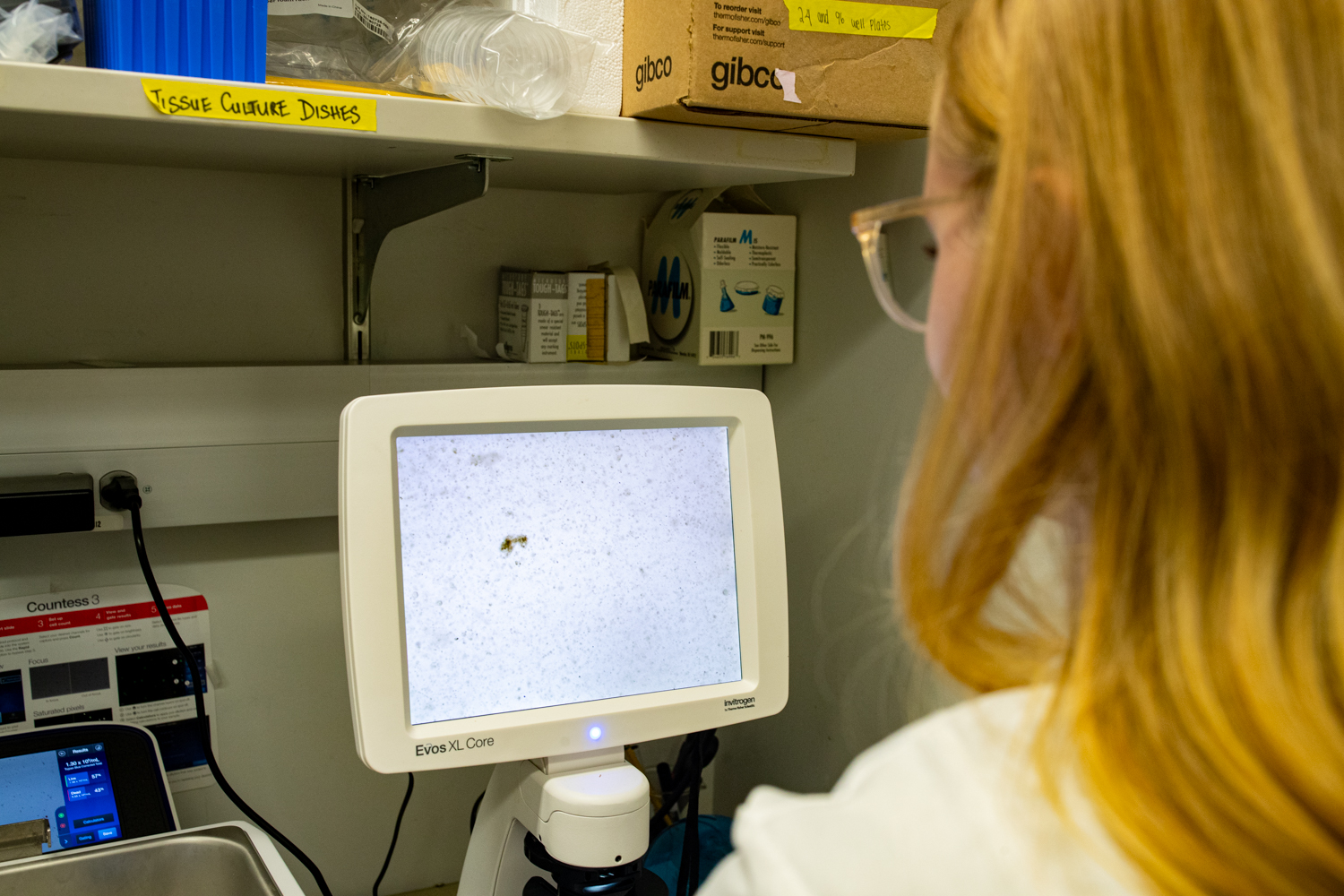
Within the lab Colling works in, she gets up to five uterine cancer tissue samples a week from patients within the Gynecologic Oncology clinic at UIHC who consented to a donation.
“And those are just for patients who consent,” Colling said. “So this is really a pressing health issue.”
Colling said she hopes her research improves patient outcomes and gives patients more autonomy in how they treat their uterine cancer. Colling said, besides surgery, patients are offered hormone therapy as the only alternative option, but the currently used therapies often fail to prevent the cancer from resurfacing.
“It’s a really difficult situation for these patients to be put in,” she said. “I want to be able to give them more choice of having an effective option that’s nonsurgical, so that they can feel confident in saying ‘I’m going to feel safe.’”
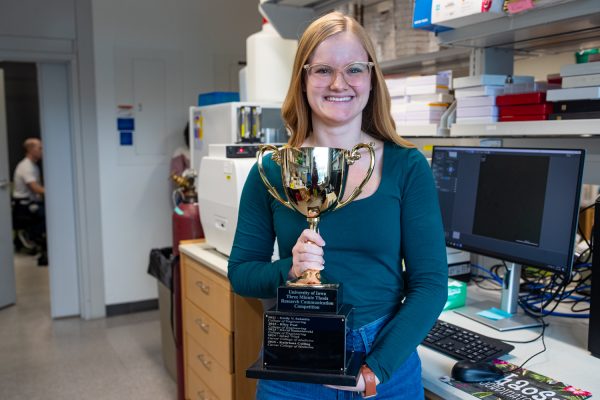
Colling’s work has not gone without recognition. On Nov. 13, she won the UI’s Three Minute Thesis Competition, a space for doctorate and master’s students to present their original research in general terms for a nonspecialist audience. She also won the contest’s People’s Choice award.
“It was an incredible experience,” she said. “I was surprised to have won after watching all the finalist presentations. It was just outstanding. I thought it really could have gone to any one of us, but I was honored that I was chosen to win the competition.”
Thiel was in the audience as Colling gave her presentation and said she had no involvement in helping Colling prepare.
“I was blown away by her presentation,” Thiel said. “I routinely give talks on this topic, and the way that she conveyed the urgency for better research and treatments for uterine cancer was just so compelling. I wasn’t surprised that she won, and I’m extremely proud.”
RELATED: UI researchers receive funding for clinical trials in new cancer treatment
Thiel runs her research lab under the UI’s Department of Obstetrics and Gynecology with the goal of creating new treatment options for gynecologic cancers. Her lab works in collaboration with researchers from the University of New Mexico, the University of Utah, and the University of Kansas.
Thiel said she launched the lab in June 2022, initially planning to wait a year to begin mentoring graduate students.
“I wanted to get the lab a little bit more established,” she said. “But [Colling] was so motivated and persistent and just conveyed such a passion for the work. My lab was setting out to do that. I’m glad we welcomed her into my research program. She’s been incredibly productive in her three years at the lab.”
Thiel said Colling’s work will advance into clinical trials in the next two to three years.
“For a graduate student to see their research already being tested clinically is just a phenomenal opportunity,” she said. “Katie has a very bright future ahead of her in whatever career path she chooses. I hope that she stays in cancer research where she can continue to make a major impact.”
Miles Pufall, the director of UI’s Cancer Biology program and a collaborator in Thiel’s lab, said that while Thiel’s lab investigates what drugs work best to fight uterine cancer, he digs into how they more broadly interact with the cancer.
Pufall said he is on Colling’s dissertation committee, overseeing her research and giving her guidance when needed.
“She has rarely needed too much guidance,” he said. “It’s more fun to hear what she’s working on and see what she’s thinking about it and give a suggestion here and there. It’s been a total joy working with this group.”
Pufall said Colling’s research is currently a challenging field. While other areas of research, like leukemia, a cancer of the blood-forming tissues, have more data and straightforwardness, researchers have yet to clear the haziness for questions around uterine cancer. Pufall said researchers must still reveal what causes uterine cancer, who is prone to it, and what the hallmarks of a milder or more extreme case are.
“We only know some of those right now, so in some ways, it’s a little bit exciting because we’re trying to discover some of these things,” he said. “We need to discover those things before we can really understand how to better treat it in a lot of cases.”
In spite of the unknowns surrounding uterine cancer, Putall said he believes Colling is qualified for the challenge.
“She’s already off to a stellar start to her graduate career, given her work ethic, how smart she is, and how well she communicates her problem,” he said. “People are missing one of those most of the time.”
Colling said before the effective hormone therapies from her findings are able to be put into clinical trials, they must be tested in both preclinical screening models and mouse models.
Colling said she hopes her research sheds a much-needed light on uterine cancer, an issue that has been ignored by the public eye for a long while.
“You always hear about breast cancer, lung cancer, ovarian cancer, but you don’t hear anywhere near as much about uterine cancer,” she said. “I hope that this research that we’re doing is also able to raise awareness for the pressing need there is for more effective treatments for this condition.”