


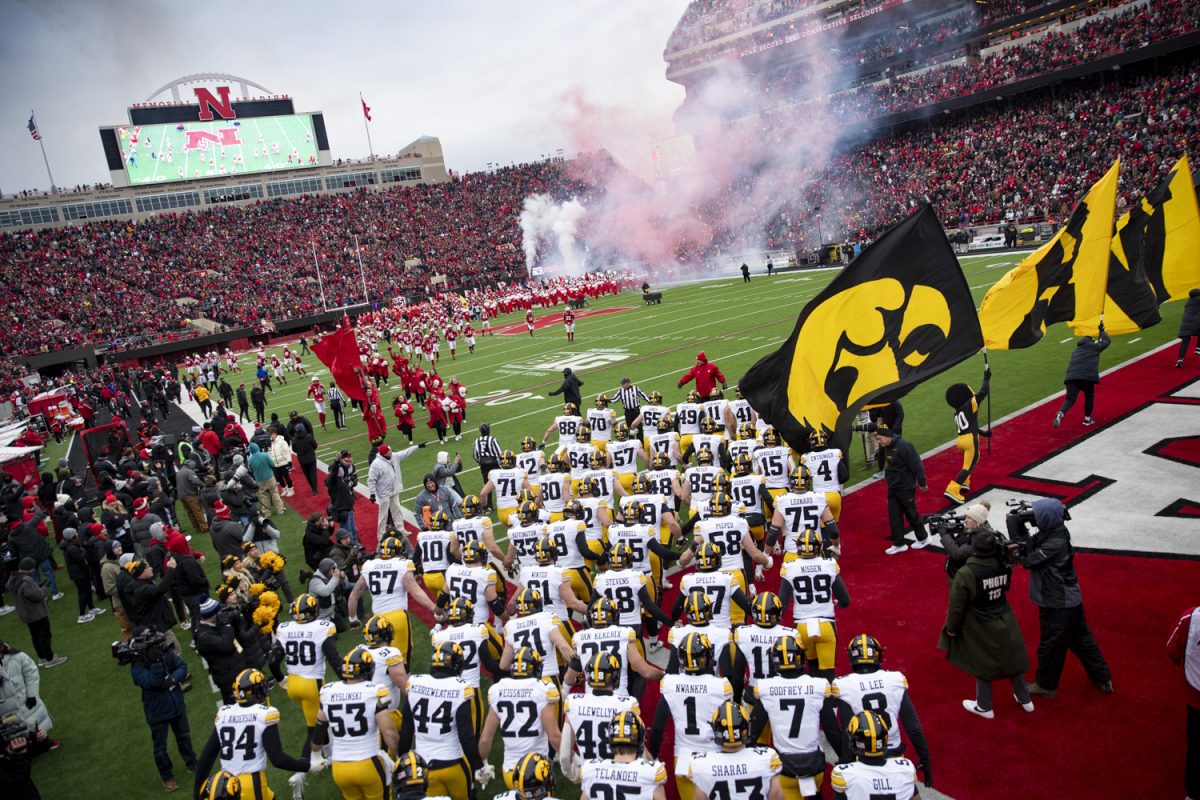
It’s December.
A highly anticipated football season has already steered its way toward the finish line.
For Iowa, this season was both a mix of familiarity and new beginnings. Iowa finished the regular season at 8-4 for the seventh time under long-time head coach Kirk Ferentz, but unlike some of those previous seasons, there is optimism.
“These guys have been an exceptional group to work with, the leadership has been strong, and the way they work together has been really good,” Ferentz said at a press conference on Dec. 3.
Though the expanded College Football Playoff and NIL have lowered the prestige of bowl games, the Hawkeyes have the chance to secure a nine-win season with a win over No. 14 Vanderbilt in the ReliaQuest Bowl on New Year’s Eve, something that has occurred just 19 times in Iowa’s 136-year football history.
“This team deserves to be at least an eight-win team, and I’ll be really surprised if they don’t try like hell to win nine [in a bowl game],” Ferentz said after Iowa’s 40-16 win over Nebraska on Nov. 28.
While the bulk of the attention remains on preparing for Vanderbilt, the Hawkeyes are also focused on building their future towards 2026 and beyond. Ferentz, 70, already announced his intention to return next year, his 28th as head coach, and it doesn’t appear he has any desire to retire anytime soon.
“God, I hope so. I mean, unless you know something I don’t know,” Ferentz said when asked if he was returning next season.“I feel good physically. I’ve got permission from my wife to keep doing this. And it’s what I like doing. I really enjoy doing it. … I don’t envision stopping anytime in the near future.”
With Ferentz likely confirmed for another season as head coach, the next chapter of Iowa football is clear – win the ReliaQuest Bowl, attack the transfer portal, and build for 2026.
Competing with highly-ranked foes
The Hawkeyes could easily be playing in the College Football Playoff this season if just a couple of those four losses had gone their way. All of the defeats were against ranked foes, a common theme in recent Iowa history.
The Hawkeyes are currently on a 13-game losing streak against ranked teams, a streak that dates back to 2021. Iowa was barely competitive in most of those games, including shutout losses to Penn State and Tennessee in 2023 and a 28-point loss at Ohio State in 2024.
But all of that changed this season.
While the results remained the same, the Hawkeyes proved the headlines of getting beaten down by ranked teams were well in the past.
Iowa entered its annual rivalry clash with Iowa State as a rare underdog, but held its own against the then-No. 16 Cyclones. The Hawkeyes trailed by 10 points in the second quarter, rallied to tie the game in the fourth quarter, but lost 16-13 in heartbreaking fashion when Kyle Konrardy drilled a 54-yard field goal in the final minutes.
The loss was devastating for Iowa — which has lost three of four against Iowa State — and was the beginning of this season’s string of gut-wrenching defeats against ranked teams.
The Hawkeyes’ next opportunity for a win was then-No. 11 Indiana at Kinnick Stadium. It marked the first time Iowa hosted a ranked foe at home since 2022, but like the Iowa State game, the Hawkeyes fell in heartbreaking fashion. Iowa had the ball with a chance to take the lead late, but an unfortunate field goal miss by Drew Stevens turned the tide back in the Hoosiers’ favor, and Indiana won 20-15
A three-game winning streak followed, vaulting Iowa into the initial CFP rankings. The 6-2 Hawkeyes had an extra week of preparation for a showdown with then-No. 9 Oregon at Kinnick. Iowa trailed for much of the game, but quarterback Mark Gronowski orchestrated a 12-play, 93-yard touchdown drive to take a one-point lead with under two minutes remaining.
But the Ducks ripped the hearts out of Hawkeye fans yet again by responding with a scoring drive of their own that ended with a game-winning field goal in the waning seconds. The 18-16 loss would carry over to the following week’s game against then-No. 17 USC in Los Angeles, as Iowa blew an 11-point halftime lead and lost, 26-21.
Had the Hawkeyes turned two of those losses into wins to finish 10-2, they could have heard their name called during the CFP Selection Show. Instead, Iowa fans are left to wonder what could’ve been.
While the close defeats have formed a dark cloud over what has otherwise been a very successful season, it could also be a sign the Hawkeyes are closer to taking the next step and making a run to the Playoff.
“We came up short a couple times, but it wasn’t for lack of effort or paying attention to detail, all those kinds of things,” Ferentz said. “…The teams that we lost to were really good teams, and sometimes that’s the way that goes.”
It’s far too early to gauge how good Iowa and its 2026 opponents will be, but the Hawkeyes will again have plenty of opportunities to make a statement next season. National powerhouse Ohio State will make its first visit to Kinnick Stadium since 2017, and Iowa also will play Michigan on the road.
Offense no longer offensive
Iowa’s losing streak to ranked teams began in 2021, which coincided with a historically inept period of offensive failure in Iowa City. The Hawkeyes were a below-average unit that season, but failed to muster 20 points per game in both 2022 and 2023.
Offensive coordinator Brian Ferentz was dismissed after that 2023 campaign, leading to a nationwide search for his replacement. The search yielded Green Bay Packers senior analyst Tim Lester, a coaching veteran with 23 seasons of college and professional coaching experience, including six seasons as Western Michigan’s head coach.
Despite featuring a revolving door of quarterbacks in his first season – Cade McNamara, Brendan Sullivan, and Jackson Stratton – Lester improved Iowa’s offense from 132nd in 2023 to 72nd in 2024. A primary factor in the upgrade was the emergence of star running back Kaleb Johnson, but Lester’s presence clearly played a role in the improvement.
Flash-forward to this season, and any previous concerns about the Hawkeye offense are over. While he battled injuries and inconsistency throughout much of the season, Gronowski showed flashes of what Lester’s offense can be.
While Iowa finished with the 17th-best passing offense in the Big Ten, anyone who watched the games could clearly see the notable improvement. The passing offense was in disarray after the first two games, but Lester settled Gronowski down after that. Gronowski averaged just 127.4 passing yards per game, but did manage to record 6.2 yards per pass – nearly identical to their 6.6 yards per completion in 2024.
In the season before Lester’s arrival, the Hawkeyes averaged 4.8 yards per pass. While Iowa remains a step behind some of the Big Ten’s passing juggernauts like Indiana and Ohio State – each averaging over nine yards per pass – all signs point to the needle continuing to move in 2026.
The Hawkeyes will lose many key contributors next season, but one of the most significant talking points throughout the entire offseason will be the quarterback position. Gronowski has easily provided Iowa’s best quarterback play since Nate Stanley in 2019, but the ReliaQuest Bowl will mark his final game as a Hawkeye.
Auburn transfer Hank Brown entered the season as the No. 2 option, but a new backup has quickly emerged in Jeremy Hecklinski. The redshirt freshman transferred from Wake Forest before the season and has quickly earned the coaching staff’s trust.
Hecklinski has played in just two games this season, scoring a rushing touchdown against Minnesota on Oct. 25. – but the three-star recruit built a strong reputation during his prep career in Marietta, Georgia, with Andrew Ivins of 247 Sports calling him “a new-age gunslinger with some moxie.”
The Hawkeyes have recruited a new starting quarterback from the transfer portal before, but general manager Tyler Barnes hinted Iowa will likely lean toward developing one of its in-house quarterbacks for 2026, which could be Hecklinski.
“Unless there’s some type of movement in our room, we feel good about where we’re at, and we plan to roll with the guys we’ve got in there,” Barnes said.
Portal Kombat
While Iowa may not be on the hunt for a quarterback in the transfer portal, Ferentz and his staff plan to attack the portal for some of their other needs.
“We’re always looking to help our football team. We will be,” Ferentz said at a press conference on Dec. 3. “It is interesting, whatever the window is, it’s pretty quick in January. We may be playing cards and watching soap operas here for the next couple of weeks, but I know what we’ll be doing in early January. We’ll be very active in that.”
Quarterback should not be a portal need this year, but the Hawkeyes still have other pressing needs to address. There are talented underclassmen beneath the graduating seniors, but Iowa could seek additional veteran help on both lines of scrimmage and at linebacker.
The Hawkeyes have always thrived in the trenches, but one area that has been a struggle is the wide receiver room. No Iowa pass-catcher has eclipsed 300 yards this season, and its leading receiver is tight end DJ Vonnahme.
Jacob Gill, Sam Phillips, and Kaden Wetjen will all graduate after the season, leaving sophomores Reece Vander Zee and Dayton Howard as the only experienced wideouts left in the room. Both are great building pieces for Lester’s offense, but adding more experience could help Iowa take the next step in 2026.
When asked further about the transfer portal, Ferentz referenced the addition of Gill and the impact he has made in Iowa City in just two years.
“[He’s] been with us for two years, and doesn’t have franchise numbers, if you will, putting it in those terms, but the value he’s added, I’m talking about the leadership on our football team, he’s a big part of that,” Ferentz said. “He embodies everything you want in a football player.”
Success on the recruiting trail
While some of the top-tier programs in college football attempt to heavily build their rosters via the transfer portal, the Hawkeyes’ identity hasn’t wilted. As long as Ferentz is on the sidelines in Iowa City, he will maintain Iowa’s status as a developmental program.
That strategy has continued to pay off for the Hawkeyes. Though Ferentz is now in his 70s, his recruiting has improved with age. 247 Sports ranked Iowa’s 2026 class at No. 28, which slots in above other notable programs, Indiana and Missouri.
“We feel good about the group overall,” Ferentz said. “I think we addressed the things we were trying to address, and we feel good about that. Then we’ll continue to look around and see what we can do to keep supplementing the roster, but I feel good about that.”
The class features seven four-star prospects, highlighted by defensive back Darion Jones and quarterback Tradon Bessinger.
Both could be star players down the road for Iowa, but fans were especially excited by Bessinger’s commitment, who Barnes said has a “whippy arm.” The Kaysville, Utah native was initially committed to Boise State in May, but the Hawkeyes managed to flip him in November.
Other notable names in the class are two Iowa City West players — linebacker Julian Manson and offensive lineman Colin Whitters – and Luke Brewer, a three-star tight end from Norwalk, Iowa.
While early enrollment is a common requirement at some high-major programs, Ferentz doesn’t force his recruits to do it; instead, he encourages them to participate in their winter and spring sports. Nonetheless, Iowa still anticipates 14 recruits to arrive on campus in January, which Ferentz said will be the “biggest” number of players they’ve ever welcomed early.
Despite the class’s lofty prestige, Barnes and Ferentz were utterly unaware of it until asked by reporters, and the Hawkeyes are content with keeping it that way.
At Iowa, recruits aren’t assessed by their stars or rankings; they are judged by their character.
You have to dig into who the kid is, and at some point you’re going to figure out if their values match ours,” Barnes said. “Now more than ever, you can figure out real quick if their values don’t match ours. If the money and the numbers are the most important thing, that’s not who we are.”