


You might look for the best coupon management software thinking the work ends once you issue codes and check redemptions. Complexity starts once incentives span POS, apps, loyalty, and affiliate channels. The devil hides in the details at scale, and even coupons try to escape chaos which always gets a quiet laugh during demos.
The ranking reflects real usage patterns and technical depth. Each platform was tested against identity targeting, fraud controls, rule flexibility, omnichannel execution, and clean integration with existing stacks. You get results shaped through live scenarios, not surface features.
Five platforms earned top marks for 2026. Open Loyalty leads with API-first depth and loyalty logic. Talon.One supports advanced rule orchestration. Vouchery.io speeds up targeting through automation and AI. SessionM merges loyalty and execution for scaled retail. Uniqodo protects margin with controlled distribution and single-use codes.
The best coupon management software gives you one rule layer and room to test complex incentives without rebuilding logic for each channel.
Comparison table
| Tool | Rating | Core Focus for Coupons & Promotions | Best For | Coupon / Promotion Strengths |
| Open Loyalty | 4.8/5 | Loyalty-first platform with coupons as part of a broader gamified rewards system | Medium to large brands running loyalty with points, tiers, challenges, and coupons | Personalized coupons tied to points and tiers across channels with API control for apps, POS, and loyalty stacks |
| Talon.One | 4.8/5 | Promotion & incentives engine for highly granular rules and promo logic | Mid-market and enterprise teams needing complex rule based couponing across channels | Advanced rule engine for complex coupon logic with strong APIs and tooling for custom flows |
| Vouchery.io | 4.5/5 | AI-driven coupon & promo automation with strong focus on personalization | Startups to enterprise teams wanting automated coupon campaigns without heavy custom logic | AI targeting for smart coupon delivery across channels plus fraud controls and fast campaign setup |
| SessionM | 4.5/5 | Enterprise loyalty & engagement hub with promo and coupon capabilities | Large enterprises needing loyalty plus offers tied to rich customer data | Real-time profiles drive omnichannel coupons and card-linked offers inside the Mastercard network |
| Uniqodo | 4.8/5 | Secure coupon code generation, distribution & misuse prevention | Ecommerce brands and D2C retailers focused on stopping code leakage and tracking ROI precisely | Focus on single-use codes, tight usage limits, ecommerce integrations, and reporting to protect margin |
Open Loyalty
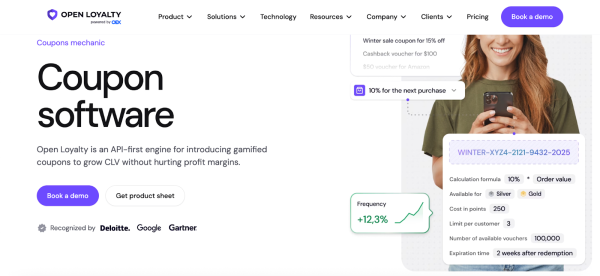
Open Loyalty is widely viewed as a leader for enterprise teams that want a unified loyalty and coupon management software engine with API control. A headless model lets teams wire loyalty logic into existing commerce platforms while using the built-in admin UI for configuration. Coupon issuance links with points, tiers, wallets, code scanning, and gamification, which creates a strong base for custom omnichannel promotion flows rather than preset campaign types. The strength comes from treating promotions and loyalty as one system rather than two siloed features. Success has many parents when a stack works cleanly.
LinkedIn: https://www.linkedin.com/company/open-loyalty/
Pros: Flexible API model supports deep integration. Designed for enterprise scale, security, ISO certifications
Cons: Integration requires technical resources. Not aimed at tiny teams that want a simple widget
Talon.One
Talon.One offers a rule engine that lets promotion logic operate like code, making it a strong choice among the best coupon management software options for organizations with advanced requirements. Retailers can combine attributes, cart contents, external signals, and pricing rules under one engine. A strong developer focus gives teams a sandbox, SDKs, and documentation that speeds integration.
LinkedIn: https://www.linkedin.com/company/talononeloyalty/product/
Pros: Granular rule engine. Developer tooling supports testing and versioning
Cons: Complex rules require technical skills. Enterprise pricing model
Vouchery.io
Vouchery.io places AI at the center of its promo engine. Many retailers see it as one of the best coupon management software choices for mid-market growth teams that want Next Best Offer targeting and frictionless campaign setup. Prediction models support redemption uplift and reduce misuse risk. A ready-made UI and integrations allow marketing teams to run campaigns without building heavy rule logic.
LinkedIn: https://www.linkedin.com/products/vouchery-io/
Pros: AI personalization and abuse scoring. Clear pricing tiers with generous code limits
Cons: Advanced support tied to higher tiers. Large enterprises may prefer broader CDP suites
SessionM
SessionM, part of Mastercard, combines loyalty, customer data, and engagement orchestration with deep POS integration. Many large retailers treat it as one of the best coupon management software options when physical and digital channels need unified rules. Event-driven campaigns fire offers based on purchase context. Strong integration with operational systems makes coupon logic work at scale.
LinkedIn: https://www.linkedin.com/company/sessionm/
Pros: Deep POS integration. Operates with Mastercard reliability and compliance
Cons: Enterprise deployment scope. Suited for large teams, not small merchants
Uniqodo
Uniqodo targets promotion control and margin protection. The engine distributes unique codes, limits leakage, and manages affiliate flows with high granularity. Many e-commerce brands rank it among the best coupon management software options when uncontrolled coupon sharing damages ROI. Controls allow brands to grant codes only to verified audiences, partners, and defined contexts.
LinkedIn: https://www.linkedin.com/company/uniqodo-limited/
Pros: Advanced single-use code controls. Designed for affiliate and partner use cases
Cons: Specialist scope. May require separate loyalty stack
Final verdict
You choose the best coupon management software based on your scale, tech appetite, and stack maturity. Mature teams treat promotions as a shared capability rather than a single channel trick. Open Loyalty stands out through depth, multi tenant architecture, and unified loyalty plus coupon logic. Voucherify, Talon.One, Snipp, CodeBroker, Vouchery.io, and Mezzofy all solve specific scenarios, so you match the engine to your use case, not the other way around.
A smart rollout uses a tight pilot that tests issuance rules, identity mapping, and live redemption performance. Gather user feedback early and plan for steady evolution instead of a big bang launch.
FAQ
How does coupon rule complexity influence platform selection?
Complex rule logic requires a platform that can model events, user attributes, and pricing constraints without custom code. Engines with granular rule builders reduce friction during rapid iteration.
What matters most when evaluating extensibility in promotion engines?
Extensibility comes from APIs, modular logic layers, and access to event streams. It lets teams scale campaigns without rebuilding promotion logic for each channel.
How do retailers prevent coupon abuse without hurting engagement?
Single-use codes, authenticated redemption, abuse scoring, and quota limits protect ROI. Strong identity checks keep campaigns profitable without unnecessary friction.
Where do loyalty programs intersect with coupon systems?
Loyalty data shapes eligibility, reward logic, and segmentation. Unified engines allow coupons to operate alongside points, wallets, and gamified rewards with shared identity.
Why do some enterprise teams centralize pricing and promotion logic?
Centralization creates one source of truth for discounts, making governance cleaner. Teams gain consistent behavior across POS, apps, and partner channels while reducing risk.