


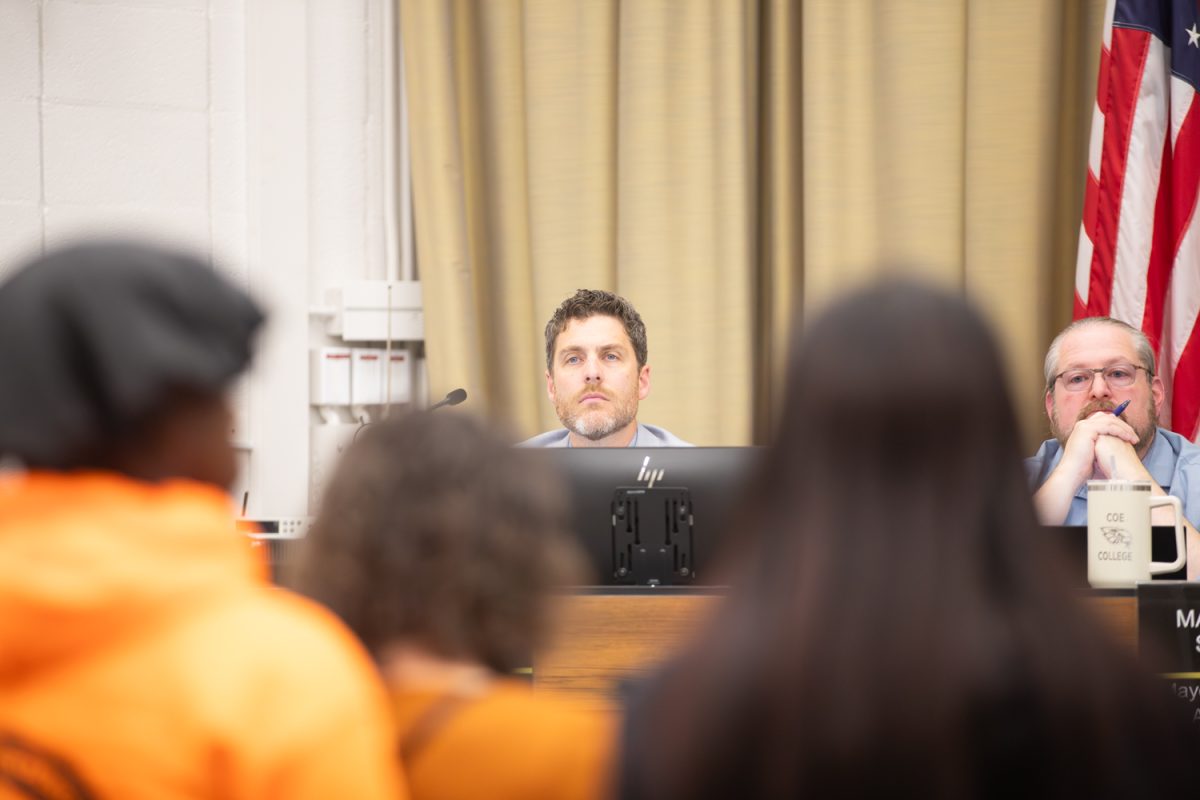
During its last formal meeting of 2025, the Iowa City City Council adopted several policy and infrastructure measures aimed at preparing the city for the year ahead Tuesday.
The council addressed key issues ranging from workplace policies to major capital projects and state-level advocacy priorities.
Among the resolutions were updated personnel policies for city employees, approval of the Burlington Street bridge replacement design concept, and discussion of the city’s 2026 legislative agenda.
Iowa City 2026 state legislative priorities
Before the start of the Iowa legislative session, the city council adopts and communicates Iowa City’s positions on political issues, including housing, immigration, and human rights, to the elected delegation. The 2026 Iowa legislative session will commence on Jan. 12, marking the second year of the 91st Iowa General Assembly.
City Attorney Eric Goers urged the council to fail the resolution as there was still indecision among councilors about which items to remove or revise. As a result, the council voted unanimously to reject the proposal, with the intention of revisiting a revised version at their next meeting on Jan. 6, allowing more time for deliberation and refinement of their legislative priorities.
Mayor Pro Tem Mazahir Salih said she was concerned about the inclusion of an immigration component in the legislative priorities, questioning whether it was too specific or outside the council’s typical focus.
Councilor Laura Bergus agreed to advocate for the protection of immigrant rights and ensure protected identities remain safeguarded, aligned with the city’s broader civil rights goals.
“I think it’s very important that we continue to stand in our values and to make the record so that people know that Iowa City still believes in these things and that we’re not going to try to imagine a world in which they couldn’t pass laws that would do all these things,” Bergus said.
Burlington Street bridge replacement project
The resolution, prepared by Iowa City’s Senior Engineer Justin Harland, approved the design concept for the Burlington Street bridge replacement project and was unanimously approved by the council.
The footbridge, primarily crossed by University of Iowa students who live on the west side of campus and community members going to football games at Kinnick Stadium, is nearing the end of its “useful” design and hasn’t been updated since 1986, according to the resolution.
In 2021, the city performed a bridge inspection, and the conditions were listed as “poor” and “structurally deficient.”
Mike Kurek, Eastern Iowa transportation manager and senior project manager at HDR Engineering, an engineering consultant firm in Cedar Rapids, discussed project designs for consideration, walking councilors through the planning study that identified the bridge’s needs, evaluated alternatives, and produced a preferred concept for replacing the century-old eastbound span.
Kurek said the planning study focused on addressing safety, accessibility, and long-term functionality, noting that the bridge’s age and structural condition made replacement unavoidable.
RELATED: IC City Council, Downtown District consider tax district renewal, expansion
“What surfaced to the top was a list of needs and wants,” he said. “Starting with creating lower-stress, ADA-compliant space to bike and walk, designing safer roads and intersections, and prioritizing emergency vehicle access to the medical center.”
Councilor Josh Moe said he was concerned about safety, particularly with how future design choices could affect the Burlington Street dam and surrounding infrastructure. He urged the city to keep dam improvements in the project scope rather than treating them as optional.
“I think we should continue to keep that as part of the project and make it as safe as possible,” he said. “If we shortcut that one piece, suddenly we’re thinking about taller guardrails and different safety features and all kinds of other elements.”
The project is anticipated to take multiple years, with construction set to start in the spring of 2029 and is predicted to cost around $70 million.
Personnel policies update
The council unanimously voted to rescind the 2024 personnel policies, or rules and guidelines that govern an organization’s employer-employee relations, to adopt an updated version to improve clarity and reflect changes that have occurred in the workplace.
The updated personnel policies discuss a more relaxed dress code, appearance and grooming standards, and other workplace rules and clarifications, including rest breaks and updating the city’s exit interview questionnaire provision to better reflect current practices for city workers.
Councilor Oliver Weilein initially voted to pull the item from the consent agenda for further discussion. He said he was in favor of approving the resolution, but wanted to have more discussions with staff before the policies are updated.
“I think all I would say is maybe look to see if we can have a more in-depth, holistic conversation between city staff, and maybe even ask union reps or whatever we think could be the best vehicle for that conversation, because some [staffers] are bringing up concerns,” he said.
Councilor Megan Alter agreed with Weilein’s concerns but cautioned against the council becoming too involved in day-to-day operations.
“Sometimes it’s about whether you’re front facing with customers or the public. So I think as long as we give some latitude for staff for the city manager’s office while they’re engaging with staff, that those conversations can continue,” she said.