
This is an installment in a multi-part series.
With a growing trade system increasingly shaped by tariffs and inflation, uncertainty for local coffee roasters in the Iowa City area has heightened with increases in the price of coffee beans over the last year.
The average price per pound of ground coffee has risen 35 percent. In December 2024, the cost per pound of ground roast coffee was $6.77. In September of 2025, that amount rose to $9.13 per pound, according to data released by the U.S. Labor Department.
The price of unroasted beans is not set locally, but through the global commodity futures market, otherwise known as the “C market.” The marketplace sets future prices for essential goods, including food, beverages, and household goods, and is commonly influenced by global economic health, including tariffs, which change the price per pound of coffee.
Futures markets are a trading mechanism primarily used in commodity markets like corn, soybeans, and other agricultural outputs, allowing commodities produced now to be sold later at a set price. Setting a contract price for the future allows producers to protect themselves against potential price drops.
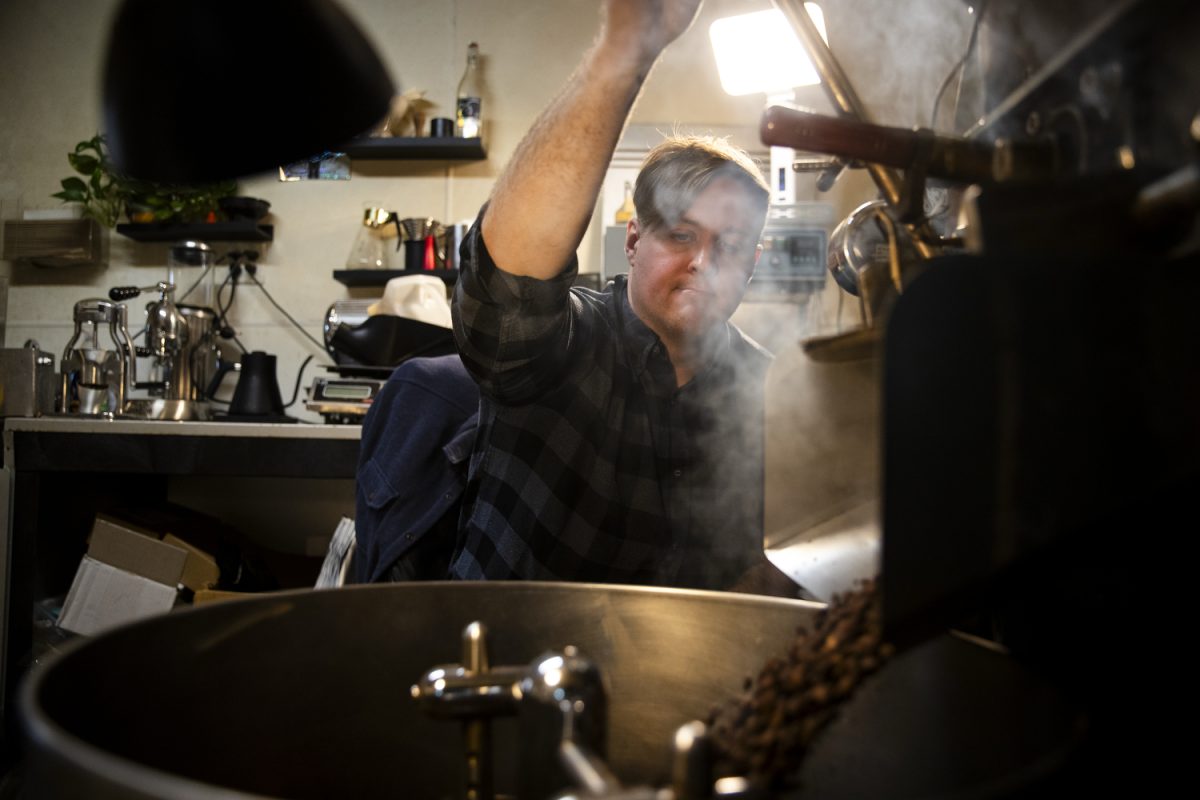
These fluctuations have been amplified by the presence of tariffs, specifically tariffs placed on Brazilian coffee imports. Sam Caster, owner and operator of Brass Ring Coffee in Iowa City, said Brazil produces roughly 40 percent of the world’s coffee supply, making the county an important player in the coffee market as a whole.
However, President Donald Trump rolled back tariffs, on Brazilian coffee on Nov. 21. This did not immediately resolve negative price effects, as the futures price dropped, erasing 6 percent of the Brazilian coffee market’s value, according to Reuters.
“I am ordering far less Brazilian coffee because of the incredibly steep tariffs that have been levied against them,” Caster said. “This is a real nightmare scenario.”
Encounter Cafe, a local coffee shop in downtown Iowa City, however, has not seen the immediate impacts of these tariffs, as the cafe does not purchase Brazilian-sourced beans, meaning they are not paying more for their coffee beans and are not having to raise their prices.
“We only buy beans from Central America, so from places like Honduras, Nicaragua, and Guatemala,” Ray Yutzy, general manager of Encounter Cafe, said.
In November 2025, the Trump administration reached a trade agreement with Argentina, Guatemala, El Salvador, and Ecuador on goods that cannot be grown in the U.S. This includes goods like bananas, coffee, and textiles.
“We just haven’t seen any significant increases at all,” Yutzy said. “I think we just got really lucky that none of our coffee is coming from countries with high tariffs.”
Caster compared his situation to trying to run a gas station without any access to oil from major oil-producing companies. Coffee beans have no viable domestic alternative and cannot be grown at the necessary scale in the United States due to climate limitations.
Coffee beans need the tropical climate countries in the “coffee belt,” which include Mexico, Brazil, and Ethiopia. Because the U.S. lacks this climate, American roasters remain dependent on imports.
“If the C market changes from $3.80 to $4.15, then roasters have no choice but to adjust our prices or accept slimmer profit margins,” Caster said. “The tariff situation has created a ton of chaos in the C market, causing massive price spikes accompanied by sudden price drops.”
These swings in the market have forced Caster to rethink how and when he orders and sources his beans. Caster said he tends to carefully watch the market and wait for prices to fall before putting in orders.
“This has caused me to be incredibly opportunistic when ordering coffee,” Caster said. “If the market is at a crazy high, I’ll usually just wait until it drops and source as much coffee as possible once the C market goes back down.”
To offset rising costs, Caster said he is buying beans in bulk to reduce shipping fees. Even so, price increases have been unavoidable for Caster.
“I have had to do a price increase this year,” Caster said. “I would say customers have been a bit surprised, but overall very understanding of the situation.”
But Caster said he isn’t very worried about the impact of raising prices on his business. In a coffee-oriented community like Iowa City, Caster said demand is not an issue for him.
“Demand for coffee, especially in Iowa City, is as high as it has ever been,” Caster said.
This demand is shaped by consumer habits, and in downtown Iowa City, students make up a large percentage of these consumers.
University of Iowa first-year student Grace Market said she prefers to go to chain coffee shops like Starbucks or Dunkin’, rather than local coffee shops.
“It is just too expensive,” Market said. “It is hard to justify spending that kind of money on coffee when you know it will be cheaper at Starbucks.”
A 12-ounce latte at Starbucks costs $5.45, excluding tax. At Java House, a local coffee shop in Iowa City, a 12-ounce latte costs $5.25. While the prices are similar, Market said chain coffee shops are more appealing to her because she always knows what she is going to get.
Market is originally from Wisconsin, and said she has noticed an increase in prices since moving to Iowa City, specifically the pricing in local coffee shops. She said for her, it feels like she never knows what she is going to end up spending on a coffee.
“The other day I went into a local coffee shop and paid around $8 for a hot chocolate, which is unreasonable in my opinion,” Market said.