


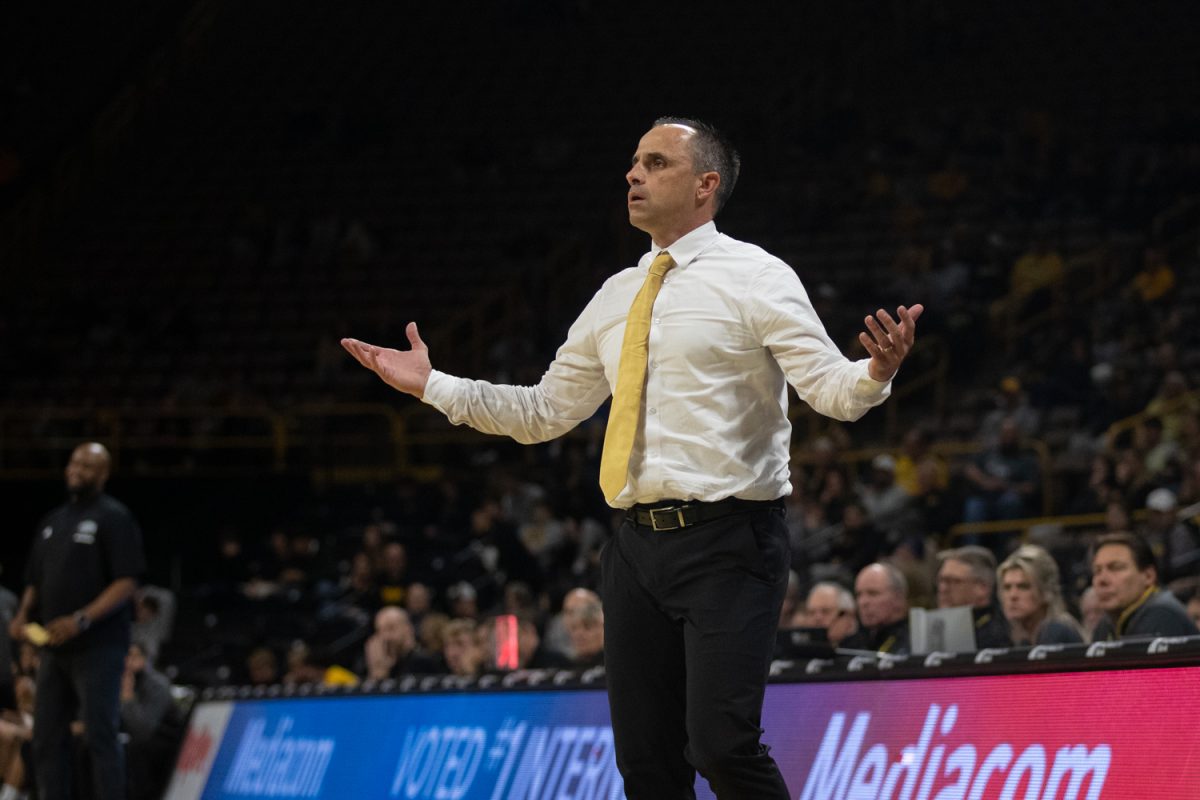
After having three days to look at the tape from Iowa men’s basketball’s blowout loss to Michigan State on Tuesday, head coach Ben McCollum came into Friday’s media availability with the same resolutions he had in his postgame presser.
It was the Hawkeyes’ first loss of the season, and it came at the hands of the No. 7-ranked Spartans on the road. A glaring issue in McCollum’s eyes was the offensive stagnancy, not getting in and out of actions consistently, and that’s partly to do with Michigan State intentionally clogging the paint and making Iowa play from outside the perimeter.
“We worked on things to try and combat that, and I think we just didn’t execute,” said forward Cam Manyawu. “You might be able to say that was part of the atmosphere when we just weren’t really thinking about what we were supposed to do.”
Another one was the rebounding battle. The Spartans outgained the Hawkeyes on the boards, 37-18, including 13 offensive rebounds. Rebounding has always been a big emphasis for McCollum, only this time around it’s a little bigger after Tuesday’s performance.
“If you have just a massive 7-foot-2 guy, then your box outs don’t have to be as good,” McCollum said. “You don’t have to help with that stuff. But if you don’t, which is what we’ve had in the past, then everybody needs to consistently do that. And we didn’t consistently do that in that game.”
For almost everyone on the team except Brendan Hausen adn Cooper Koch, the Michigan State loss was a great taste of what Division I basketball, more specifically Big Ten basketball, is going to be like as conference play continues.
Scouting Maryland
Up next is a home matchup against Maryland, who’ll pose as another challenge with its aggressive rebounding approach. The Terrapins average 13 offensive rebounds a game, the same amount the Hawkeyes gave up to Michigan State.
Outside of that, Maryland has struggled in several parts of the game, especially offensively where it ranks last in the Big Ten with a 41 percent field goal percentage and a 31 percent three-point percentage.
The Terrapins’ offensive struggles can be credited to its speedy playstyle. While the shots go in at a lower clip, puts a lot of pressure on the defense leading to fouls — ranked second in teh Big Ten with 15.2 opponent fouls per game, only behind Iowa.
Maryland is averaging a Big Ten-leading 22.6 made free throws on 29 attempts a game at a 77 percent clip.
“Historically, they do play pretty fast,” McCollum said. “They play fast, [they’re] a multi-defense team, and then obviously they got a really good big guy in Pharrel Payne, who’s elite.”
Payne ranks eighth in the Big Ten with 18.9 points per game and fourth with a 64.4 field goal percentage. The 6-foot-9 senior forward is one of four Terrapins to average double-digit points thus far, which accounts for 71 percent of the team’s point average.
A top-heavy Matyland team that gives up a Big Ten-hgih 78 points per game to opponents can pose as a favorable matchup for Iowa to find its way back into the win column.
“We’ll just have to make sure we do our little things with boxing out, and, focusing on our offensive flow and our defensive spacing. Those will be big for us,” Manyawu said. “And if we just execute the little things that we didn’t really execute against Michigan State, we’ll be successful in this game.”