
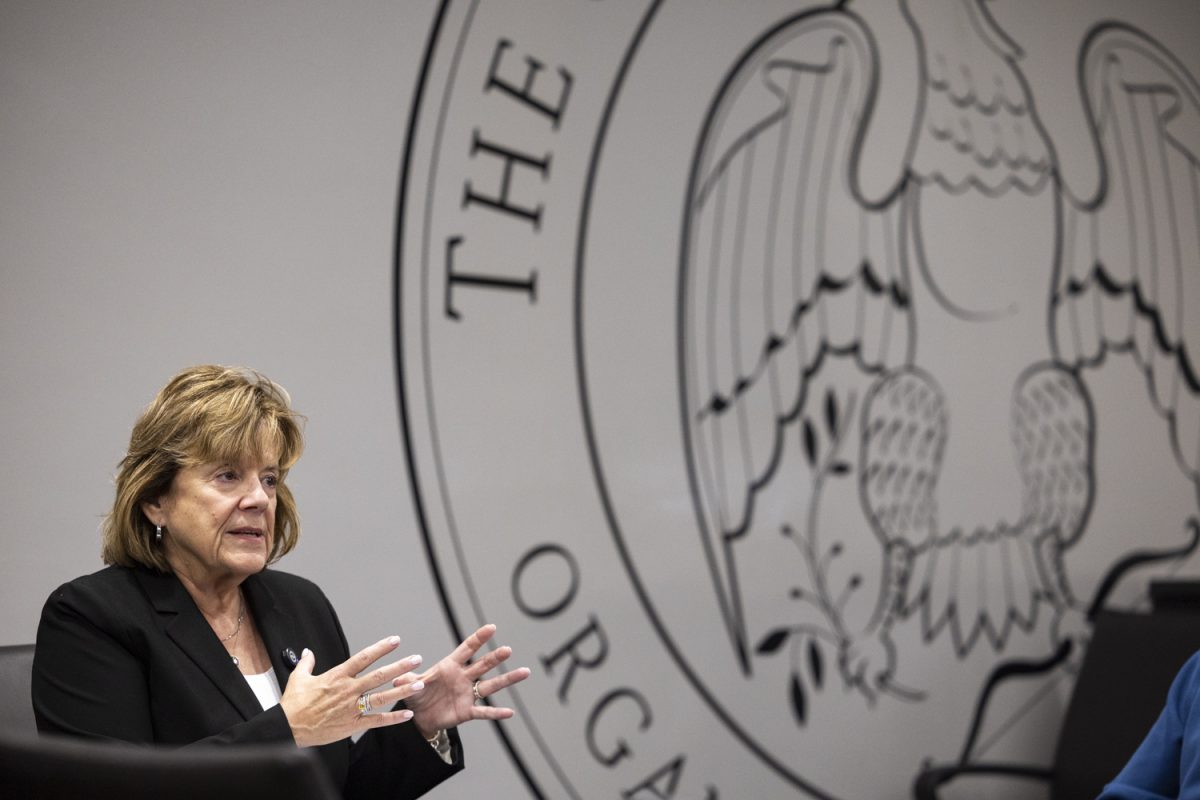
The Daily Iowan interviewed University of Iowa President Barbara Wilson Thursday on several topics, including the newly founded UI Center for Intellectual Freedom, the NCAA national women’s wrestling tournament, and what the recent Immigration and Customs Enforcement, or ICE, presence in Iowa City means for campus life.
This interview has been edited for length and clarity.
The Daily Iowan: With the Center for Intellectual Freedom opening in the spring semester, what are your thoughts on the decision to have the center at the UI?
Wilson: We’re trying to be as supportive as possible, but it’s not something that we’re directly involved in right now. What we are involved in, and what I’m really excited about, is our efforts around civic dialogue, and that’s really on this campus.
We’ve been piloting a program in the residence halls to really help our students learn skills around listening, around curiosity, around resisting affective polarization. I think part of what we’re seeing in this country is a polarization of citizens, where we just avoid people who think differently from us and we don’t talk to people who we perceive as having different beliefs, and that’s not going to get us very far in society. So if we can figure out how to help young, new students to bridge some of those divides early on, I think we’re going to all be better off for it.
The bill stipulates once state appropriations for the Center for Intellectual Freedom end, funding required to operate the center — an estimated $1.5 million a year — will be provided by the regent institutions. What does this look like for the University of Iowa?
We’ll work with the [Board of Regents] on those issues. I think we haven’t even begun to think about long-term financing right now. It’s more about what this center is going to do, and how it will intersect with a variety of constituents, and what the bylaws are going to look like. So I don’t think we’re really even discussing, and again, it’ll be up to the board to figure that out, because the center does report to the board.
The Hawkeyes will host the first-ever NCAA women’s wrestling national championship in the spring. What does this mean for the university and the future of the sport at Iowa?
Anytime we can host a championship game or series is a good thing for the university and really for the community.
Women’s wrestling, which is, as you know, a growing sport, and one that we hope will grow beyond just a place like the University of Iowa. To have us be able to showcase that is just phenomenal. It’s an opportunity. We’ve got great coaches and great student athletes, so I just think it’s wonderful.
With the AI certificate program set to begin in Fall 2026, what will this mean for the presence of AI on campus and ongoing discussion surrounding higher education and AI?
There’s so much talk about AI, and I would be foolish to say I know exactly how it’s going to evolve in this country and on a campus like ours, but what I can tell you is, we’re thinking about AI like a tool.
I think what the goal for all of us is to think about AI as a set of tools and to make sure our students, and our faculty, staff, and community are all ready for this new set of tools. Know how to use it, know how to critique it, know how to benefit from it, and think deeply about the ethical and philosophical issues around AI.
If the Iowa Board of Regents were to sign on to the higher education compact, how would the University of Iowa be impacted?
I’m happy to say that the board talks with the [regent university] presidents regularly. We’re in regular conversation with the board members. I think the board is really smart. They think deeply. We’re doing many of the things that are in the compact already, but we’re not doing all of them.
We are really thinking deeply about issues that are in the compact, where our faculty are thinking about ways to ensure that we teach in certain ways and make sure that we encourage open dialogue and exploration of ideas. So we’re not that far off from some of the issues there, but signing something like that is a big step.
How would the compact’s requirement to not factor in sex, race, or gender identity into admissions impact or alter university diversity efforts and student demographics?
We’re not spending a lot of time figuring out how to reject people. We’re really spending time opening the doors and saying, ‘You look college capable, come to Iowa.’
From my perspective, as a public flagship institution, we should be admitting as many young people as we can possibly support and as possibly can succeed here. It’s an index, so you can find out pretty quickly whether you’re in or not.
How has the research arm of the university, as an R1 research university, recovered from federal funding cuts?
We’re still monitoring that. Fortunately, we’ve had a very small impact of some of the changes at the federal level around research. Only about 1 percent of our grants have been canceled, or cut, or stopped. In the grand scheme of things, that’s a very small impact.
Our concern is that things open up and get moving again, because we have a lot of young and seasoned scientists who have grant proposals that want those things reviewed, and they need funding, and they want clinical trials to continue. I think we’re seeing things open up, and we’re feeling pretty optimistic.
How is the university balancing a large budget for capital projects like the IMU renovation, which has a student fee component, while tuition increases continue to be approved by the regents?
Every decision we make around improvements and capital expenditures are thought out by lots of people. We do a lot of scenario planning, and we do a lot of contingency planning. We don’t launch anything if we aren’t pretty sure we can cover the project with the funds that we have, or that we can do a bonding or borrow money appropriately.
I’m thankful to our students, both undergrads and grads, who agreed to a modest increase in fees to support the renovation of the IMU. We wouldn’t have done it if that hadn’t happened.
RELATED: Q&A | UI President Barbara Wilson talks campus diversity, building updates
You called for a “comprehensive investigation” in response to an undercover Fox News video of UI employees discussing compliance with state DEI laws. What is the anticipated timeline for the investigation, and will you share the findings with the university community?
It wasn’t just me that called for that. We’re working with the [Iowa] Attorney General’s office and with the Board Office on that investigation.
To the extent that we can, we will share the findings. There are two employees that are involved, and we are really always careful about employee protection and making sure that we don’t reveal personnel information to the broad public.
Following ICE’s recent presence in Iowa City, what are your concerns, if any, surrounding the potential presence of ICE on the University of Iowa campus?
I’m always concerned about anybody who comes onto campus, because I care about the safety of our faculty, our staff, and our students.
We haven’t had any reports of ICE on campus. We would hope that they would contact us if they were going to come on campus. We have a good relationship with a lot of law enforcement agencies across the state, and we’ll continue to work to do that and to make sure that we get the heads up if there’s going to be something happening, but nothing’s happened at this point.
What is your response to the recent grievance filed by the graduate student union COGS regarding an “unexpected $1,500 in tuition bills for graduate students?” Are these concerns well-founded, and is there a particular reason for this?
We’re always concerned about our students and about how we pay them, and what we pay them, what their benefits are. We know about the grievance, and we’ll continue to work with COGS.
Our grad students are really critical to everything we do. We couldn’t do a lot of the teaching and research that we do without their incredible involvement. We want to make sure that we take good care of our folks and that we also follow the laws and principles of what we can do as a public institution.
When Brian Busch was arrested, the UI said it was reevaluating its conflict of interest policies and updating its oversight of funds at the machine shop. What form has this taken, and what is the university doing to track and prevent instances of fraud from happening elsewhere across all departments?
Nobody wants these things to happen. It’s not good for the university. Fortunately, we caught it, we took care of it. I think that’s our responsibility as a state institution, is to make sure we don’t have those cases. But am I going to tell you we’re never going to have a problem again in the future? No, that would be foolish.
Our goal is to train, educate, and make sure, if there are bad things that are happening, we find them quickly and move to take care of them.