


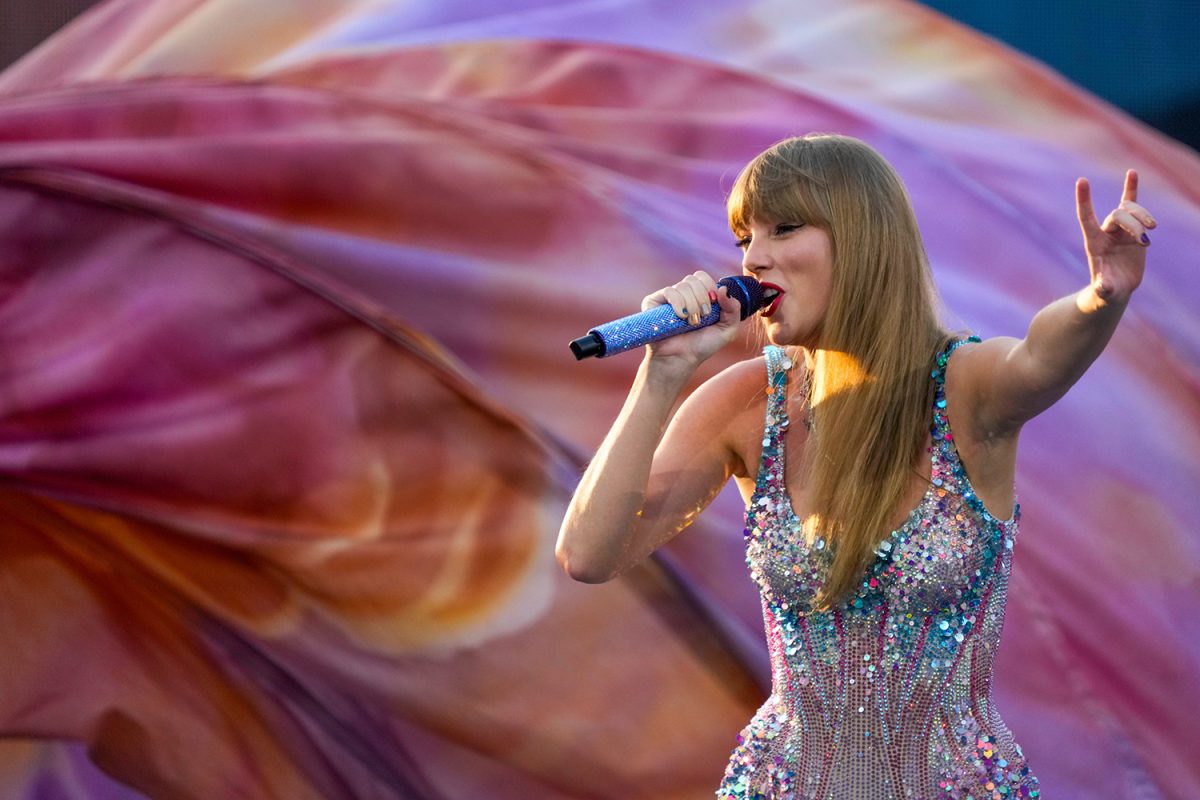
It’s impossible to ignore Taylor Swift.
She is on every late-night show, hitting top charts every time she releases music, and makes an enormous impact on the economy by touring.
I can undoubtedly admit Swift is a global phenomenon deserving of discussion. It is almost ignorant not to acknowledge her influence. Yet, we also can’t ignore the recent profit-driven style her work is stuck in.
My love for her music peaked at her albums “folklore” and “evermore,” which could be said for a lot of her fans. But I wouldn’t consider myself a fan of her as a person, and especially not of her latest music.
Candice Wuehle, University of Iowa professor for the honors class “Poetics (Taylor’s Version),” said Swift’s impact, both economically and socially, merits her work being discussed in an academic setting. The class encourages discourse about Swift’s work through a poetic lens, as students analyze intertextuality and themes within the artist’s stardom.
“‘The Tortured Poets Society’ openly acknowledges she is working within poetic traditions. There are direct allusions to her resonance with the confessionalist movement, and we get literary references, from Greek mythology to Coleridge’s Rime of the Ancient Mariner,” Wuehle said.
Harvard professor Rachel Burt started teaching about Swift’s discography in 2023, with countless colleges, including the UI, following suit shortly after.
However, her newest album, “The Life of a Showgirl,” has become emblematic of problems in the music industry, and has solidified my personal distaste.
“The rule of show business is, if it’s the first week of my album release, and you are saying either my name or my album title, you’re helping,” Swift said in response to the criticism surrounding the album.
But that’s not what art is. Music is about telling a story, which Swift, admittedly, has done in the past. At 20-years-old, Swift told a story of heartbreak and vulnerability with her 2010 album “Speak Now.” In “Reputation,” Swift reacted to the public scrutiny she faced, namely about her feud with the Kardashians, and about reclaiming her story.
As an emerging female pop star, Swift rightfully had a story to tell. In her acceptance speech for the Woman of the Decade Award, she explicitly called out the double standard between men and women in the music industry.
In her 20s, her publicized relationships and start in the music industry as a young woman made for great songwriting. At 35, this formula is oversaturated. And with her billionaire status, perpetuating these storytelling beats feels like a money-making attempt.
“[Swift doesn’t] have any uplifting story anymore to cause me to care about her or her music,” Nell Petersen, UI second-year student, said.
In the first week of her new album’s release, Swift released 34 variants of the same album. In the same week, she made $135 million in revenue, according to Billboard.
Avid fans were buying these variants even before hearing the album itself, with Aiden Watson, a Taylor Swift fan, sharing in a story by People Magazine he had spent $800 on the variants. Watson stated he doesn’t even play the music he buys but merely uses them as wall art.
This isn’t new, though. “Midnights” had 19 variants offered to fans, in the form of CDs, cassettes, vinyls, and more. It might just be speculation to think she released so many versions of “Life of a Showgirl” so soon because of the criticism and lukewarm reviews it received.
But in the end, Swift is raking in money, and it’s not just because of album variants. She also released an 89-minute lyrical video “watch party” in theaters, which made $46 million worldwide.
“Swift’s music uses aesthetics to fill the void where artistic substance should go,” Parker Lee, a UI second-year student, said. “Her vapid, childish lyricism, like writing ‘So High School’ when she graduated nearly two decades ago, appeals to and encourages a demographic of, largely, other young women who are scared of growing up.”
And maybe, for that reason, “The Life of a Showgirl” has a marketing disconnect. When Swift first announced her album on fiancé Travis Kelce’s podcast, many people, including myself, expected the album to be primarily about the record-breaking Eras Tour that had concluded months prior. Although a few songs definitely reference her experience, it seems the main focus of the album is Kelce… and sex?
Swift, who has been a symbol of independence and feminism for women, has largely appealed to female audiences. But in doing so, she alienated other audiences, especially men, from her music. I would argue she has changed her narrative to appeal to audiences who think her music is overly sappy and annoying.
“Swift has definitely resonated with me as an artist in part because she has made independence for women glamorous,” Wuehle said. “But I was very disappointed when ‘Life of a Showgirl’ came out, and I heard she made a reversal. It makes me really sad she has made this reversal at this current political moment.”
Swift’s influence extends far beyond the music industry — her political presence, or lack thereof, recently, has become just as defining.
Although we shouldn’t turn to celebrities for their political views, nor should celebrities feel obligated to educate their fan base, Swift has explicitly involved herself in politics in the past.
In her “Miss Americana” Netflix film, she emotionally discussed President Donald Trump and how she could no longer stay silent about politics. During the 2024 presidential election, Swift publicly endorsed Democratic nominee Kamala Harris, while criticizing Trump.
Yet, Swift has been largely silent about Trump’s recent actions in the White House, including the immigration arrests across the country and the white supremacy movement taking place.
She has also yet to make any statement about the Israel-Hamas conflict, for which she, rightfully so, has received backlash. Fans, namely the #SwiftiesForPalestine community, have persistently asked the artist to comment on the occupation in Gaza, to no avail.
What is even more deafening about her silence is her fiancé’s neutrality in politics. Before the 2025 Super Bowl, Kelce said it was an honor to have the president at the game, no matter who it is.
Now, when it really matters, she has suddenly gone mute. It’s hard not to wonder whether her previous activism was an authentic conviction or a strategic move to fit the cultural moment.
Recent lyrics like “have a couple kids, got the whole block looking like you” and “good thing I like my friends canceled” combined with merch reading “protect the family” are incredibly tone-deaf. Even though these might not have been intentional, her silence on such topics is not helping her case.
It’s impossible to ignore Swift, but maybe that’s the problem. The louder her fame gets, the quieter her substance becomes.