


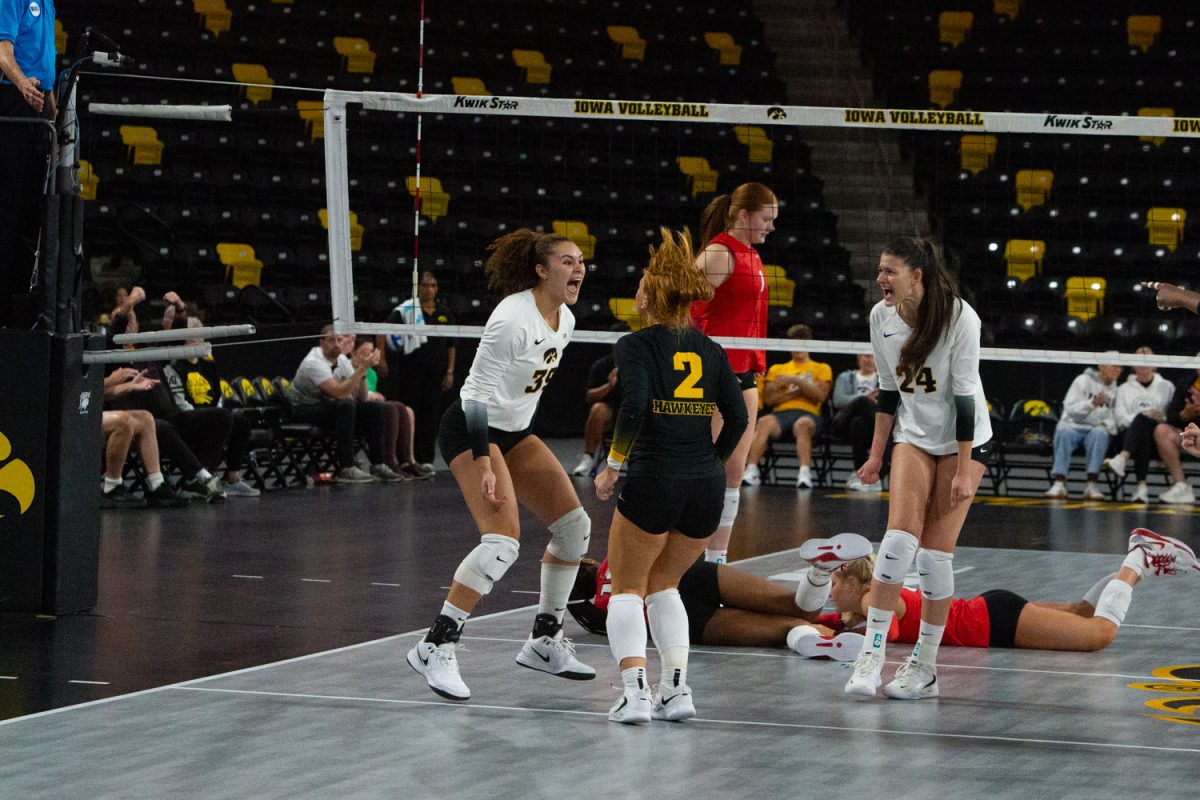
While the practice is most associated with college football, redshirting expands to numerous sports, especially at a school like Iowa. In Iowa City, volleyball is one squad which employs redshirting and has experienced benefits from its redshirt additions this year.
Redshirting refers to a student-athlete’s sole or joint decision with their coaches to withdraw from collegiate competition for a season but still retain a year of eligibility for future use. Reasons for doing so include taking time to recover from injury, build up skills, learn from older players, or a combination of motivations.
For Alyssa Worden, an ACL tear in high school led the third-year to redshirt her first season at Iowa. Upon her start in the 2024-25 season, the outside hitter has proven a force to be reckoned with. Worden ranks sixth on the team in points and kills this season, her 86 kills almost twice from her total last year.
“It does help you gain some college experience because the game is a lot faster,” Worden said. “It helps to watch the people on the court and how they deal with their adversities.”
At surface level, a year on the sidelines could appear frustrating or even boring, especially for someone like Worden, a star player and two-time state champion at South Elgin High School in Illinois. Yet the outside hitter never felt any disinterest — rather, she gained a sense of wisdom.
“You gain a different perspective while you’re on the bench, especially as a redshirt,” Worden said. “You gain more experience, you gain
maturity, and [you] understand how to deal with college ball.”
Head coach Jim Barnes was involved with Worden’s decision not to play her first year at Iowa and said the year off helped her physically.
“She was coming off a really tough injury coming into college, so it gave her more time to get her body to the level where she can play,” Barnes said. “We’re just now starting to see her physically be able to play at the level she’s capable of.”
Barnes also credited Worden as a great talent. The third-year nabbed a double-double in Iowa’s 3-1 win over Michigan State on Oct. 24, with career-highs of 16 kills and 15 digs.
“She’s really starting to come along here in the second half of the season,” Barnes said.
Worden is one of several Hawkeyes who have redshirted in past seasons. These athletes have already proven to be welcome additions to the program once they return to the court.
Second-year Aleksandra Stojanovic has proven to be a force at the middle, tallying over 100 kills this season, while fellow second-year Hallie
Steponaitis, an outside hitter, nabbed a career-high 11 kills in Iowa’s 3-2 loss to Michigan on Oct. 11.

For third-year Allison Berent, the decision to redshirt came well before her days as a Big Ten contender.
Originally from Rochester Hills, Michigan, Berent began her college career at Alabama, where she appeared in eight matches as a first-year. The social and mental shortcomings of the program, however, took a heavy toll on her, leading Berent to redshirt her second year and subsequently enter the portal.
“I think [at] Iowa, there’s more care for the players,” Berent said. “It’s a closely knit community and everyone cares for each other. The coaches care for your well-being before you’re even an athlete in their eyes. They put the same amount of effort into you to become the best
athlete you can.”
Reflecting on her decision, Berent said she was glad to have sat out her second year.
“I see it more as a blessing in disguise that I did,” Berent said. “I didn’t play at all, I hopped in the portal, and I have an extra year at a school that I actually want to rep on my jersey.”
Barnes ultimately credited the experience of redshirting as giving an opportunity to a player who needed extra time to adjust. While team performance is still prioritized, a redshirt year grants a player the chance to focus on themselves, then return to the group with improved skills.
“It’s the only time in their life they ever really sit the bench,” Barnes said. “They’ve been stars coming out of high school and club, and this gives them an opportunity to really train and focus on some developmental areas they haven’t been able to do, help them get physically stronger, and adjust so that they can contribute the next year.”