
Iowa educators and advocates called on Iowa’s congressional delegation and President Trump’s administration on Thursday to prevent a lapse of funding in the U.S. Department of Agriculture’s Supplemental Nutrition Program, or SNAP.
Nationwide, nearly 42 million low-income Americans rely on SNAP to purchase food each month, according to the U.S. Department of Agriculture. On Saturday, the program will run out of funding.
The Iowa State Education Association, or ISEA, a nonprofit education advocacy group based in Des Moines, held a press conference Thursday to demand action from the Iowa congressional delegation and the Trump administration.
U.S. Press Secretary Karoline Leavitt announced on X, formerly known as Twitter, on Oct. 7, the administration would grant $300 million in unspent tariff revenue to keep the Special Supplemental Nutrition Program for Women, Infants, and Children, or WIC, going according to AP News .
The USDA stated in a recent memo that it would be unable to use contingency funds to resupply the SNAP program for November.
The U.S. Department of Agriculture, or USDA, website states SNAP funds will run out on Nov. 1, including SNAP dependents’ Electronic Benefit Transfer Cards, or EBT cards, which are used to access government-issued food and cash assistance benefits.
“Bottom line, the well has run dry,” the website notice said. “We are approaching an inflection point for Senate Democrats. They can continue to hold out for healthcare for illegal aliens and gender mutilation procedures, or reopen the government.”
At the Thursday press conference, ISEA President Joshua Brown scathed both sides of the political aisle for allowing SNAP to lose funding.
“For Iowa, SNAP is not a political talking point,” Brown said. “It is the difference between a child having a decent meal and having to face the day with an empty stomach. When students come to school hungry, their ability to learn disappears.”
Brown directly addressed the Iowa congressional delegation and the Trump administration, and said the delegation is failing the moral test presented before them.
RELATED: Federal budget cuts limit access to nutrition education programs in Iowa
“You are fighting over budget lines and political talking points while children are going to bed, worried about where their next meal is going to come from,” he said. “You are treating the future of our children as a bargaining chip in a game of partisan politics.”
Brown said hunger is detrimental to children’s learning, claiming children who face chronic food insecurity lag behind their peers in math and reading development. Brown said the path of inaction during SNAP’s fund depletion could follow children’s learning development for years to come.
A 2024 UNICEF report found that hunger can reduce academic performance by up to 20 percent.
“Hunger is a thief,” he said. “It steals concentration. It steals memory. It steals the very foundation of cognitive development. You cannot expect a child to focus on mathematical equations when their body is only focused on survival.”
Brown said the USDA has the ability to release emergency funds for SNAP; it simply needs the go-ahead from the president and the secretary of agriculture. He said he hopes the press conference will create a chain of urgency from Iowa residents to Washington, D.C.
“We teach our students when they disagree that we need to sit down and have conversations to figure out a way and a path forward,” he said. “I wish that our elected officials were modeling that good behavior here, because our students are watching and they’re seeing adults just yell at each other.”
Anne Discher, executive director of Common Good Iowa, a nonpartisan nonprofit organization that creates policy solutions for Iowa’s pressing issues through research and advocacy, said food stability issues arose for SNAP-dependent families long before the shutdown.
Discher said food costs are at record highs and that the dependents on SNAP reflect that. According to Discher, over 270,000 Iowans in 133,000 households relied on SNAP benefits in September. She added two-thirds of participants live in families with children.
Discher also said SNAP dependents will be negatively impacted by the Federal Reconciliation bill, or the One Big Beautiful Bill Act, passed in July.
Discher said the bill plans to strip food assistance from millions of citizens. She said additional financial pressures from the states may cause some lawmakers to end their SNAP programs entirely.
“But we’re not there now, and we do not need to be,” she said. “Congress can act. The state of Iowa should join what many other states are doing and put state resources either onto EBT cards or into food banks and food pantries.”
Jenn Stadler, Des Moines Public Schools’ SUCCESS supervisor, a school program assisting students from kindergarten through age 21 with basic needs and educational impairments, and attendee at the conference, said the SNAP halt would have a detrimental effect on Des Moines students and students all across Iowa.
Stadler said 76 percent of Des Moines public school students qualify for free or reduced lunch.
“To put a number to that, it’s just under 24,000 of our students,” Stadler said. “While not all of those families qualify for SNAP benefits, we know that when our students come to school hungry, they are not able to learn.”
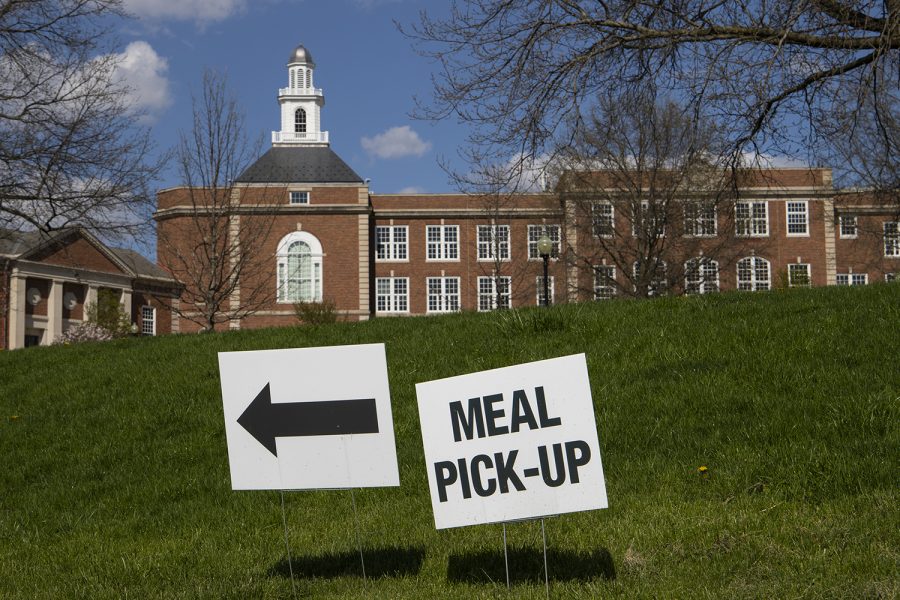
Stradler said Des Moines public schools have several programs like the Fresh Fruits and Vegetables program and several food pantries ready to assist families facing food instability that help provide breakfast, lunch, fruits, and snacks for students.
“We encourage regular school attendance on a daily basis, but especially now, knowing that families will be facing the possibility of not having their SNAP benefits,” she said. “Regular school attendance will allow your child to have access to breakfast and lunch.”
Brown directed his point to Iowa lawmakers.
“This is not a liberal or conservative issue; it is a human issue,” he said. “End the shutdown now. Let our students eat, let our students learn, and let our teachers teach.”