


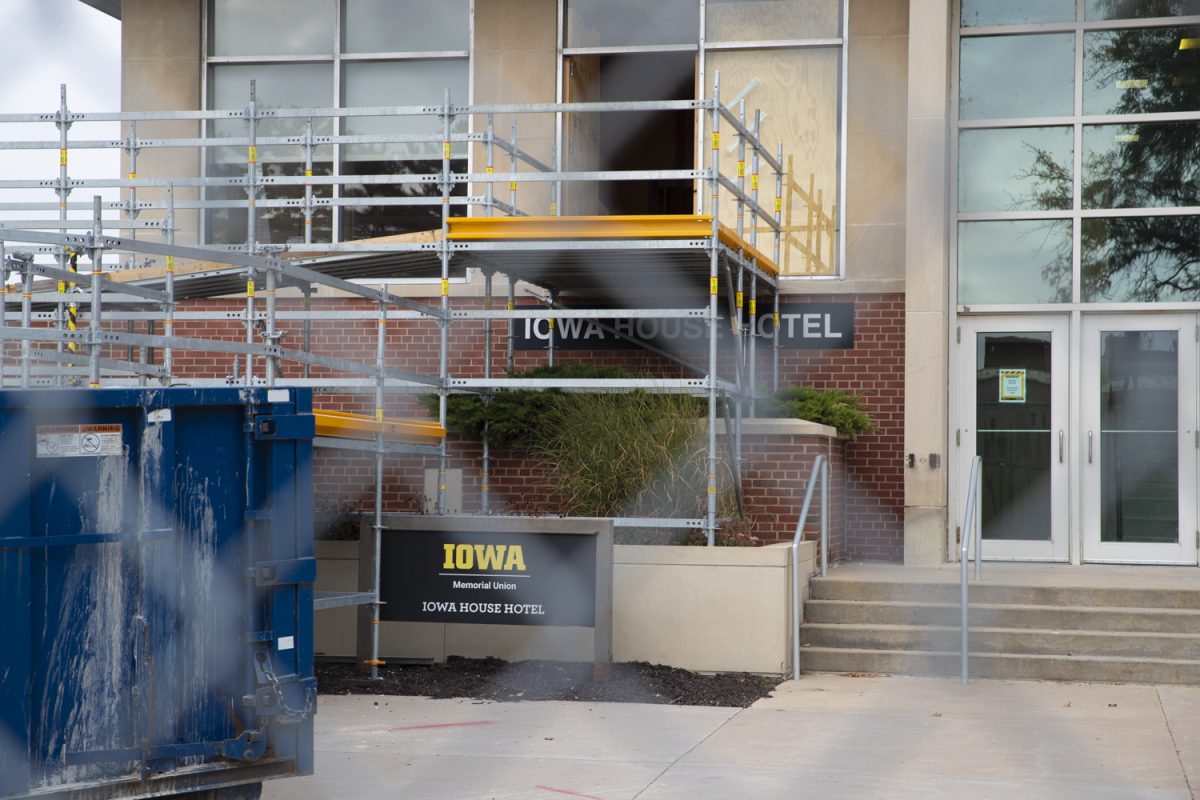
The Iowa Memorial Union on the University of Iowa campus is celebrating its 100th anniversary this year, but the building faculty and students are commemorating will look a lot different in just two years’ time.
After debate over the design and funding process, the Iowa Board of Regents approved an $81.4 million plan to renovate 120,000 of the historic building’s 326,729 square feet in April.
The project is part of the university’s 10 Year Master Plan to “modernize and improve campus,” according to UI Facilities Management.
Construction began just before the 2025-26 academic year. Phase one of the project is expected to finish in August 2026, with the second and final phase completed by August 2027, Bill Nelson, associate dean and executive director of the IMU, said.
This renovation project will mark the fifth time the IMU has been renovated, with additions and refurbishments made in 1927, 1955, 1965, and 1988, excluding the seven-year restoration project after the 2008 flood. That project cost $21.6 million, according to the university.
The $81.4 million price tag is comparable to a UI project completed eight years ago — Catlett Residence Hall, a modern, sleek student housing option on the campus’ east side, built from the ground up. The price on the project was $80 million, according to Design Engineers MEP, the design firm behind the construction. At capacity, it can house 1,049 students.
Just a year ago, the university was examining its options to add a new residence hall on the east side of the UI campus. However, it rejected the idea and decided to continue operating Mayflower Residence Hall, and the university is going full-throttle on the IMU’s renovation.
Nelson said the university has three main pillars it hopes to develop and improve upon for the renovations: interior and exterior appearance, student and faculty circulation, and well-being.
The first phase consists of gutting the fourth-floor Iowa House Hotel, which closed in February after 60 years. The entire space is torn “down to the studs,” Nelson said.
RELATED: UI launches grant program to boost federal research competitiveness
One challenge crews encountered while tearing down the hotel was removing the old 400-pound cast-iron bathtubs, Nelson said. But progress is otherwise going as scheduled.
He said the space will become a center focused on well-being and student support by holding services such as Student Life, Student Accountability, and Finance offices, as well as for student organizations like Fraternity and Sorority Life.
Several staple UI functions that already exist in the union will relocate elsewhere in the vices, which will be housed on the second floor. Student Health will relocate from Westlawn to the third floor of the IMU after completion, he said.
“I’m really pleased about that [the addition of student health and relocation of existing UI functions], in terms of how that will reenergize and revitalize our relationship with student organizations in general because of the larger space and the ability to serve more students,” he said.
Aesthetic changes, primarily modernizing the building with floor-to-ceiling windows around the building’s southeast corner and interior decorative redesigns, will appeal much more to students.
This will include the university reutilizing the union’s south parking lot.
Circulation is the other issue, with the project breaking through several interior walls to create direct pathways throughout the building and a grand staircase at the main entrance to allow movement between each floor.
Moving from floor to floor in the building necessitates traveling between different sets of stairs and elevators, an accessibility issue Nelson said the university wants to improve.
The second phase will focus on those remaining structural and circulation changes. Services located in the building will continue to shift as construction is underway, with functions like the Academic Resource Center, home of the UI’s Supplemental Instruction, having relocated permanently from the building to the UI Main Library, Nelson said.
The South Room, a meeting space and a historic part of the building, will be completely replaced as part of the main hallway expansion.
Costs and outreach
Student fees are the primary means of funding for the project, responsible for accumulating around $75 million of the $81.4 million project total, Nelson said.
The fee, specifically, is $120 per semester for undergraduate students and $100 per semester for graduate students, amounting to roughly $5.6 million and $1.2 million from undergrads and post-grads, respectively, in 2025-26, based on current
student enrollment.
According to the university, there are 23,407 undergraduate students and 6,269 graduate students enrolled for the 2025-26 academic year.
The remaining $6.4 million, Nelson said, will come in from Student Health Reserves and donor funds. Next month, Nelson and the Executive Director of Development for the UI Center for Advancement, Britt Bergquist, are traveling to Washington, D.C., to do outreach with student government alumni to see if named, gifted spaces are possible.
Nelson said the university has identified eight spaces within the building that could be gifted. Securing those donations would mean existing dollars could be reallocated to other parts of the project.
UI second-year student Lee Nienhaus said she is happy to pay the additional fee for the improved campus experience. She works at KRUI, the university’s student radio station, and, from her time in the union, said the union’s halls are usually empty.
“I feel like having this sort of revival of the facility is going to bring about a lot of students using it more often,” she said. “I feel like a lot of people use it as a study space because it’s so quiet.”
For the time being, the project’s design and construction will be funded by bonds, leaving the university in debt, according to Iowa Board of Regents meeting documents from June.
According to Board of Regents documents, the average time to maturity for the issued bonds is 15.3 years.
The regents delayed approval of the project in February, citing possible federal funding difficulties. At that meeting, UI Senior Vice President for Finance and Operations Rod Lehnertz said he was confident the university could fund the project beyond tenuous federal dollars.
The student fee aspect was initially confirmed in 2023 by the university and the regents. On campus, that discussion and outreach was led by the Undergraduate Student Government and the Graduate and Professional
Student Government.
USG President Thomas Knudsen said as the project entered its planning phases in 2022 and 2023, USG held a variety of roundtables and student outreach events to gather campus sentiment towards the building and identify important points for the project.
“We got a big opportunity to share USG feedback but also leadership feedback across campus,” Knudsen said. “And so [Fraternity and Sorority Life] got the opportunity to be there, Housing and Dining, the whole nine yards.”
Knudsen also said USG and GPSG functions would not be disrupted amid the construction, adding the two bodies are actively involved in overseeing small project details pertaining specifically to student life.
Nationally-branded food vendors are included in the discussion, though Nelson said brand contracts are not yet finalized and specific brands could not be referenced outside of Godfather’s Pizza, which will continue its existing contract.
Union Station Dining on the building’s bottom floor, for example, will be replaced by a national brand, as well as other spaces within the building.
Knudsen said USG and GPSG hosted a taste test event to gauge student preferences for nationally branded vendors as another method of collecting campus input for the renovations.
“Not a lot of schools do that, and I’m proud that we did it that way,”
Nelson said.
The increased access, ease of experience, and modernization of the building to improve student life are all things Nelson said he hopes to establish as the building continues construction through 2027.
“I can’t even tell you how thrilled I am about possibilities for this building,” he said.