



Strategic marketing: definition, scope, and connection to business goals
Strategic marketing is a long-range system for choosing markets, shaping demand, and linking choices to business goals and sustainable growth. The discipline sets priorities for product or service lines, pricing, channels, and communications so every action compounds toward market share and profit.
A plan translates the stance into the marketing mix, a marketing plan, and guardrails for activities and decisions. Strong strategic planning ties the company’s mission to an overall strategy that attracts customers, builds brand loyalty, and drives business success.
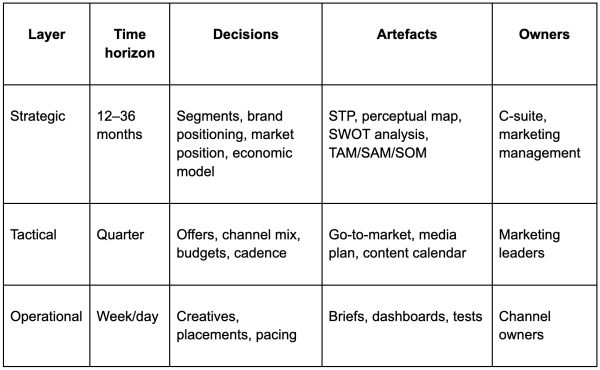
Strategic vs Tactical vs Operational:
Market analysis and marketing research that drive choices
Market analysis defines where value sits, who holds power, and how to win a competitive edge. Teams map demand, switching costs, and profit pools, then size market opportunities within competitive markets and the broader competitive landscape.
Marketing research supplies valuable insights through interviews, observation, and trustworthy secondary sources, giving a deep understanding of customer needs and industry trends. Peer-reviewed studies show that tighter segment focus often correlates with higher margins and faster growth; add a specific citation during editing.
Market segmentation, target audience, and brand positioning
Market segmentation selects specific customer groups and priority segments with shared economics and jobs to be done. Brand positioning states the promise, proof, and payoff that move the target market, then claims a durable market position on the perceptual map. Use competitor analysis to calibrate claims and pricing power. Done well, the result is higher customer loyalty, faster acquisition of new customers, and a step toward sustainable growth.
Competitive strategy, competitive advantage, and hybrid strategy
Competitive strategy sets the playing field and the escalation path. Competitive advantage comes from cost structure, compounding differentiation, data moats, or network effects that raise rival costs into a sustainable competitive advantage. A hybrid strategy can blend focused differentiation with selective cost wins where organizational capabilities and internal resources allow.

Strategic marketing process and the seven essential steps
The strategic marketing process is the operating system that turns choices into repeatable execution. Teams run a situation analysis, link to the company’s mission, and convert aims into goals and objectives that cascade through the overall marketing strategy. A practical version follows seven essential steps that many businesses can adopt:
- Clarify mission statement and business goals.
- Conduct situation analysis and market analysis with clean marketing data.
- Define market segmentation and target audience.
- Set brand positioning and market position.
- Build the strategic marketing plan and overall marketing strategy with a resilient marketing mix.
- Launch marketing efforts and marketing technique pilots inside a coherent marketing program.
- Install continuous monitoring to analyze complex data and refine the plan.
Develop marketing strategies and the marketing mix
Develop marketing strategies and the marketing mix to connect offer, pricing, channels, and measurement. Use digital marketing where your target audience over-indexes, and publish proof that reduces risk at each stage. Link packaging and price fences to positioning and willingness to pay. The outcome is improved unit economics and a firmer competitive edge. Strategic marketing management at this stage means writing a clear budget, assigning owners, and protecting focus so the strategic marketing plan does not drift.
Example: a B2B SaaS introduced a €29 starter tier with usage-based overages and a “pro” fence; contribution margin lifted six points in its top segment.
90-day playbook:
- Ship a one-page marketing strategy that states where to play and what to stop.
- Produce an STP snapshot and define two segment-specific journeys.
- Launch two content proofs and one flagship case study as marketing strategy examples.
- Test two paid and two organic routes with incrementality holdouts.
- Tune pricing and packaging, then set good-better-best tied to value metrics.
- Reallocate toward winners and end weak bets fast.
- Document strategic marketing examples and lessons for reuse.
Governance, metrics, and learning that compound results
Governance, metrics, and learning turn intent into compounding results. Strategic marketing supports business growth when teams isolate lift with clean tests, study complex data without bias, and refresh plans as conditions shift. Strategic marketing helps a business owner guard brand equity while expanding market share, deepening customer engagement, and reinforcing competitive positioning through clear goals and objectives.
Most common questions:
What is meant by strategic marketing?
Strategic marketing is the disciplined system that selects markets, defines a differentiated market position, and orchestrates the marketing mix to hit measurable business goals. It links research, segmentation, positioning, and resource allocation into one plan that compounds competitive advantage.
What are the 4 marketing strategies?
The classic set comes from the Ansoff Matrix: market penetration, market development, product development, and diversification. Teams pick the growth path for each target audience, then set channel, pricing, and product bets to match risk and return.
What are the 5 C’s of strategic marketing?
Company, Customers, Competitors, Collaborators, and Context. Assess strengths and constraints, map customer needs, profile rivals, identify partners and supply chain actors, and read macro forces such as regulation and technology shifts.
Why is strategic marketing important?
Strategic marketing focuses resources where they drive revenue quality, margin, and cash efficiency. Expect lower blended CAC, stronger LTV/CAC, faster win rates, and steadier pipeline velocity when choices concentrate on a clear target audience and brand positioning that supports pricing power.