
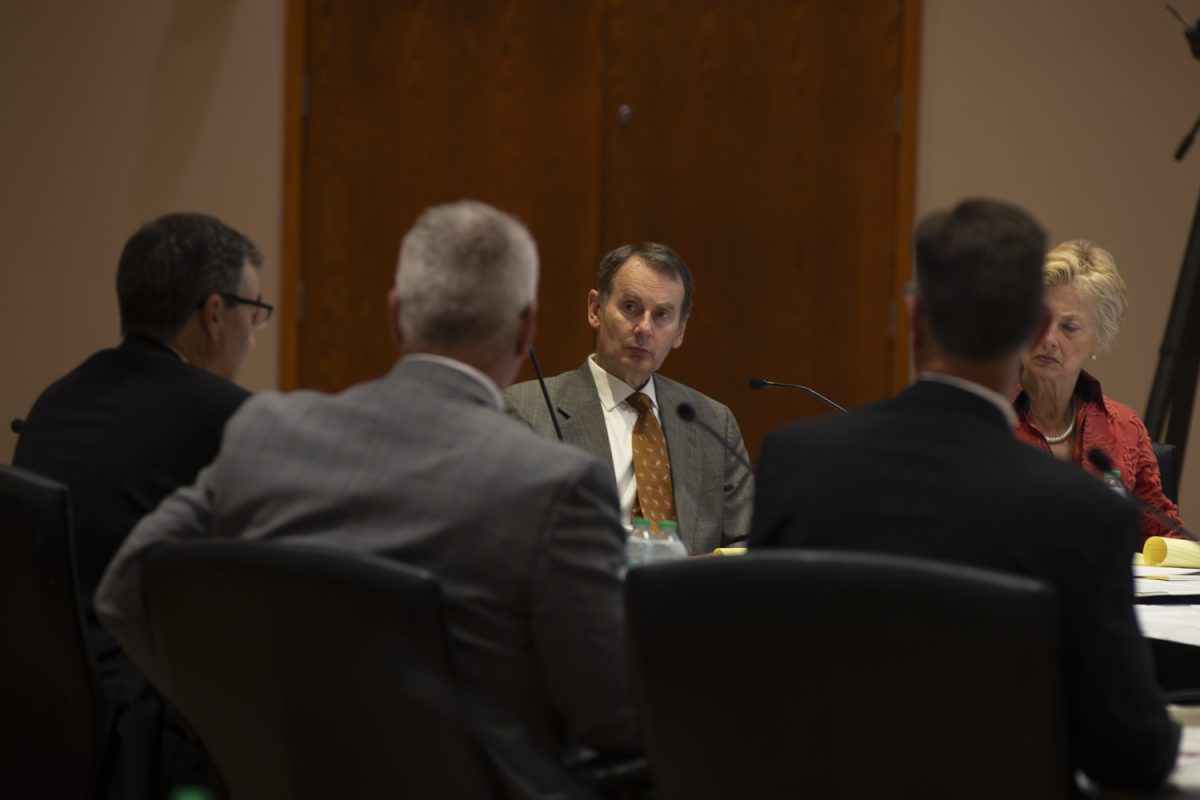
CEDAR FALLS — Following the assassination of conservative activist Charlie Kirk, the Iowa Board of Regents unanimously voted to conduct immediate investigations of employees at each of the three regent universities thought to have violated Section I of its freedom of expression policy.
The investigations are to be conducted within two weeks. Upon completion, university presidents are to take immediate action, “up to and including termination, upon the conclusion of those investigations,” according to a statement from Iowa Board of Regents President Sherry Bates.
During the regents’ Wednesday meeting, Bates said universities are to delegate future freedom of expression investigations.
In the statement, Bates disagreed with content released on social media by unnamed university employees in regard to Kirk’s death, claiming it was impermissible, but did not specify the posts in question.
“Posts like the ones we saw last week are offensive, inappropriate, and above all, unacceptable,” she wrote. “We expect more from those who work at our institutions.”
The Board of Regents freedom of expression policy includes a section on social media. It states employees have the right to share personal opinions on their own social media, as protected by the First Amendment. However, they must clarify their views are their own.
The policy states the university may need to take action if an employee’s personal expression causes harm, threatens, or intimidates a co-worker in order to ensure safety and efficiency.
RELATED: Iowa Board of Regents approve relocation of UIHC EMS Learning Resource Center
Regent David Barker said he almost voted no on the motion because he believes there is very little investigation to be done on at least one of the posts.
“I wouldn’t want that vote to be interpreted as opposing taking action,” he said. “It’s my expectation that action would be much faster than in two weeks.”
Regent Robert Cramer spoke about the balance between protecting free speech and maintaining a nondisruptive workplace.
“We’ve seen some appalling things on social media in the last week,” he said. “And we also understand that some appalling things are protected by the First Amendment. So the purpose of this is to delve in and see if any of these [posts] cross the threshold to where they’re so disruptive to the university that they still need discipline in an employment sense.”
Cramer also said students and employees are treated differently.
“We’re not talking about punishing anyone for what they said or posted, but we’re also saying there’s not an absolute right to employment if that employee is disrupting the university,” Cramer said.