


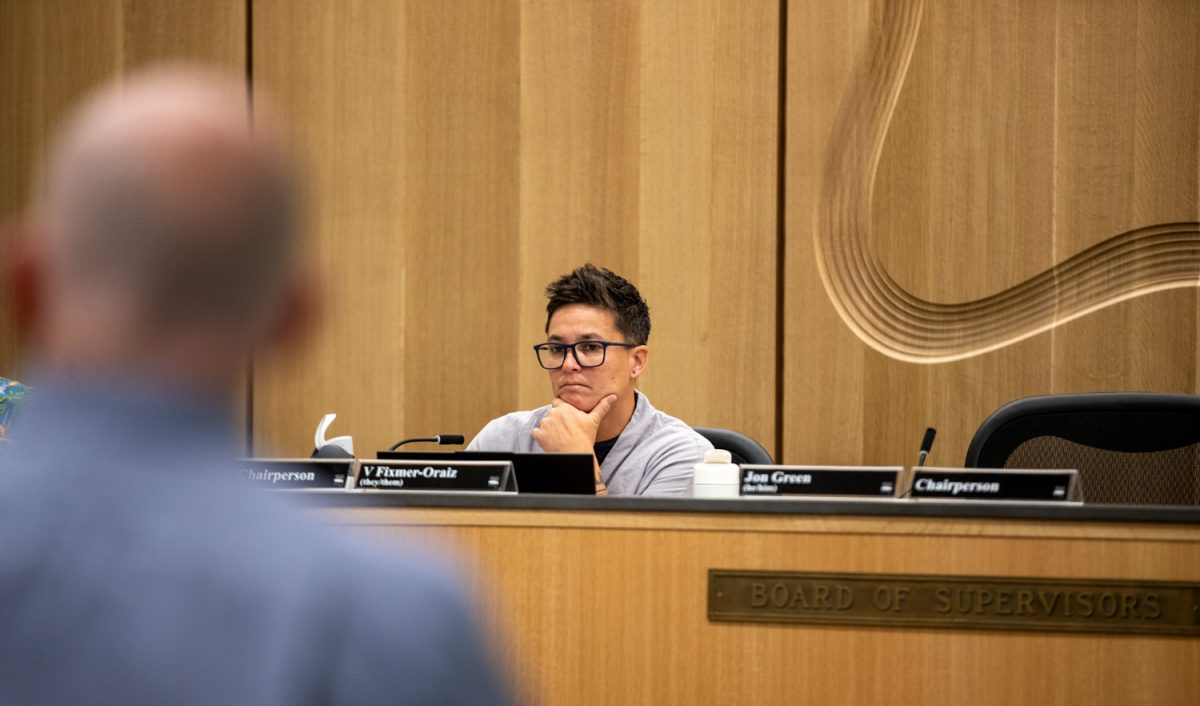
The Johnson County Board of Supervisors held a meeting on Tuesday and discussed the preliminary findings and housing assessment for growth in the unincorporated and nonmetro areas of Johnson County.
The assessment – led by Jeff Sauser, co-founding principal of Community Scale – focused on finding what the barriers to affordable housing are and recommendations for solving them.
Sauser recommended the board take advantage of the untapped potential in unincorporated Johnson County, as it is currently growing at a faster rate than the metro areas. The board highlighted finding ways to accommodate the aging population, revitalizing downtown areas, and making changes to policies that have to do with the development of agricultural land.
One particular policy discussed was the Farmstead Split and how to modernize the policy. Currently, the Farmstead Split only allows for one unit every four acres. Sauser said the board should reflect on these policies at a more in-depth level, to account for the way farms in Johnson County differ from others in the state.
The supervisors discussed possible backlash and resistance concerning these policy changes. Both Sauser and the board said developing farmland is a controversial topic for many Iowans.
Supervisor Lisa Green-Douglass said some cases have been blocked at the state level.
“We have got at the state level legislation that tries to limit or impede development and agricultural areas,” Green-Douglass said.
While the board agreed it has become increasingly difficult to define what qualifies as a farm and who qualifies as farmers, there was some disagreement over whether or not to tweak policies surrounding subdividing, or the specific splitting, of farm land.
RELATED: Johnson County committee works toward housing assessment need study
Concerns surrounding historical consequences, such as urban sprawl, or the expansion of urban areas in a poorly controlled manner, were primarily brought up by Chair Rod Sullivan. While the Community Scale assessment suggested around 950 homes to be built in the next decade, Sullivan argued the amount be closer to 25.
“Unincorporated Johnson County doesn’t need a whole bunch more housing, and I think that any positives gained from it are way offset by the negatives,” he said.
Supervisor V Fixmer-Oraiz disagreed and said the data should be reviewed and discussed further.
All supervisors agreed that finding ways to collaborate with surrounding communities who want to grow and create more affordable housing options would be the best way to move forward.
“You see a lot of that hometown pride,” Fixmer-Oraiz said. “That’s why people come back. We just want to keep giving those incentives – keep helping them grow.”