


University of Iowa’s athletes and coaches put in plenty of work in practice, competition, and their personal lives to produce the best version of their program.
Before their first game of the season kicked off, the Iowa women’s soccer team had gained recognition from United Soccer Coaches in their preseason poll, ranking No. 13 in the nation.
Under the leadership of newcomer Ben McCollum, Iowa men’s basketball has already garnered honors for several players, such as Drake transfer Bennett Stirtz’s invitation to the Chris Paul Elite Guard Camp this summer.
For Iowa men’s golf, multiple athletes saw successful seasons on and off the course, with two athletes named to the 2025 Spring Academic All-Big Ten Team, not to mention rising fourth-year Gage Messingham’s advance to the final stage of qualifying for the 125th U.S. Open.
While coaching staff and athletes themselves play a large part in the success of each of Iowa’s varsity teams, another group, the support staff, works largely behind the scenes to create opportunities as well.
Major conference programs need high-caliber specialty coaches, trainers, and mental health professionals. This could be why 17 percent of expenditures by schools in the Big Ten are made up of compensation for non-coaching athletics staff, a sum of $425 million.
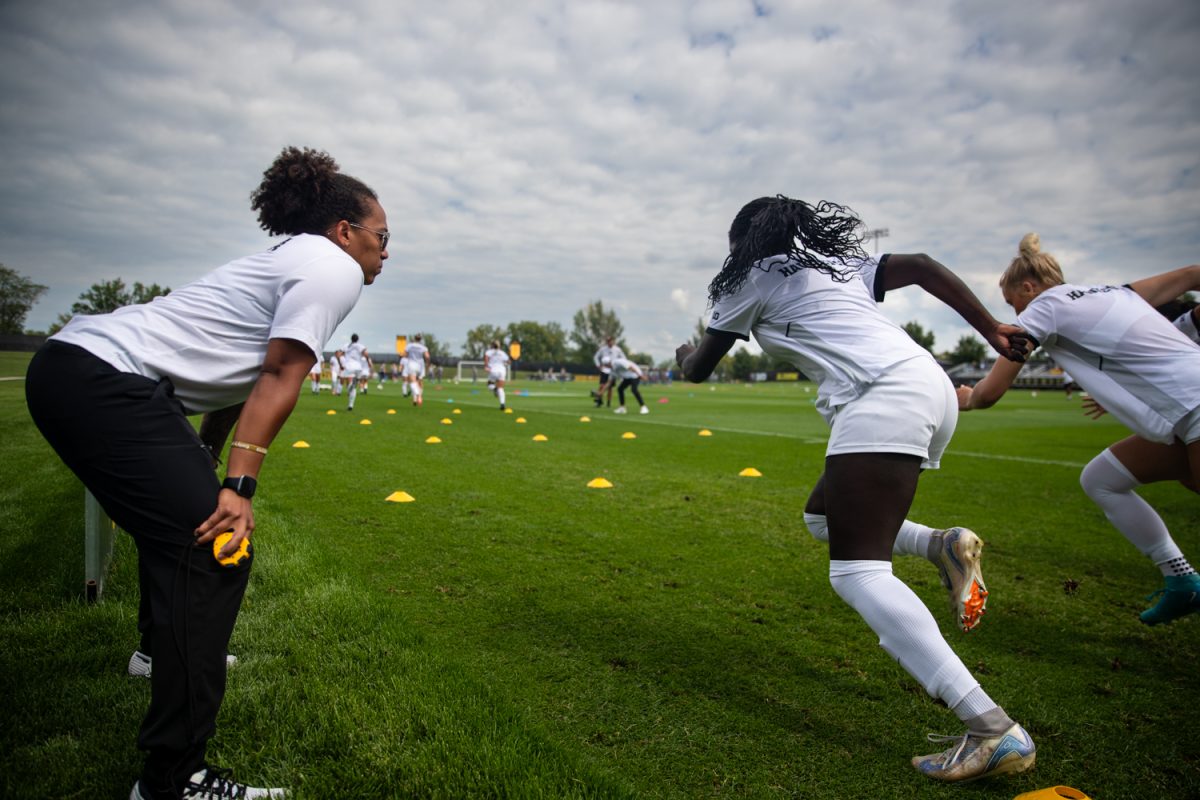
At a Big Ten school like the UI, positions like athletic trainers and sports psychologists are crucial. One example is Mariah Cook, who serves as a strength and conditioning coach for four different sports – women’s soccer, golf, tennis, and cross country.
“The main goal in my role is to help put the best version of each of those athletes on the field and to keep them there,” Cook said. “Part of that really requires building a foundation that is durable and resilient enough to handle the demands of not only training, but competing at their sport at such a high level.”
After exhibition games against South Dakota and Kansas, Iowa women’s soccer commenced their season with a 3-2 road win at No. 6 Arkansas on Aug. 14. Cook praised 12th-year head coach Dave Dilanni for his recruitment of strong athletes and staff.
“Coach Dilanni and his staff [have] done an amazing job over the past 12 seasons to build this program and recruit really good people, really hardworking kids, and surround himself with an amazing staff,” Cook said. “I’m really lucky that I’ve gotten to come in and be part of that.”
Brad Floy works as the athletic trainer for Iowa men’s basketball, having been a full-time employee in Iowa City since 2012.
“I think what sets the University of Iowa apart from pretty much everybody else in the Big Ten is our medical care, specifically our sports medicine,” Floy said. “Having the opportunity to work within a few hundred yards of one of the best medical centers in the country, along with some of the best team physicians in the country, put me in a position to do the best job that I possibly could.”
Floy further credited the opportunity that was presented to him, having started his career out of grad school elsewhere.
“Aside from being an Iowa native, it’s fortunate that my home state also had this opportunity available,” Floy said. “That’s what drew me back. My first position was at Fresno State. I enjoyed being there, but there’s nothing like the University of Iowa health care system that we’ve got.”
Physical health is unsurprisingly a key component of athletic performance, but recent years have seen increasing inclusion of an athlete’s mental health and wellness as well.
Much like with trainers and dieticians for an athlete’s physique, sports psychologists and therapists play a key role in the mental well-being of a college athlete.
Tanner Smith, who works as a mental health therapist for the UI’s sports psychology department, noted that all athletes, no matter how skilled, are human beings first and foremost.
“They’re college students, so they’re going to have to deal with all of the issues that any of us as human beings deal with,” Smith said. “They have families and histories and romantic relationships, they have to transition into the dorms and [do] all the stuff that everybody else deals with.”
Smith also acknowledged the correlation between mental health and athletic performance.
“What we know, obviously, is that if they’re struggling in any of those areas, it’s very easy to struggle on the field, court, whatever their playing surface is,” Smith said. “If someone has a parent that’s ill or they’re going through a breakup, it’s hard to focus in and go try to shoot a really good round of golf.”
Like any position in sports, professions associated with support staff deal with new developments regularly, especially given the volatility of the NCAA.
Following the departure of Fran McCaffery from men’s basketball and the subsequent hiring of Drake’s Ben McCollum as head coach, Floy discussed the changes that accompanied McCollum’s arrival in Iowa City.
“In the first five months that he’s been here now, I couldn’t have thought it could have gone any better,” Floy said. “It’s been really good. He’s really easy to talk to. He understands things. He doesn’t try to overstep his expertise area and into the medical field, but he wants to know what’s going on.”
Floy ultimately described his experience with McCollum as very positive. He said he is optimistic about the future of the program.
“It’s been a great transition,” Floy said. “I’m really looking forward to working with him for years to come.”
Although Iowa wasn’t the first school to begin incorporating the mental health of athletes, Smith nonetheless praised the growth of these resources on campuses.
“Since I’ve gotten here, we have grown, I would say, quicker than I’ve seen a lot of other universities grow,” Smith said. “I’d say the University of Iowa has been really good about prioritizing it up front and really pushing those services.”
Cook concluded that Iowa is made special by both the reputation of its programs and the quality of the people who work for those programs.
“I feel like everyone I spoke to has done an amazing job uplifting student athletes,” Cook said. “People come and work here, and they stay here a long time. There’s lots of coaches and other employees who came to Iowa years ago, [who] still love their jobs and show up every day to serve with a positive attitude. I think that speaks a lot, especially in the landscape of athletics. You really don’t see that everywhere.”