


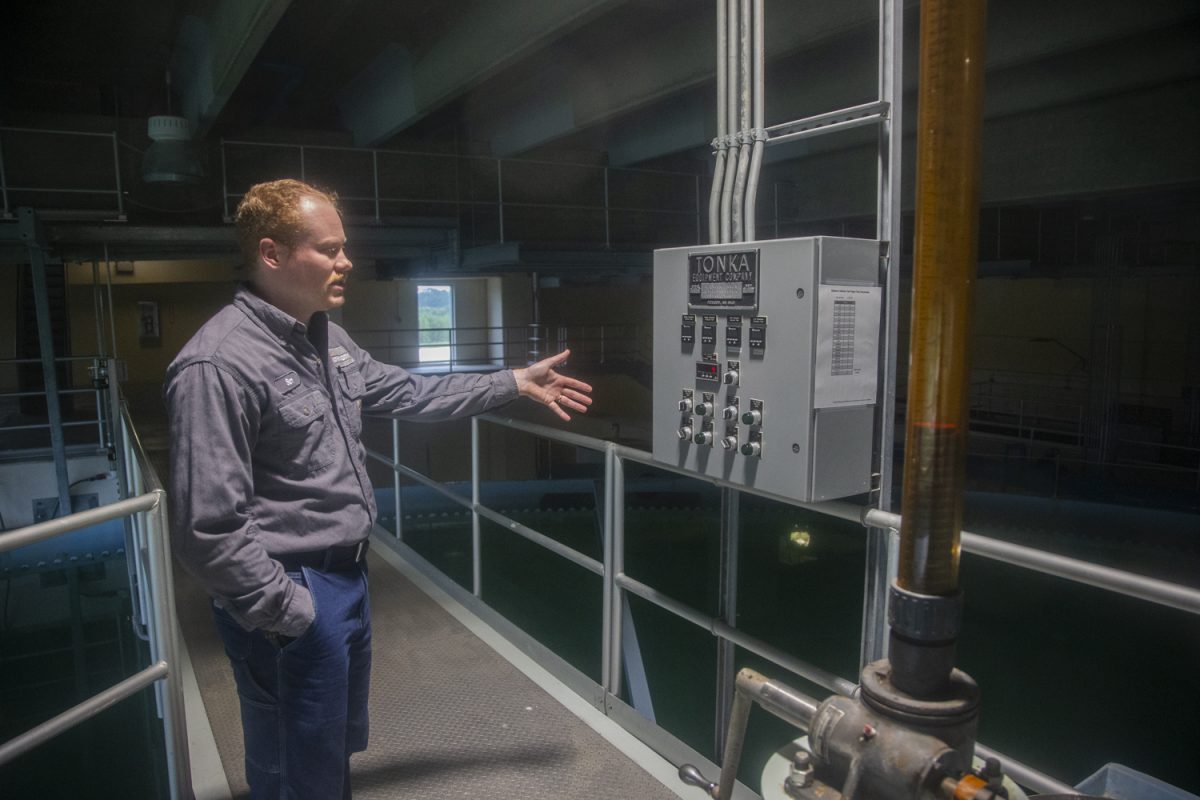
During the summer, the Iowa City community had a lower overall need for water treatment than Des Moines, despite both the city and the state capital grappling with high nitrate levels in the Des Moines, Raccoon, and Iowa Rivers.
The Iowa Department of Natural Resources detected elevated levels of nitrates in river water, posing problems for the 600,000 people using central Iowa water, according to Central Iowa Water Works.
Nitrates are naturally occurring chemical compounds present in air, soil, and water, which in large quantities can pose threats to health like thyroid issues and cancers, according to the Iowa Environmental Council.
When there are elevated levels of nitrates in river water, more resources must be expended to filter the water for safe drinking, and the elevated levels of nitrates lower the supply of available, clean water. The city of Des Moines characterized the dilemma as clean water demand “outpacing filtration capacity.”
To curb the growing gap in public water supply, Des Moines and Central Iowa Water Works issued a lawn watering ban in June. By July 29, they rescinded the ban once they made sufficient progress, according to Central Iowa Water Works.
The Environmental Protection Agency has a nitrate measurement standard for “finished water,” or water ready for use, of 10 mg per liter, an amount not naturally visible to the naked eye but a significant amount nonetheless. Not only did Des Moines exceed these levels, but so did Iowa City.
The Iowa River, especially in May, exceeded the 10 mg/L standard and even reached a higher peak than recorded in previous years at 17.2 mg/L, according to data collected by the University of Iowa Hydroscience and Engineering department, and published on the Iowa Water Quality Information System.
Those who spent their summer in Iowa City, unlike those who spent it in the state’s capital, could make a few key observations: no lawn watering ban, no news on nitrates at all. Even when nitrate levels peaked at higher levels than recently recorded and behaved similarly to Des Moines’ levels, life continued as normal.
The answer to this puzzle, according to Iowa City water treatment officials, is demand, which Iowa City Water Superintendent Jonathan Durst said Iowa City had less of than Des Moines over the summer.
“For Iowa City, our customer demand remained relatively steady without a large summer irrigation demand,” he said. “For Des Moines, I am led to understand from reporting, they had irrigation demands causing a substantial increase in their daily production.”
Every summer, Iowans see higher nitrate levels, Durst said, but varying circumstances affect how a municipality like Iowa City might react.
He said there are three methods a treatment plant can use to treat water. One is distillation, which Durst said is economically unfeasible at scales large enough to serve an entire city. Therefore, the remaining two, filtration and dilution, are commonly used. Dilution often uses groundwater from aquifers.
Aquifers are deep and widespread reservoirs of groundwater. According to a UI map of Iowa aquifers, the state has access to four main aquifers that populate the Midwest: the Dakota, Mississippian, Silurian-Devonian, and Cambrian-Ordovician.
Dilution relies on aquifers as a renewable source of clean water to dilute the nitrate-filled water to below the 10 mg/L standard.
Durst said for Iowa City the costs incurred by the use of dilution have already been built into the facility, with no additional costs.
“Now, if we ran into a situation where the nitrates got so high that even our ability to draw water from those wells was insufficient to dilute them, then we’d be in trouble,” Durst said.
A key issue affecting the availability of groundwater is precipitation, another variable different in 2025 than in previous years.
According to the Iowa Department of Agriculture and Land Stewardship, rainfall totals in Iowa were 5.03 inches above average in July, at 9.20 inches, making it the second wettest in 153 years.
Durst said, however, increased rainfall is a “double-edged sword” when it comes to nitrate treatment. The additional rainfall reduces manual irrigation on farmland but also floods groundwater channels with more nitrates from runoff.
“So I would say most of the time, it might just balance itself out,” he said.
Wastewater treatment is another important step in the water treatment process. Tim Wilkey, Iowa City wastewater superintendent, said the Iowa City facility discharges up to 10 million gallons daily. Over the summer, the facility met solid filtration and discharge requirements for nitrogen and phosphorous of 10 and 1 mg/L, respectively, according to the Iowa Department of Natural Resources.
“We’re consistently meeting our nitrogen discharge requirements and our phosphorus discharge requirements, but we have no control of what is already in the river,” he said. “And a lot of the nitrogen phosphates that’s in the river is not from humans. It’s typically from agriculture.”
Agriculture is frequently the target of scrutiny when runoff nitrates and groundwater become an issue.
Iowa Department of Natural Resources Water Quality Resource Coordinator Adam Schnieders said, however, it is justified.
“Agriculture is the dominant land use in Iowa and the primary source of nutrient runoff and urban runoff, including storm water from roads and parking lots,” Schnieders said.
The process for initiating municipal action to enforce water restrictions would start from the city’s water division, Durst said, but only if nitrates reached an unmanageable level.
Durst said he is glad, despite rising and falling year after year, the nitrate issue has risen to the forefront of people’s minds.
“People care about it now,” he said. “Those cares only seem to matter in a crisis. Otherwise, people would rather just not have to worry about it.”