


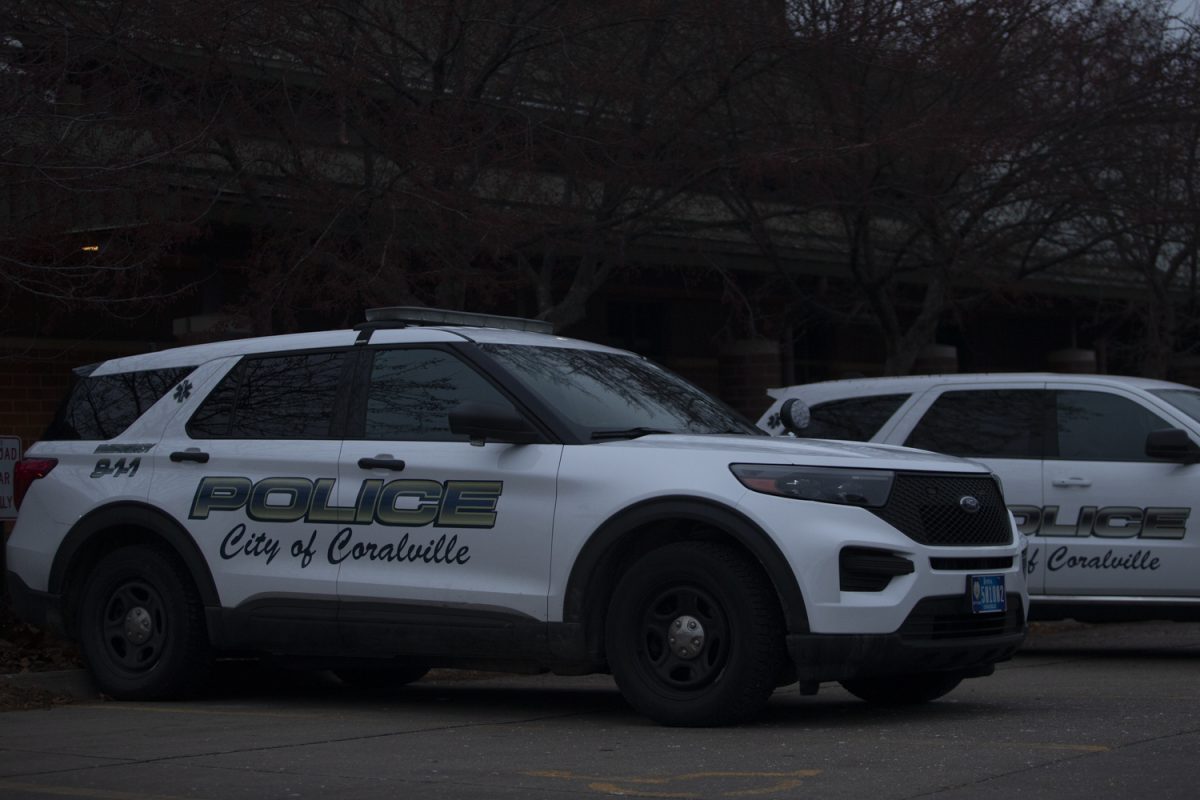
The Coralville Police Department is considering the use of automated license plate reader technology, a tool for law enforcement some find controversial due to concerns of potential misuse of data.
Black solar-powered cameras can be found lining streets across Iowa, gathering images of every vehicle that passes. These cameras track license plates in real time, log location data, and contribute to a rapidly growing network of data shared by law enforcement agencies.
These products are designed and sold by Flock Safety, a security hardware and software development company whose technology is slowly being implemented in cities across the U.S.
According to its website, Flock uses artificial intelligence-powered technology to track vehicles on the road, collecting “vehicle fingerprints,” a term coined by the company.
Coralville is considering installing six cameras across town. Installation of these cameras will draw $18,000 annually out of the city’s budget, according to the Coralville Police Department. According to Flock’s website, any server and software management costs are built into the annual subscription.
Once reserved for high traffic metro areas, automated license plate readers are popping up in smaller communities, including Iowa City and the surrounding area.
As the number of these cameras increases, the American Civil Liberties Union of Iowa has criticized the use of this technology, citing excessive government oversight and possible violations to privacy.
The Coralville Police Department continues to evaluate the strengths and weaknesses of this technology and whether it is right for the community.
“This technology isn’t something new,” Kyle Nicholson, Coralville’s chief of police, said. “I was motivated by this because we’re catching up with the times.”
Proponents of these cameras cite faster recoveries for stolen vehicles, missing persons’ cases, and warrant executions. These cameras are already in use by Iowa City and North Liberty.
“This is something that will make our officers more effective and help us solve crimes,” Nicholson said.
The ACLU of Iowa has heavily criticized the use of these cameras and said they are an infringement of privacy rights.
“The potential for misuse of that information is huge when data is in a centralized database that can be accessed by any police department in the country who has ALPR cameras with specifically the Flock company,” Becca Eastwood, deputy police director for the ACLU, said.
Flock stores data in a cloud network, in which the data can be seen by anyone who has access. Eastwood said a network that can be accessed by the U.S. Immigration and Customs Enforcement, or ICE, is a danger to immigrant communities.
Similarly, Eastwood cited a case in which Texas law enforcement used the ALPR network to track down a woman who had gotten an abortion in May. These cases raise questions about privacy rights for individuals on the road.
Megan Roos, an Iowa City resident, said she feels these cameras are a threat to her community, citing concerns about mass surveillance, lack of public input, and potential misuse of data by law enforcement or other third parties.
“We have other tools law enforcement can use to solve crimes or prevent crimes,” Roos said. “I don’t think there are sufficient legal protections in place to protect individuals from the potentially dangerous data they are collecting.”
Nicholson said the Coralville Police Department is aware of these concerns and is cautiously approaching the implementation of this technology. While the potential for misuse can be worrisome, the department wants to assure the public they have systems put in place.
“We have policies and procedures to prevent [misuse] from happening,” Nicholson said. “We are just trying to build a safer Coralville, ultimately, at the end of the day.”
Eastwood said awareness is the first step in addressing the use of these cameras, pointing out most residents do not even realize cameras are silently monitoring their communities.
“There is a lot of education that needs to be done. ALPRs themselves have been around for quite some time, but the expansion of use of ALPRs that we are seeing is a fairly recent development,” Eastwood said. “There is a lot of work to be done to make sure that folks know that their cities are surveilling them this way.”