


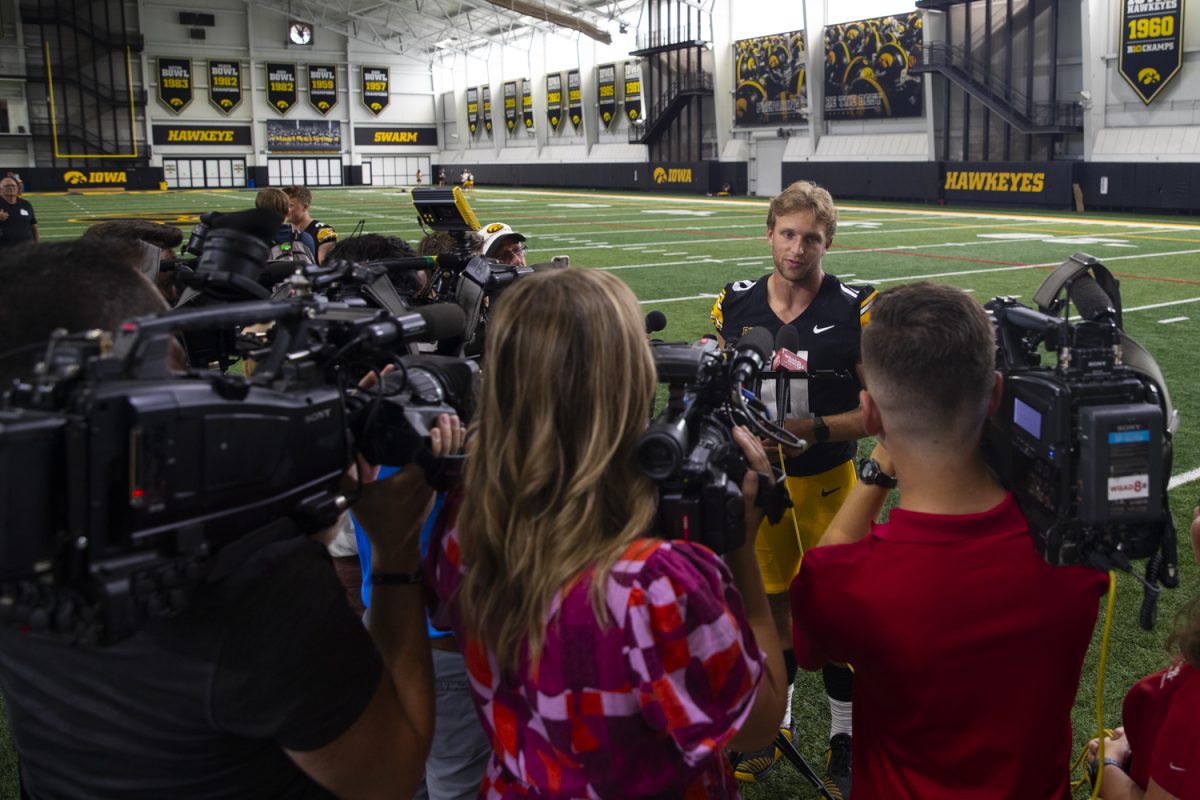
Patience is not the forte of Iowa transfer quarterback Mark Gronowski. Why wait and otherwise follow convention when it would only betray natural ability?
The pattern started with his bike.
At around 3 1/2 years old, Gronowski declared his training wheels unnecessary. His mom, Deborah, pointed out his premature age, but soon relented. She’s armed with proof two decades later.
“He just took off on his two-wheeler,” she said, handing over a photo of Gronowski happily pedaling down the sidewalk, tufts of blonde hair peaking out from under his red helmet.
Next up at the negotiating table was his dad, Ray. A former college quarterback at Drake, Ray didn’t want his son playing football until fifth grade. Mark refused no for an answer and Ray capitulated. Even though Deborah remembers her son as one of 22 “bobbleheads” in a sea of oversized helmets adorning undersized bodies, Gronowski’s frame and speed still stuck out.
Early physical superiority is the hallmark trait for most Division I football players. Spend time and talk with people who know Gronowski, and they’ll tell you physical traits were secondary to his progress.
The quarterback’s rise to stardom at South Dakota State arrived because of the relationships he forged with everyone around him. He elevated himself to a leadership role, but never considered himself beyond reproach.
“It’s such an important part in getting to know people,” Gronowski said. “It helps you be able to build that rapport. I can hold them accountable. They can hold me accountable.”
After winning two FCS national championships at South Dakota State, Gronowski aims to replicate such success at Iowa, a Big Ten stage with brighter lights, a greater audience, and higher expectations. He is starting that climb at the ground level and relying on the same tactics. Accomplishments ring hollow without others to share them with.
“To want to be great, to be great, to stay humble the entire time through your high school and college career, I think is a real gift,” said Bill Ellinghaus, Gronowski’s high school coach.. “I haven’t seen many kids be able to handle success like he has.”
The older younger brother
Ask Ray and Deborah to describe a typical summer day with their three children, and their initial reactions tell the whole story. Ray lets out an exasperated sigh while Deborah bursts out laughing. With their trio of kids all grown up, what were once hectic days are now considered with nostalgia.
“I joke with my kids, I’m like, ‘You guys were all born on bleachers,’” Deborah said.
Sarah, the oldest, played softball with Ray as coach for nine years before starring in the outfield at Butler. Mark, eight years younger and a three-sport athlete growing up, recalls hours of shared batting practice. Deborah said the age gap made connection difficult at first, but now the pair are “inseparable.”
Joining Mark in the stands for countless games was the middle sibling, Ryan. Four years older than Mark, Ryan has an intellectual developmental disability (IDD) and a rare form of epilepsy that’s resulted in multiple seizures. Also an athlete, Ryan played flag football in the Special Olympics.
Outside of tossing the football around in the backyard, Mark and Ryan’s bond grew more significant as Mark got older. The duo spent a year together in elementary school and rode the same bus. By age 10, the younger boy transitioned into more of an older brother role. In Deborah’s words, he became more of a watcher and protector.
“It’s not easy being a sibling of someone with an IDD,” Deborah said. “You grow up quickly. You have to learn compassion. You learn that people are different. You learn what a true friend is.”
A young Gronowski quickly became a mindful judge of character, wanting to surround himself with people who accepted Ryan. Deborah noticed one of Gronowski’s friends had stopped coming over to the house, and her son had a succinct answer.
“[Mark] goes, ‘Mom, he makes fun of Ryan,’” Deborah remembered. “‘He laughs at Ryan. He doesn’t laugh with him.’”
Soon Mark’s travel baseball coaches began to take notice, calling him wise beyond his years.
“He was more cognizant, sympathetic,” Ray said. “For other people, he was more caring. They always said he seemed much older than everyone else.”
Ryan’s team won the gold medal at the USA Special Olympics in 2022, and Gronowski couldn’t have been happier watching his brother celebrate with his teammates.
“Just getting the biggest hugs from him after games is one of the best feelings,” Gronowski said.
Ryan, in turn, is a friend to everyone. Whether it be with a reporter or Iowa head coach Kirk Ferentz, Ryan responds similarly. Walking with a confident gait, he’ll offer a firm handshake and a beaming smile. Watching this behavior for years, Gronowski can’t help but emulate his older brother.
“It’s been a blessing. I’ve learned so many things from him,” Gronowski said. “Just having that positive attitude every single day, no matter what’s going on in life. And always looking for the best in people that are around you, no matter what they look like, who they are, or what they’ve done in the past.”
Gronowski carried these lessons throughout his career, the first stop being Neuqua Valley High School in his hometown of Naperville, Illinois.
The servant leader
Ellinghaus isn’t afraid to face facts.
If he’s realized one thing during his 13 years as the head coach at Neuqua Valley, it’s that his players don’t play for him. Sure, he’d like to be a source of motivation, but that spark needs to flow from the guys on the field. For two years on the varsity squad, Gronowski flipped that ignition switch.
“He knew he couldn’t be successful without all 10 other guys doing their job, right?” Elinghaus said. “So he would build that trust and that relationship with everybody else. Built it up in such a way that they all felt really, really good about it and they all wanted to be the best player they could be for Mark.”
Gronowski’s parents credit part of their son’s leadership to a weekend camp he attended his junior year of high school. The program taught him to help identify peers who needed assistance, whether it be academic, social, or health in terms of drugs and alcohol.
Gronowski wanted everyone around him to feel comfortableand appreciated, such as with his offensive line, inviting his teammates over for homemade meals. Elinghaus described his quarterback as a “servant leader” who never looked down on the people who admired him.
“He would go out and just make absolutely every play on the field, and do it in such a way where you never felt like he was a superstar,” Elinghaus said. “Because he made everybody else around him so much better by the way he interacted with them.”
Gronowski compiled head-turning numbers. In a September, 2019 game against powerhouse East St. Louis, the quarterback threw for five touchdowns and added two more on the ground, compiling all seven of Neuqua Valley’s scores in a 50-48 loss. The Wildcats still won the conference title that season, with Gronowski earning all-state honors and a nomination for the Illinois Gatorade Player of the Year award.
Even with 4,082 total yards and 39 touchdowns, South Dakota State was Gronowski’s best scholarship offer. With 660 all-time wins, the Jackrabbits are well-respected in the FCS, but at the time of Gronowski’s commitment, had never appeared in the FCS championship game. Gronowski signed with South Dakota State prior to his senior season, and even though Wisconsin and Northwestern showed late interest, the quarterback stuck by the first ones who took a chance on him
His parents advised him to go where he’s loved, and in Brookings, South Dakota, Gronowski found an appreciative home. But adversity greeted him first.
The comeback
The photos were identical in composition, but indicative of progress. Every day, Gronowski would photograph two legs, hoping that his left knee would return to its prior form.
“That’s how he was able to get through it,” Deborah said. “Because he’d be, like, ‘First day: I can’t walk. Second day: I can’t walk.’”
The quarterback tore his ACL on the opening drive of the national championship game his true freshman season, stranding him on the bench in a 23-21 loss to Sam Houston State University.
“It was probably one of the saddest days of our lives,” Ray said. “Just because he had accomplished so much.”
While documenting his six-month recovery process, Gronowski shifted his focus to learning from others. Quarterback Chris Oladokun transferred from Samford for a final season of eligibility, leading the Jackrabbits to an 11-4 record and a spot in the semifinals. Oladokun taught Gronowski how to take notes when watching film, and Gronowski absorbed as much as he could, travelling to every game and wearing a headset to hear play calls.
The following year, with Oladokun off in the NFL, Gronowski found himself across the line of scrimmage from multiple future pros inside Iowa’s Kinnick Stadium. Future first-round picks in defensive end Lukas Van Ness and linebacker Jack Campbell wreaked havoc in a 7-3 game Gronowski jokingly dubbed “the greatest offensive showing in history.”
With future NFL tight end Tucker Kraft out for much of the game due to injury, Gronowski completed only 10 passes for 87 yards in the defeat, by far his worst performance of the season. The Jackrabbits never lost again, winning their next 14 games and claiming the national title.
“He went to the lowest of lows to the highest of highs,” Ray said. “And what we were worried about it is, ‘What’s he gonna do for an encore?’”
The friend to everyone
Gronowski enjoys the concert in his ears. Not the booming rap or heavy metal music shaking the walls of the locker room — all that noise is tuned out. The quarterback used to embrace that added adrenaline rush, but the older version of himself moved on to more productive listening.
Sitting at his locker, the junior dons headphones, listening to classical music. Gronowski doesn’t call himself a Mozart fan, but rather just appreciates the calm. The quarterback still wants to win at all costs, but can’t allow excitement to override his competitive nature.
Learning under then-South Dakota State mental performance coach Kris Kracht, Gronowski began to visualize how the upcoming game would play out. He envisioned triumph but also the response to failure.
Armed with that new approach, Gronowski’s encore was a symphony of success, a triumphant tune featuring 5,779 passing yards, 70 total touchdowns, and a 64.5 completion percentage over the next two seasons. The Jackrabbits claimed their second consecutive title in 2023, with Gronowski earning the Walter Payton Award as the FCS’ top player.
Yet Gronowski stayed grounded as the accolades and awards piled up. He still cooked meals for his offensive lineman and forged connections by seeking to learn more about them and their background, a suggestion from Ray. Sophomore defensive tackle Bryce Hawthorne spent two years alongside Gronowski at South Dakota State and took notice of his quarterback’s actions.
“Just him being a fantastic leader,” Hawthorne, who transferred to Iowa this offseason, said. “Just seeing him to get to know everybody, and I mean everybody. I thought a starting QB shouldn’t know, at least be good friends with, a freshman D-tackle, but no. It did not matter.”
After a 11-3 campaign in 2024 ended with a loss in the semifinals, South Dakota State head coach Jimmy Rogers left for the Washington State job. Offensive coordinator Josh Davis departed for Fresno State. Gronowski had one more year of eligibility, but had eyes set on the NFL. He received an invite to the NFL Scouting Combine and planned to go to Dallas to prepare. Discussions with league scouts, his agent, and parents sparked a different direction.
Gronowski suffered a shoulder injury in 2024 but played the rest of that season. He said talent evaluators recognized the quarterback’s strengths, but were aware of the injury that eventually required surgery. That caution, combined with name, image, and likeness opportunities at major FBS schools prompted the quarterback to enter the portal in late December. Gronowski proved himself in 2022, and three years later, aims to do the same at the FBS, major-conference level. Finding a home at that level plunged his life into chaos.
The fearless opportunist
Last winter, Gronowski rarely got off his phone. He said his missed calls hit 100, same with his incoming texts. Deborah wanted to know who exactly her son was talking to, and so Gronowski’s girlfriend found a whiteboard, wrote the name of the caller, and displayed it for the rest of the family.
“Like Vanna White,” Deborah said with a laugh.
“[Deborah] would be, like, ‘Who’s [head coach] Lincoln Riley?” Ray added. “I go, ‘It’s USC. Shhh!’”
When Iowa came calling, Gronowski drew immediate similarities to his former school. A culture that embraced the grind of a season, one that persisted through change as constant as Midwest weather. The two universities began competition in 1889, and each compiled over 650 all-time wins.
Alas, the stigma remained. He and Ray heard it from plenty of friends — Iowa is where quarterbacks go to die.
Gronowski and his dad made sure to address the haunting line when meeting with Ferentz and Iowa second-year offensive coordinator Tim Lester, whose experience as a coach in the NFL provided some initial comfort. The Hawkeyes’ 328 yards per game last season added more support.
“‘We can start to try and change that narrative,’” Lester remembered telling them. “‘The offense that we’re running is not what we’ve been running here for quite a bit of time.’ I was just honest with them. Tell them the truth. It’s about relationships, right? What we can do together.”
Gronowski transferred to Iowa in January and spent the spring semester on campus, wrapping up his masters degree in mechanical engineering but sitting out spring practice as he recovered from surgery.
Hundreds of mental reps on the sideline and hours studying the playbook culminated in a return to action over the summer. Ferentz said the quarterback completed 6-of-9 passes during his first 11-on-11 session, and Lester added an extra detail.
“But the ball never touched the ground, you can do the math on that,” the coordinator said with a smile.
It’s inevitable for first-day errors to flare up during the season. An errant throw might wind up in the hands of a coach on the sideline, or worse, an opposing defender. As starved as the Iowa fan base is for quality quarterback play, its patience runs thin.
Ray and Deborah experienced this reality watching their son play at Kinnick, listening as some rained boos on then-Iowa quarterback Spencer Petras.
“What I’d love to see is him being able to meet the expectations of what Iowa wants or deserves in a quarterback,” Ray said of his son. “Ulitmately, it’s not the national championship, that’s always a goal. It’s not the [College Football Playoff], that’s always a goal. But I would love to see him walk away and say he changed the narrative for Iowa.”
Gronowski said he sees pressure as an opportunity. While he holds himself to a high standard, the quarterback has to stare down failure. For all the relationships he’s built with others, he must construct a forgiving one for himself.
“You have to just play free,” Gronowski said. “You have to be willing to throw that interception. You can’t be holding back all the time and almost play with the pressure of, ‘What if I don’t succeed?’ You got to throw the interception before you actually throw the interception. You can’t always make the touchdowns without being able to be a little risky.”