


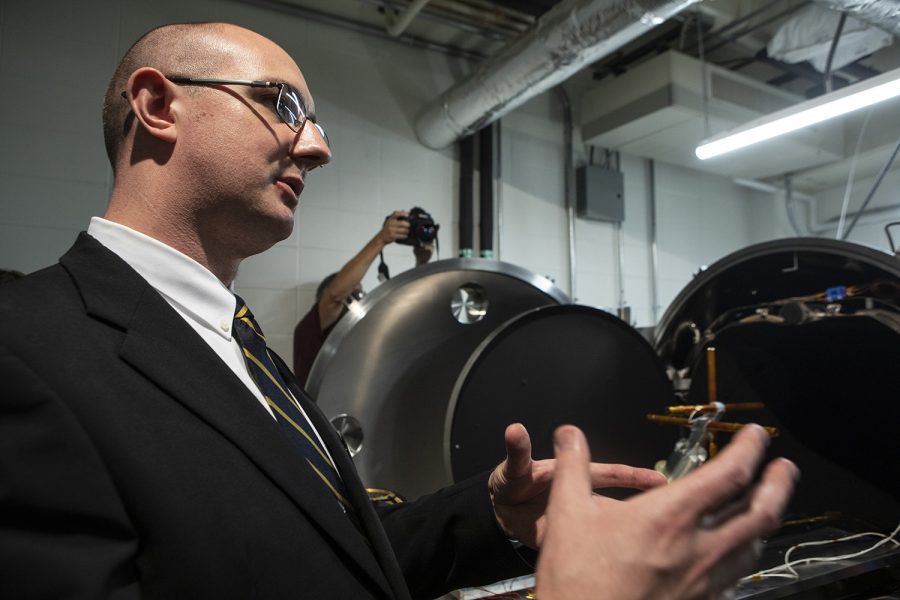
A study led by University of Iowa Associate Professor David Miles will study how the sun impacts the Earth’s magnetic field using a NASA satellite that will launch later this month.
The study dubbed TRACERS, or Tandem Reconnection and Cusp Electrodynamics Reconnaissance Satellites, will gather data about how the Earth and the Sun’s magnetic field interact to help understand long-standing questions about space weather.
Scientists hope to use the information to help better protect NASA and other agencies’ satellites from space weather. The study will also examine how space weather interacts with GPS, communication signals, and astronauts working in space.
“What we will learn from TRACERS is critical for the understanding and eventually the predicting of how energy from our sun impacts the earth and our space and ground-based assets,” said Joe Westlake, division director of Heliophysics at NASA Headquarters, during a news conference call on Thursday morning. “It’s going to help us keep our way of life safe here on Earth, and help to continue to enable space safe space exploration.”
They will study how solar wind, or the ejection of large amounts of electromagnetic radiation from the sun, known as space weather, affects space operations.
Miles, of the UI, said that space weather can cause beautiful phenomena as well, but can also bring challenges to ground and space operations.
“What we’re looking at trying to understand is how the coupling between those systems changes in space and in time,” Miles said.
However, putting a satellite through one specific system only gives you a snapshot of the impacts, Miles said. To combat that, they are launching two satellites that will have the same orbit but be seconds apart from each other.
The satellites will launch from Vandenberg Space Force Base in California aboard a SpaceX Falcon 9, the world’s first reusable orbital-class rocket.
The satellites will run a one-year mission and orbit the Earth’s poles thousands of times before reentering the atmosphere and burning up.