


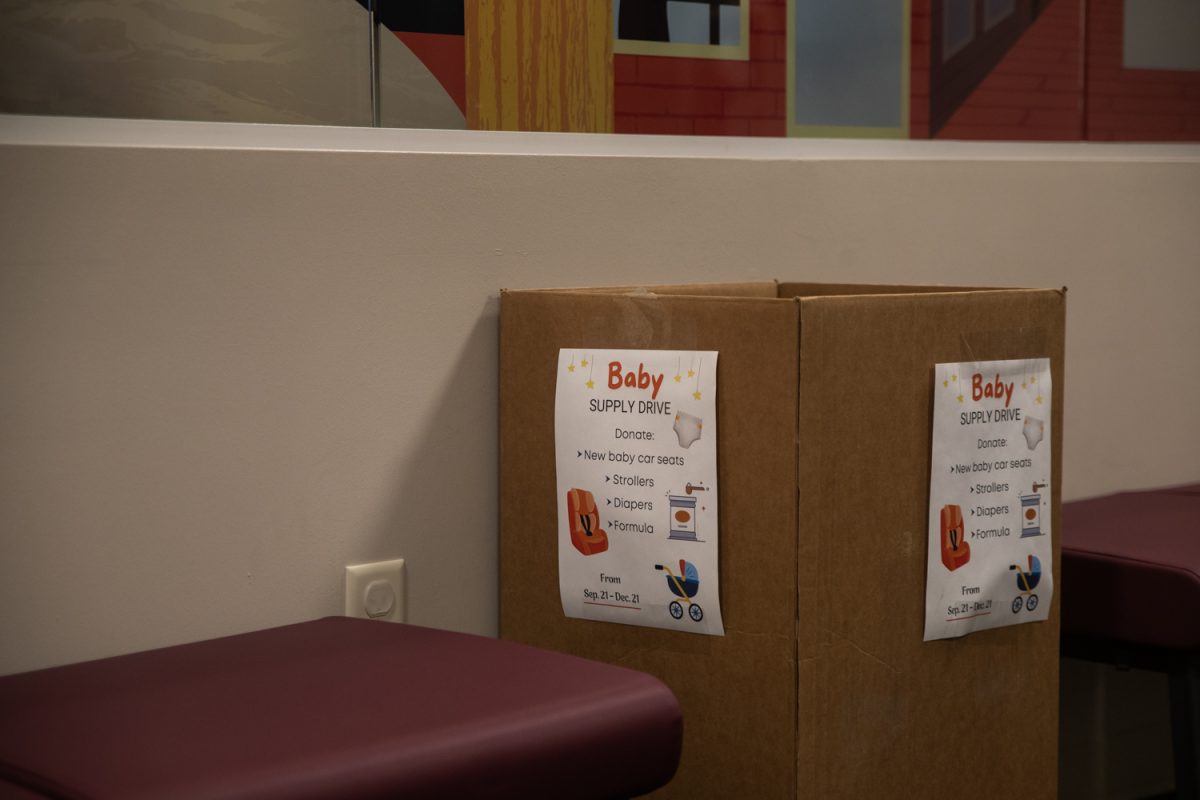
The Eastern Iowa Baby Supply Drive, brought together through the collaboration of local organizations like the AmeriCorps Immigrant Maternal Health Project, Johnson County Public Health, and the University of Iowa Health Care Family Care Center, will formally end on Dec. 21.
Contributors for the drive were brought together by Allison Largo, coordinator for AmeriCorps’ Immigrant Maternal Health Project. The drive collects baby supplies in the hopes of distributing them to low-income immigrant, or simply inexperienced, mothers in Iowa. The drive received items such as car seats, strollers, diapers, and formula.
Largo said the overall turnout has been good. The locations have received nearly 60 car seats, the main item requested for the drive.
The idea for the drive started when Largo discovered that, despite local agencies seeing many of the same women across Johnson County Public Health, the Family Medicine Clinic, and the Iowa City Free Medical Clinic, there was little communication between the parties.
“Nobody was talking to each other, and they’re all seeing the same moms, but there was no connection between all these agencies,” she said. “We needed to do something in Iowa City because we’re the baby hub of Iowa. The University of Iowa hospital alone performs 4,000 births per year.”
Largo was able to successfully start operations on Sept. 21, 2024, marking the first year of the Eastern Iowa Baby Supply Drive.
Largo said the drive had a focus on supporting mothers who are in need during the fall and winter months — particularly for immigrants.
“With immigrant moms, regardless of how you came here, you usually don’t have moms or sisters here. Nobody’s giving you a baby shower,” she said. “Usually, their husbands are working two or three jobs. They came here to work, so the moms are usually at home by themselves.”
Largo said there were many instances of culture shock that surprised immigrant mothers post-birth, namely, Iowa’s mandatory car seat law.
Babies are required to be fitted in a car seat by a nurse when leaving the hospital. Largo said many mothers forget or simply can’t afford the item as they are already caught in the chaos of buying diapers, food, and other supplies.
“You probably need a minimum of $250 just for that first week alone when having a baby,” she said.
Rachel Lewis, a clinical practice leader at the Family Medicine Clinic, elaborated on the struggles such mothers face trying to prioritize their babies’ safety.
Besides car seats, cribs are an essential item many low-income mothers don’t always have.
“Babies need to sleep in their own environment to decrease SIDS, and a lot of people can’t afford that, so they sleep with their babies,” Lewis said. “That’s a danger to babies, so it’s a big push to either get them in a crib or pack and play and a safe car seat.”
Lewis said items that support mothers and babies contribute to baby safety and the mental health of local mothers.
“I feel like in the winter months, everyone’s mental health decreases a little bit, especially with pregnant women with postpartum depression. If we can destress their lives a little bit, that could deter their postpartum blues from turning into postpartum depression,” she said.
Roberta Sloat, clinical services manager at Johnson County Public Health, said culture shock is one of the factors that impact immigrant mothers’ mental health.
“Our medical system is very different than the systems in other countries, especially for women from African countries,” she said. “Navigating everything here and trying to understand why we do things the way we do when you don’t speak the language is very difficult.”
Sloat described the struggle immigrant mothers face not being able to afford essentials many take for granted.
“We also do see daily barriers with more simple things that we might think are simple, but they’re not, like transportation, childcare,” she said. “Food is also a barrier to obtaining care. Who’s going to go to an appointment if they’re hungry?”
Sloat believes the drive can help alleviate this burden.
“Anytime they don’t have to spend money on a car seat or one package of diapers is going to positively affect how much food they can afford or other items that they need to buy. So every little bit helps,” she said.
Largo hopes the supplies donated will last for all of 2025.