

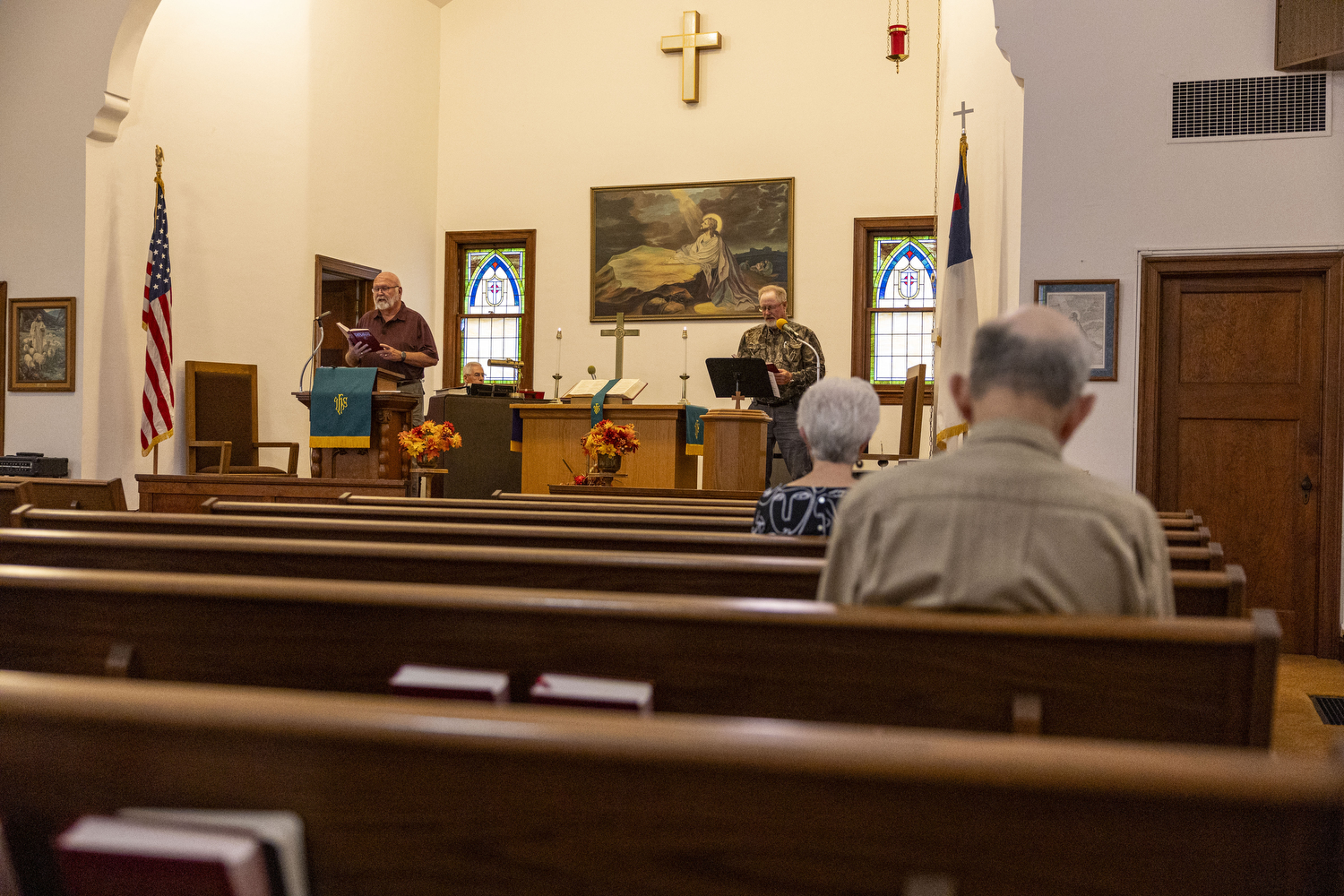

Most Sunday mornings, Marcia Barker walks out of her house just before 8 a.m. and meets her friend in the middle of the road. Together, they walk across the quiet main street to church. The retired women, who admit they hate waking up early, sneak into the back pews of the old white church just after the service starts to join a handful of other churchgoers. On Sept. 14, only six members were in attendance
On a good day, the Batavia United Methodist Church in Batavia, Iowa, holds a congregation of 17 people. The church used to be a significant part of the community in the rural town, but an aging population and lack of job opportunities in the area have taken a toll on Sunday attendance.
According to the World Population Review, 418 people live in Batavia as of 2025; the population has decreased by roughly 3.5 percent since 2020. Just under 15 percent of the town’s population is senior citizens.
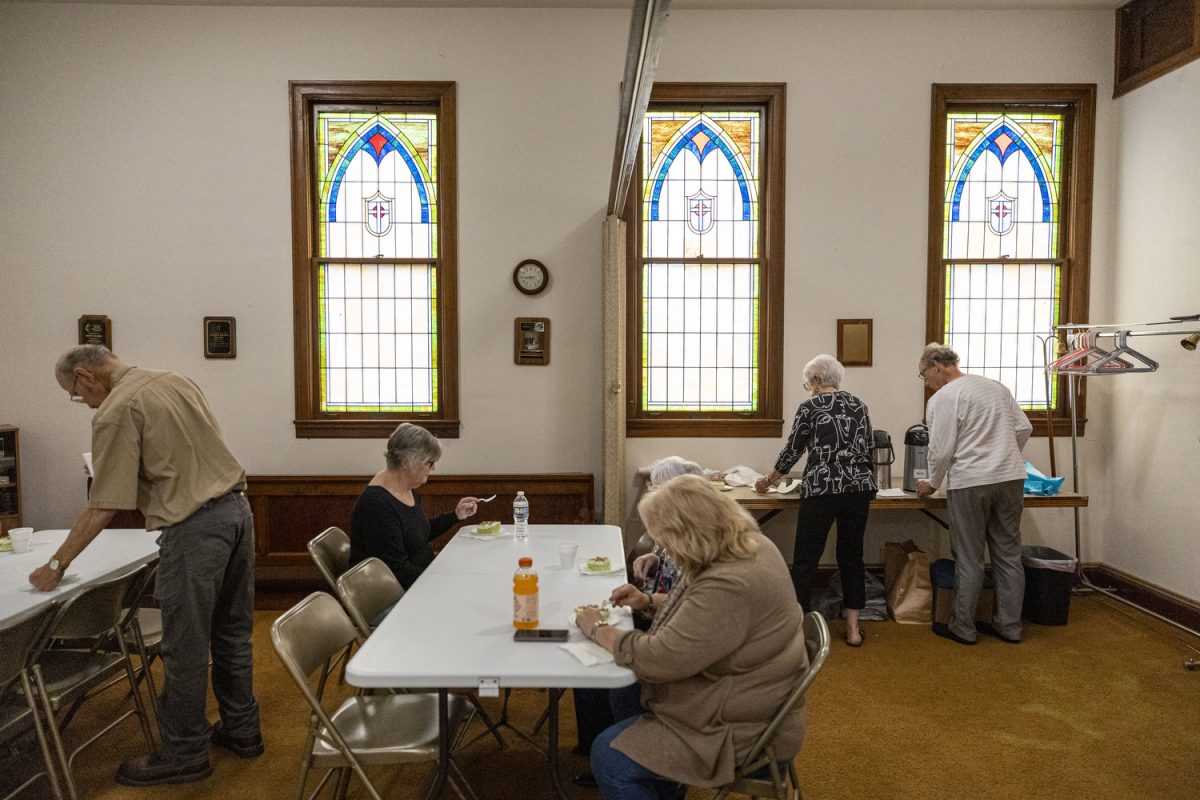
During the fellowship — a time after the service for members to catch up and eat together — held in the back of the single-room church sanctuary, Kurt Bechert, 61, a farmer who has attended Batavia UMC for about 40 years and serves as the current worship leader, joked that the church used to be full, with about 100 people in attendance a week. But things have changed, he said. Now, he notes, “Everyone’s now out in the cemetery.”
Barker recalled when the church community was still active, she sent her kids to vacation bible school during the summers. She said the church held auctions regularly in order to raise funds for the church’s upkeep and events. But over time, the few remaining members were the only ones buying anything.
“After we’re gone, there probably won’t be a church here,” she said flatly, between bites of her chocolate chip cookie.
Despite Barker’s concerns that the church may close one day, she said the small congregation, with only four members at fellowship, has thoroughly bonded over the years. She said she lost her granddaughter a while back, and the members helped to support her through a difficult time.
“If we go through a crisis, we’re there for each other,” Barker said.
This sense of community and joy that the current members get from attending church and participating in the community is something folks at Batavia want to share with others. Bechert said he’d love to see the sanctuary full week to week, and the congregation is happy to take anyone.
“I’d give up my front parking spot,” he joked.
Mike Mitchell, 74, a long-time member at Batavia, shares similar sentiments with Barker. When asked what his hopes are for the future of their church, he said, “Just that it survives.”
Although the future seems grim for Batavia UMC, with less than 20 current members, the parish is actually luckier than others, as it’s been able to stay open. Bechert said he takes care of all the records and checkbooks for the church and another member has been able to handle all the electric and handy work, keeping costs relatively low.
For Savannah Waechter, a third-year student at the University of Iowa, and her younger sister Isabelle Waechter, a first-year UI student, the closure of their church in their hometown of Livermore, Iowa, was painful.
In a town of 381 people per the 2020 U.S. census, Savannah said there was very little to do besides work on the farm, go to school, and go to church. For most, she said, the tradition of going to church every week and engaging with the community was the only thing folks had to look forward to in the isolated, rural area.
The sisters’ mother worked at Sacred Heart Catholic Church as the parish’s secretary and kept all the books and records, just as her grandmother did before her. The Waechter’s father managed all the music for Sunday services, and Savannah said it was never difficult to have other members step up in his absence or fill in for anyone from week to week.
She said since she was three years old, the diocese in her area had been warning the town that Sacred Heart may close, but regular attendance from roughly 50 families in the area and the tight-knit congregation led her to believe otherwise. Until 2021.
Despite numerous fundraising events, resulting in upwards of $50,000 just before the church’s closure, and pleas from the parish members, a priest shortage in the area ultimately forced the church to shut its doors, Savannah said. In the Catholic Church, a priest can only give up to three services per day, and there just weren’t enough priests in the area to keep Sacred Heart afloat.
The loss of the local priest fit a pattern in the country: According to the Center for Applied Research in the Apostolate, the number of priests in the U.S. has declined by 40 percent between 1965 and 2021.
“I think almost everyone in that church cried because that was so much of a family,” she said. “Yes, we were a close community because we’re all farmers and because we’re a small town, but it just was amplified by the church.”
When the sisters are home during school breaks, they now have to drive about 40 minutes out of town to go to a different church that’s much larger and less connected than the one they grew up in.
Isabelle said all the former “church ladies” from Sacred Heart approached her family to help out and volunteer at her high school graduation party because, without the church in town, they needed to find another purpose.
Savannah added that any walk around town can result in chatting with all their neighbors on their porches for hours at a time.
“When you’re retired and you don’t have anything else, they’re [Livermore residents] like, ‘I want to help out. I want to have a sense of belonging and a sense of importance and identity.’ And you just lose that,” Savannah said.
Now, the building just sits vacant in town. Savannah said the church had one final sale of all the sacred memorabilia for people in town to keep a piece of what was lost, but now the lot is overgrown with weeds, and the building is empty.
Isabelle said the sign advertising the church’s final sale has not been touched in three years and still reads: Sept. 2, 2022.
“We look at it [Sacred Heart] every single time that we would leave our house, something that used to be so alive,” Isabelle said.
Small-town pastors spread thin
The Catholic and Methodist churches in Iowa, much like around the nation where the number of elders in the UMC has decreased from 21,500 in 1990 to just over 10,000 in 2023, a nearly 50 percent decline, according to the Lewis Center for Church Leadership, are both facing clergy shortages in rural areas — to the point that, oftentimes, a single priest or pastor is giving a service at multiple churches every Sunday.
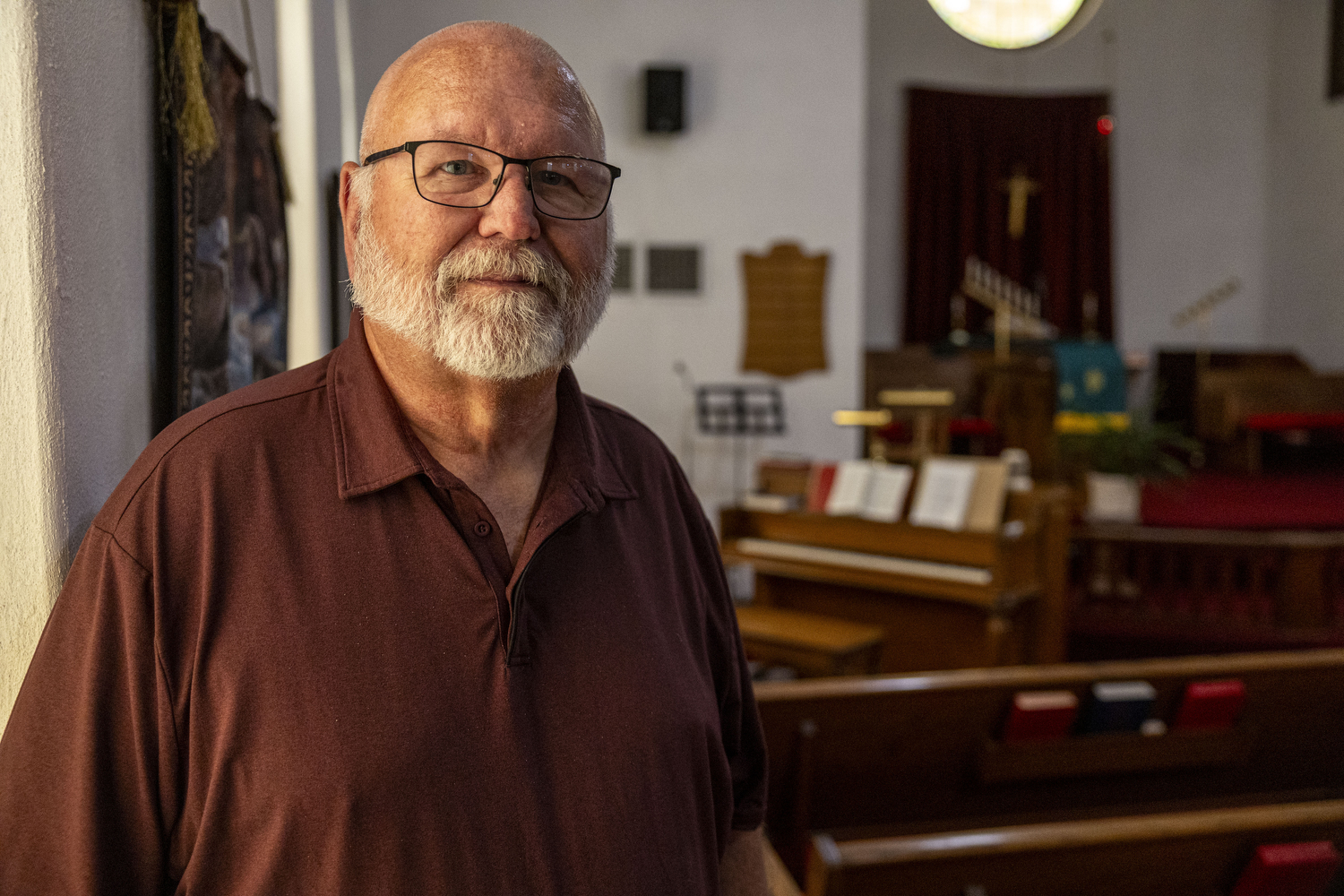
Savannah and Isabelle’s church ceased operations for this very reason, but the Batavia UMC is still hanging on under the leadership of Pastor Dave Peterson.
Every Sunday, 68-year-old Peterson wakes up around 6 a.m. at his home in Sigourney, Iowa, and drives 40 minutes south to Batavia UMC for the 8 a.m. service. He hangs out for fellowship for a while, then jumps back in the car and drives 12 minutes south to Eldon UMC in Eldon, Iowa, and does the whole service and fellowship over again at 9:30 a.m.
He added that all his early morning work is always followed by a nap before his wife gets home from the church she attends in Sigourney.
“In retirement, I’m getting up earlier on Sunday morning than I ever did when I was in full-time ministry,” he said.
This hectic Sunday routine is not how Peterson expected to spend his retirement, but says he’s loved every moment.
“It’s good people at Batavia and Eldon, and it’s been a joy,” the pastor said. “It’s been fun. In fact, I’ve told some people, if I didn’t know any better, I’d do it for free.”
Starting his career working in insurance, Peterson said he made some unwise business decisions and found himself regularly going to see his pastor for guidance. Soon after, he realized he had a calling to become a pastor himself and was encouraged to go back to school and “go the full boat” by his own pastor.
He got his first full-time pastor positon at Fairfield UMC in Fairfield, Iowa, and is now an ordained elder, the highest position in the UMC, and says he can serve at any Methodist church in the world if he wanted to. But Peterson has a soft spot for small-town Iowa.
The pastor was born and raised in Altoona, Iowa, just outside Des Moines, and said when he was growing up, the town was mostly gravel roads and didn’t have a single stoplight or even a stop sign. He said I-80 wasn’t complete yet either. Now, the town has expanded and developed greatly, much to Peterson’s dismay.
“Altoona now, I don’t even recognize it as my hometown,” he said.
His small-town connections are what Peterson said have made his time in Batavia and Eldon even more enjoyable. He relates to the folks in his congregations and said he’d rather serve in a church of just a handful of people than ever work in a big-city church.
“When it comes down to it, I’m a small-town Iowa boy. I don’t care for big metropolitan stuff,” he said.
For Peterson, in retirement, he can step away from his pastor responsibilities at any point, but unfortunately for the Batavia and Eldon churches, that would likely mean facing a closure just like Sacred Heart in Livermore.
However, the pastor said he still has a few more years left in him, and rural flight for young people is as big a risk for the two churches potentially closing.
“One of the bigger issues is that congregations are getting smaller because they’re getting older. People are dying off,” Peterson said. “But also, the other thing is that you have an awful lot of people that are moving away from those rural communities in a larger area, strictly from an employment standpoint.”
Population movement to larger cities is a major contributor to church decline in Iowa.
According to the 2020 Census, 68 of Iowa’s 99 counties lost population, with growth concentrated in urban and suburban areas. Additionally, 2.2 of every 1,000 residents in rural Iowa migrated away from their small town, according to the 2024 Iowa Small Towns Project from Iowa State University.
The changing landscape
In addition to rural trends, religious participation and church attendance are down nationwide.
According to the Hartford Institute for Religion Research, smaller churches nationwide are facing a clergy shortage as the more lucrative jobs for pastors and ministers are in larger, and usually more urban, churches.
National church attendance has also been declining for years, according to the Pew Research Center. The UMC specifically has seen decreased attendance, with Methodists making up a mere 2.7 percent of the U.S. population in 2024 compared to 5.1 percent in 2007.
In the state of Iowa, Pew reports that as of 2024, 21 percent of the population attends church at least once a week, and 50 percent seldom or never attend. Pew also reports that in 2024, 25 percent of Iowans identify as mainline protestant Christians, which includes the Methodist denomination.
In general, however, church attendance is beginning to “level off” as it’s creeping back to the same numbers seen in the mid-2000s, according to Pew.
A driving force behind this resurgence is young people.
Christine Wissink, director of Outreach and Faith Formation at the UI Newman Catholic Student Center, said she’s seen participation at the center nearly triple over the last 10 years.
Wissink was unable to provide specific participation data.
However, she said she’s seen more young people signing up to go on retreats, come to community building activities, or just coming into the church to pray or read the bible. She said she’s specifically seen young men become more engaged than ever.
“It seemed in the past there was the stereotype sometimes of people being involved in churches not being cool. I think a lot of people here are young – they’re attractive, normal people,” she said. “And I think that attracts more normal people to be involved.”
Wissink said she’s also seen UI students’ involvement with their faith increase, and says more students are interested in getting involved with seminary or are simply coming into the church daily to pray or go to mass.
Popularity and high participation at the Newman Catholic Center have filled the gap for the Waechter while they’re in Iowa City for school.
“Having a community pushes you to be a better person because it’s a whole group striving towards the same goal of wanting to be better, and it’s a refuge when you’re stressed,” Isabelle Waechter said. “It’s a place you can go to if you’re accepted and appreciated, whereas sometimes when you’re out in the world, you just feel lost and stressed and maybe don’t know where you’re going, but then go back home and feel comforted again.”